Tharaka MP Gitonga Murugara, the Chairperson of the National Assembly Committee on Justice and Legal Affairs (JLAC), is at the centre of a confusing paradox that unfolded on the floor of the House as he contradicted his own committee's report during the debate on the Elections (Amendment) Bill 2024.
Formally introducing the Bill to the entire House for general debate, Mr Murugara, known within Bunge corridors as “Sir George” noted that his committee was in agreement with the deletion of a clause that seeks to cap the maximum number of voters per polling station at 1,000.
This as he pushed for the retention of the current statutory limit of 700 voters per polling station when the Bill comes up for Third Reading today.
But in a confusing twist, however, the very committee report on the Bill Murugara was pushing for adoption by the House recommended the 1,000-voter limit proposal, creating a baffling legislative knot during the debate that he did not clarify.
While moving the motion on the Bill, Mr Murugara had said “I must confess here that, as the chairperson of the Justice and Legal Affairs Committee, we have a slight problem with this provision” capping voters per polling station at 1000.
“We will be making proposals to amend these provisions when this Bill comes to a third reading,” Mr Murugara, an advocate of the High Court of Kenya, is captured by the Hansard report of the House.
Hansard is the official, verbatim record of everything said and done in a parliament or legislative assembly.
It serves as the authoritative transcript of all speeches, debates, oral questions and votes during a legislative session.
The Tharaka MP continued; “As you know very well, the current provision is that a polling area should not have more than 700 voters.”
“That is; a polling station must have at least 50 and a maximum of 700 and possibly that is what should be retained,” Mr Murugara is captured by the Hansard report.
The Tharaka MP did not indicate to the House that the comments he was making were his own and therefore, not the official position of the committee he chairs.
This failure created the impression that he disagreed with his own committee’s proposed amendments to the Bill in a report he unveiled to the House.
The Senate passed the Bill on December 5, 2024, to alter the number of voters in a polling station from a maximum of 700 to between 50 and 1,000 voters, which is now facing resistance in the National Assembly.
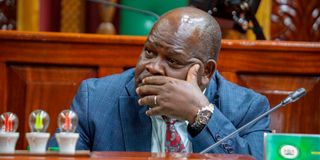
The Chairperson of the National Assembly Committee on Justice and Legal Affairs Gitonga Murugara when he appeared before the National Assembly Budget and Appropriations Committee in Nairobi on March 23, 2026.
Photo credit: Dennis Onsongo | Nation Media Group
By virtue of his Chairmanship of JLAC, Mr Murugara would likely be conferred the venerated title of Senior Counsel, if the Advocates (Amendment) Bill 2025, which his committee is processing, becomes law as presently published.
It is important to note that the real law-making in the House happens during the committee stage, which is the Committee of the Whole House and not at the Third Reading stage.
During the committee stage, a House of parliament transitions into the "nuts and bolts" stage of law making or the real law making process where wheat is separated from the chaff by deleting, rewording or inserting new clauses in the Bill.
It is the crucial phase in law making where the rubber meets the road, the entire membership of the House converts into one massive committee to conduct a detailed, clause-by-clause scrutiny of a Bill.
Section 38A of the Elections Act states that the number of voters per polling station, “for the purposes of providing efficient and effective conduct of elections, shall not exceed 700.”
However, the proposed amendment by the committee in the report to the House reads; “That Clause 21 of the Bill be amended by deleting paragraph (b) and substituting therefor the following new paragraph ‘b’.”
Essentially, the referenced new paragraph “b” in Clause 21 of the Bill, proposes the deletion of the “words "seven hundred" appearing immediately after the word "exceed" and substituting therefor the words "one thousand.”
The committee notes that “providing a maximum number of voters per polling station ensures that elections are carried out in an efficient and effective manner.”
The JLAC report justifies the capping of voters in a polling station to 1,000 based on the IEBC argument on the need to “reduce the cost of elections in the country.”
“As submitted by IEBC, expanding the maximum number of voters per polling station will help reduce the cost of elections. Also, removing the lower limit of 50 persons as amended by the Senate will cater for far-flung areas with diverse needs,” the JLAC report reads.
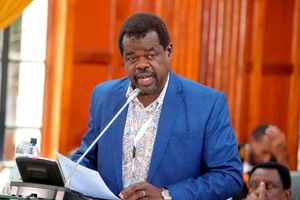
Mr Murugara was not alone in this confusion. Wajir East MP Aden Mohamed, a member of JLAC, was also oblivious of his committee’s adopted list of amendments on the Bill, limitation of number of voters at 1000 per polling station.
“Regarding the Senate proposal to limit polling stations to no more than 1,000 people, I think the Committee will propose an amendment to retain the limit at no more than 700 people per polling station,” said Mr Mohamed.
“We want to make elections easier, not harder, for people. A limit of 1,000 people per polling station could mean it takes more than 12 hours to vote. We will, therefore, propose an amendment to that section and retain the number at 700, if the House agrees,” the Wajir East MP said.
Mr Murugara’s opposition to capping voters in a polling station at 1000 was predicated on the fact that “especially now that the IEBC is not in a position to review polling stations.”
“We thought IEBC would actually come up with new polling stations which would be used in the coming general election. This appears not to be the case and, therefore, it may not be appropriate now to have this provision effected,” the Tharaka MP said.
This notwithstanding that his committee has okayed Clause 20 of the Bill, which proposes to amend the principal law to require that the IEBC designates polling stations and publishes them in the gazette notice “at least three months before the date of any election.”
Currently, it’s about 10 months before the August 10, 2027 general election.