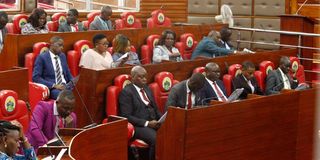
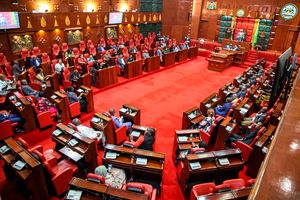
MPs in the National Assembly are locked in an argument over a proposal that would ban “outsiders” from taking the 770 special nomination slots in the county assemblies, potentially forcing political parties to only select individuals who are “locally” registered as voters.
Clause 19 of the Elections (Amendment) Bill 2024, as passed in the Senate, proposes to amend the principal Act to provide that for an individual to be nominated in a county assembly, they must be registered voters in the counties they seek nomination.
“A person shall not be nominated by a political party unless the person is, on the date of submission of the party list by the political party, a registered voter in any of the wards in the county in which the person is nominated,” reads the proposed law.
The proposed law, as adopted by the Senate in December 2024 and transmitted to the National Assembly for review and consideration, seeks to amend section 34 of the Elections Act by introducing the new clause.
While leader of majority in the National Assembly, Kimani Ichung’wah (Kikuyu) termed the proposed law as retrogressive; his Marakwet West colleague Timothy Kipchumba sees it as an opportunity to rid the county assemblies of “strangers.”
“I will be moving amendments to this Bill to delete this proposal,” said Mr Ichung’wah, noting, “Kenyans should be allowed to be nominated to serve in counties even where they are not registered voters.”
Every election year since the 2013 general election, 770 positions are reserved as special seats for the nomination of Members of County Assembly (MCAs) across the 47 counties.
The nomination is on top of the 1450 MCAs elected directly by the people in the Wards constituting single-member constituencies.
Currently, the regime managing the nomination of MCAs in the country is such that anyone can be nominated in any of the 47 county assemblies, provided that the sponsoring political party has indicated as such in the party list submitted to the electoral commission.
However, Mr Kipchumba argued that it is unfair to get outsiders to serve in county assemblies at the expense of the local registered voters.
“Many a time we see MCAs serving in counties where they are strangers,” said Mr Kipchumba. The Marakwet West MP added, “that particular nominee must have some interest in that county.”
“The nominee must be a registered voter in that county,” he asserted, with Kinangop MP Thuku Kwenya also weighing in.
“It can’t be that one is nominated in a county assembly where they are not a registered voter. It defeats the purpose of that MCA sitting in that assembly. One must be a registered voter in that jurisdiction where they are seeking nomination,” said Mr Kwenya.
The Bill also proposes that the nominations by a political party shall ensure equitable representation from all wards comprising the respective county.
If the House passes the Bill with amendments, given the comments from members, it will head to the Mediation Committee constituted by an equal membership from the two Houses for a mediated version for subsequent consideration by the two Houses.
The Elections (Amendment) Bill of 2021 by then Ndaragwa MP Jeremiah Kioni, through the Constitutional Implementation Oversight Committee (CIOC), was introduced in the 12th Parliament to amend the Elections Act to promote “local solutions to local issues” in the counties.
Following its approval by the National Assembly in April 2022, the Bill was forwarded to the Senate for debate and consideration, given its direct impact on the counties.
However, because the transmission occurred just weeks before parliament adjourned ahead of the August 2022 general election, the Senate ran out of time to debate or pass it.
Consequently, it remained stuck in the Senate’s legislative pipeline and ultimately lapsed after the 12th parliament adjourned sine die.
The argument in Mr Kioni’s Bill was that the failure to have nomination slots in the county assemblies filled by those who are registered voters there “presents the current legal framework with a gap that must be filled.”
Article 177 (1) (b) of the Constitution provides that a county assembly consists of the number of special seat members necessary to ensure that no more than two-thirds of the membership in the assembly are of the same gender.
Currently, the Elections Act provides that a person qualifies for nomination to a county assembly if the person is a member of a political party on the date of submission of the party list.
Section 35 of the Elections Act provides that a political party shall submit its party list to the IEBC at least 45 days before the date of the general election.
With the next general election due on August 10, 2027, it means that registered political parties have until June 25, 2027, to submit their party lists to the commission.
The party list, the law provides, shall, however, not contain the name of a candidate nominated for an election whether presidential, gubernatorial, senatorial, single-member constituency, county woman representative or MCA.
A party list submitted to the IEBC shall also not be open for amendment during the term of parliament or the county assembly for which the candidates are elected.
The allocation of seats is such that a party list submitted to the IEBC shall contain alternates between male and female candidates in the priority in which they are listed.
The law further demands that the party list prioritises a person with disability, the youth and any other candidate representing a marginalised group.
Nomination is based on the strength of the number of elected members a political party has in the Senate, National Assembly or the 47 county assemblies.
Within 30 days after the declaration of the general election results, the commission is required to designate, from each qualifying list, the party representatives on the basis of proportional representation.