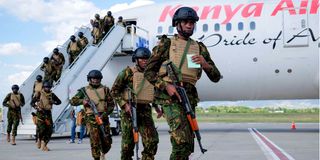
About 18 months after Kenya first deployed its police officers to Haiti to help suppress gang violence, hard lessons have emerged.
And besides the loss of life (two officers died in the battle) and related costs, Kenya has had to navigate negative perceptions of the mission while picking important lessons for the future.
It started as the Multinational Security Support mission (MSS). However, in October, the UN Security Council adjusted both the mandate and the name of the mission. It became the Gang Suppression Force (GSF). The GSF is larger than the MSS, as the UN Security Council approved it is response, in part, to the challenges identified by observers.
Kenyan police officers hold a Kenyan flag after disembarking, in Port-au-Prince, Haiti June 25, 2024.
Photo credit: Reuters
This was the first time Kenya was deploying police officers to the Caribbean country but wasn’t the first time Nairobi was deploying a security force abroad. In the past, Kenya deployed troops to Serbia, East Timor, Sudan, Namibia and Sierra Leone. The previous assignments were peacekeeping missions. Haiti was a peace and security enforcement mission.
The Haiti mission used the same international law principles as other UN peacekeeping operations: military forces acting as civilian defenders, not combatants, supported by the UN. Peace enforcement missions are of targeted at suppressing threats, often by use of the gun.
In Haiti, Kenya police officers had to first learn a new language, French. They had to do refresher courses on human rights, justice and sexual violence. They were to be police officers, security guards and first responders all woven into one. The first troops of those deployed in 2024 returned in December this year. Yet they made little progress on the battlefield, worn down by financial and capacity challenges.
The MSS, however, says it helped recapture important government installations in Haiti including the main airport, hospital and port in Port-au-Prince.
GSF may yet elevate Kenya’s global image. Yet it could still expose limitations in readiness, logistics and strategic planning.
An International Crisis Group (ICG) report says preparation, numbers and integrated plan highlight pitfalls of deploying under-resourced missions against entrenched armed groups. “Haiti’s gangs have seized neighbourhoods, thoroughfares and fuel depots — choking off supplies of food and other essentials to people in need,” ICG says.
A Kenyan police officer carries a Kenyan flag after disembarking in Haiti to join an expanded multinational force with a mandate to fight gangs, at Toussaint Louverture International Airport, in Port-au-Prince, Haiti December 8, 2025.
Photo credit: Jean Feguens Regala | Reuters
The new report states that arresting gang leaders and targeting foot soldiers can bring short-term calm. But violence is likely to return unless the groups are fully disarmed and financial backers held accountable.
Approved by the UN Security Council in October 2023, the MSS mission — under Kenyan leadership — was envisioned to help restore basic security, protect infrastructure and ultimately make space for political progress.
The ICG briefing said the new mission is needed because “with police outnumbered and out gunned by criminal groups, foreign assistance is needed.”
Police officers patrol a neighbourhood in downtown Port-au-Prince.
Photo credit: File | AFP
Force alone won’t be enough though. “Haiti’s gangs — in their hundreds and controlling key urban zones — have created a humanitarian and security emergency that local forces can no longer contain. ICG said the mission “aims to restore security and enable long overdue elections.”
According to ICG, the new GSF, to which Kenya will remain a part, should have “sufficient troops, training and equipment to overpower the gangs.”
The report emphasises that success will depend not just on boots on the ground but on preparation, intelligence and community engagement.
Kenya has taken centre stage, deploying hundreds of officers on a mission designed to reach 2,500 personnel.
Yet two years on, the force remains understrength and underfunded.
“The mission will encounter several obstacles, including shifting gang allegiances that create the possibility of a united front against it,” ICG says and warns that “fighting in Haiti’s ramshackle urban neighbourhoods will continue to put innocent civilians at risk.”