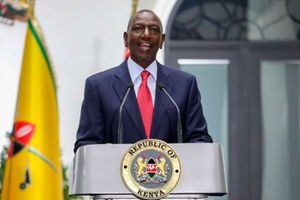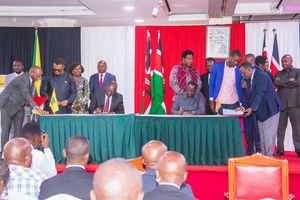
President William Ruto signs bills into law at State House.

Since the 2010 Constitution, courts have moved beyond resolving disputes between individuals and the State. Through constitutional judgments, especially from the Judicial Review and Constitutional & Human Rights Divisions, judges have increasingly tested government actions against the supreme law and, where necessary, stopped them.
That power now extends beyond individual rights to questions of how public offices are created, how state corporations manage staff, whether Parliament followed the right procedures, how counties impose charges and whether procurement rules were lawfully made.
Recent judgments show courts increasingly intervening in areas traditionally left to the Executive and Parliament, including public appointments, taxation, procurement, labour rights, digital rights, pension deductions and presidential powers.
One prominent example is the January 2026 High Court judgment declaring the creation of 21 offices of advisers to President William Ruto unconstitutional.
The court found failures involving the Public Service Commission, public participation, fiscal analysis and statutory procedures, and quashed the appointments. The offices had been intended to provide specialised expertise and advice to help deliver the administration’s agenda, even as President Ruto had earlier pledged to cut the number of government advisers by 50 per cent as part of austerity measures.
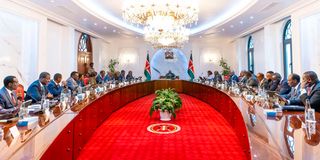
President William Ruto chairs a Cabinet meeting at State House, Nairobi, on June 30. 2026.
The court said the creation of the offices was “unconstitutional” and ordered the Public Service Commission to audit executive offices created since the 2010 Constitution.
“The appointments of the 21 interested parties (advisors) to the said unconstitutional offices were and are null and void ab initio (from inception) pursuant to Article 2(4) of the Constitution,” said the court.
The Attorney-General has appealed the decision.
In November 2025, the High Court upheld the office of the Head of Public Service and its functions but struck down a provision allowing the holder to serve “at the pleasure of the President”.
The court said the provision revived the old “pleasure doctrine”, allowing an appointing authority to remove a public officer without reasons or a hearing. It held that this violated Article 47 on fair administrative action and Article 50(1) on the right to a fair hearing.
It noted that Article 236 had effectively abolished the doctrine by requiring that a public officer cannot be dismissed, removed, demoted or subjected to disciplinary action “without due process of law”.
The machinery of the public service has also come under judicial scrutiny.
In December 2025, the High Court quashed an Attorney-General advisory and a State Corporations Advisory Committee letter concerning human resource management in state corporations and public universities. It held that the Public Service Commission’s constitutional mandate extends to those institutions, including the establishment and abolition of offices and approval of human resource instruments.
“The Public Service Commission possesses the exclusive constitutional mandate to receive, consider, and approve Human Resource Instruments of State Corporations,” the court stated.

The Milimani Law Courts in Nairobi.
The Employment and Labour Relations Court has similarly intervened in public appointments. In May 2025, it held that promotions of principal state counsels were unconstitutional and ordered corrective action following a challenge by state counsels against promotions made in November 2024.
In another 2026 ruling, the court found assistant-chief appointments discriminatory, selective, unfair and unlawful, quashed the appointment letters and ordered that candidates ranked first be appointed.
Parliament’s legislative processes have also faced intense judicial scrutiny.
In September 2024, the High Court declared the entire Privatisation Act, 2023 unconstitutional, null and void after finding that Parliament had failed to conduct meaningful public participation. It also invalidated the planned privatisation of the Kenyatta International Convention Centre.
“The entire Privatisation Act, 2023 is, therefore, unconstitutional, null and void.”
The government appealed, but the Court of Appeal declined to suspend the judgment pending the appeal. Kenya subsequently enacted a new Privatisation Act in 2025.
The Finance Act 2023 produced a different outcome. In July 2024, the Court of Appeal declared significant provisions unconstitutional, including those introduced after public participation, and found failures in the budget process.
But in October 2024, the Supreme Court reversed the decision that had voided the entire Act, allowing the 2023 law to remain in force. The ruling was a victory for the government and allowed it to continue collecting taxes under the legislation.
Courts have also redrawn the limits of criminal law and digital governance. In March 2026, the Court of Appeal declared sections 22 and 23 of the Computer Misuse and Cybercrimes Act, 2018 unconstitutional, finding their wording too broad and capable of catching innocent people.
In July 2026, the High Court separately struck down sections 6(1)(ja) and 27(1)(b) of the 2025 amendment, removing provisions that expanded State powers over online content and created the offence of cyber harassment.
Public revenue has been another major battleground.
In June 2025, the High Court declared parts of the Nairobi City County Finance Act 2023 unconstitutional, finding that the county had failed to provide adequate justification and information for new revenue measures and had not met constitutional requirements.
“The Finance Act, enacted on the basis of defective participation lacking policy context, is unconstitutional,” the court said.
In Laikipia, the High Court similarly invalidated specified taxes, charges and fees in the county’s 2024 Finance Act, citing inadequate public participation and overlap with national government functions.
But litigation has not always resulted in a government defeat. In October 2024, the High Court upheld the Affordable Housing Act, including the 1.5 per cent housing levy, finding that public participation had met the required threshold. The dispute remains before the Court of Appeal.
In January 2026, the High Court also declared the Road Maintenance Levy Fund (Imposition of Levy) Order, 2024 unconstitutional after a petition challenged the process used to introduce the levy, putting the constitutional requirement for meaningful consultation against the State’s power to raise money for road maintenance.
Tax litigation has meanwhile forced the Kenya Revenue Authority to apply statutory definitions more narrowly. In 2025, the High Court ruled that specified services supplied to foreign principals qualified as exported services and were therefore zero-rated under the VAT Act. It also found that the companies could recover qualifying input VAT, limiting KRA’s attempt to treat the disputed services as locally taxable supplies.
Procurement rules have also been subjected to constitutional scrutiny.
Recently, the High Court declared the Public Procurement and Asset Disposal Regulations, 2020 unconstitutional and void from the beginning. The court found that the regulations had not undergone meaningful public participation and struck down security deposit requirements that hindered access to justice.
Courts are increasingly intervening in areas traditionally left to the Executive and Parliament.
“The complete absence of meaningful public participation in the formulation of the Regulations renders them constitutionally infirm and incapable of legal operation,” the court said.
The regulations govern how public entities buy goods and services and how suppliers challenge procurement decisions.
In another procurement case, the High Court ruled that the President or another public officer cannot overturn a decision of the Public Procurement Administrative Review Board, although it dismissed the rest of the petition.
The cases underscore an increasingly important principle: government must show not only that it has the power to act, but also that it exercised that power through the process prescribed by law.
Courts have also scrutinised public expenditure. In January 2026, the High Court issued conservatory orders suspending fresh engagement or procurement of private advocates by public entities where in-house government lawyers, State Counsel, county attorneys or other legal officers were available, unless the required formal approval was obtained.
The court said the case raised concerns over public expenditure and the use of existing public legal resources.
The courts have also redrawn the boundaries of policing and national security.
In October 2025, the Employment and Labour Relations Court held that the National Police Service Commission had no power to recruit, train, employ, assign, promote, suspend or dismiss members of the police service, finding that these functions fell under the Inspector-General’s independent command.
It declared the proposed recruitment process and Legal Notice No. 159 of September 19, 2025 unconstitutional and permanently stopped the commission from conducting the recruitment.
The decision went beyond the recruitment exercise, defining the constitutional boundary between the commission, which has powers over appointments and discipline under Article 246, and the Inspector-General, whose command of the service is protected under Article 245.
The Court of Appeal later stayed execution of the decision pending an intended appeal, meaning the High Court’s interpretation is not the final word.
Parliament’s role in constituency development has similarly faced judicial challenge. In September 2024, a three-judge High Court bench declared the National Government Constituencies Development Fund Act, as amended in 2022 and 2023, unconstitutional.
The court found that the scheme encroached on county functions, blurred the separation between Parliament’s legislative and oversight roles and raised constitutional concerns over public finance and the Senate’s role. The ruling revived a dispute that had reached the Supreme Court, which in 2022 had upheld an earlier finding that NG-CDF legislation was unconstitutional.
Yet the courts have also declined to interfere in some cases. The Affordable Housing Act judgment is one example, while a 2025 challenge to the nomination of seven IEBC commissioners failed on the main declarations sought.
The pattern across these cases is clear. Courts are not governing the country. But through binding judgments, they increasingly determine the legal boundaries within which those who govern must operate.
Follow ourWhatsApp channel for breaking news updates and more stories like this.