On Saturday afternoon, the MT Paloma, a crude oil tanker flying a Marshall Islands flag, was steadily sailing past Mozambique, on its way to Port Elizabeth in South Africa.
The vessel should have offloaded a 68,000-tonne consignment of petroleum when it left the Port of Mombasa in Kenya on March 30.
Instead, the MT Paloma left behind a scandal as volatile as its cargo, and which has now seen three senior government officials resign over a Sh4.8 billion fuel consignment which investigators maintain is substandard.
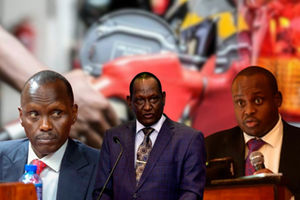
The Energy Ministry’s Deputy Director of Petroleum, Joseph Wafula and Kenya Pipeline Company’s Supply and Logistics Manager, Joel Mburu, are also in custody and being questioned pending arraignment on Tuesday.
Former Energy Principal Secretary Mohamed Liban
Head of Public Service Felix Koskei on Saturday said that the State Department of Petroleum has initiated appropriate administrative action against Mr Joseph Wafula and commenced due process against Mr Joel Mburu.
The Directorate of Criminal Investigations (DCI) on Saturday confirmed in a statement that it has recorded statements from several government officers and executives of One Petroleum Ltd.
One Petroleum Ltd is associated with Mombasa tycoon Mohamed Jaffer, who reportedly imported a 68,000-tonne consignment worth Sh2.5 billion.
Executives of the Kenyan arm of Swiss-owned Oryx Energies have been summoned to record statements, the DCI added in its statement.
The DCI probe will extend to other countries from which the One Petroleum Ltd and Oryx Energies consignments were sourced from.
“The DCI is actively liaising with government agencies and investigative agencies in other countries under the Mutual Legal Assistance (MLA) programme to establish all relevant facts surrounding this matter. Accordingly, the Directorate of Criminal Investigations wishes to inform the public that resignation from office does not in any way exonerate or absolve the suspects and persons of interest from criminal culpability. They are therefore strongly urged to cooperate fully with the investigators,” the DCI added in its statement.
In an unprecedented turn of events, the arrests, resignations and disciplinary actions happened on Good Friday, with further action expected to continue throughout the Easter period.
The five could be charged with economic sabotage, arising from accusations of collusion to import fuel with excess Sulphur levels against those set by the Kenya Bureau of Standards (KEBS).
The DCI is questioning the five on the import of two petroleum consignments totaling 128,000 tonnes, and which are worth at least Sh4.8 billion.
The two consignments were imported outside the Government-to-Government framework, through which Kenya sources petroleum products from Saudi Arabia and the United Arab Emirates (UAE).
The MT Paloma docked at the Port of Mombasa in late March, holding the first batch of 68,000 tonnes of petroleum. It was imported by One Petroleum Ltd, a firm associated with Mombasa tycoon Mohamed Jaffer.
The second consignment will dock at the Port of Mombasa in the coming days, with 60,000 tonnes of petroleum imported by Swiss-owned Oryx Energies.
On March 25, Mr Liban wrote to One Petroleum Ltd’s director, Ali Balala and Oryx Energies CEO Angeline Maangi, allowing them to import 60,000 tonnes of petroleum each. That letter allowed the importers to exceed the allowed quantities by up to 10 per cent, which meant they could bring in up to 66,000 tonnes.
The two firms had approached the Energy ministry and Epra with a proposal to import petroleum products, which were intended to fill up Kenya’s reserves.
When Mr Liban wrote to the two firms, he stated that the petroleum must meet the usual KEBS standards.
But a day later, according to documents investigators have collected to build their case, the PS was knocking on KEBS’ door, requesting that the agency bend over backwards and allow fuel imports which may not meet the usual standards.
Mr Liban said the request was to ensure a continuous supply of petroleum products and avert price increases, which would have a broader impact on the cost of several products within Kenya’s economic ecosystem.
Aside from allowing different quality of fuel, documents show Mr Liban also requested KEBS to be flexible with the testing schedules. Usually, petroleum products coming to Kenya are tested at both the loading point and in Mombasa.
Mr Liban wanted KEBS to allow products not tested at loading points to be scrutinised in Mombasa by Intertek Testing Services, which is already contracted by the standards agency.
Former Kenya Pipeline Company Managing Director Joe Sang.
Photo credit: File | Nation Media Group
The flexibility in testing schedules was intended to cater for what the unconventional methods that industry players had been forced into using to avoid fuel shortages in different countries.
Such methods include ship-to-ship transfer. Under this process, petroleum loaded onto one ship is transferred to another vessel, but on the high seas. Some of the petroleum to be brought to Kenya through the ship-to-ship transfer was intended for other countries, where Mr Liban said quality standards are different.
“We have reviewed the import schedules, and failure or a delay to receive any of the cargoes will lead to a supply shortfall and expose the country to disruptions. Additionally, the application of the penalty will lead to a higher cost of the refined petroleum products at the pump, which will affect the Kenyan consumers. This is, therefore, to request KEBS to consider the above-mentioned waivers in view of the security of supply and to mitigate escalation of cost of product to a time when the conflict eases, or the global supply normalises,” Mr Liban said in his letter to KEBS.
The Ministry of Investments, Trade and Industry, to which KEBS reports, granted Mr Liban’s request on March 28, particularly in relation to the consignment that One Petroleum was importing.
The Trade ministry, in its letter, said that the petroleum, which had higher levels of sulphur, manganese, and Benzene, must meet all other standards set by KEBS. The waiver was also on condition that the stock aboard the MT Paloma be mixed with other existing stocks to mitigate the excess Manganese.
Former Epra Director-General Daniel Kiptoo during an event in November last year.
Photo credit: File | Nation Media Group
Mr Kiptoo’s Epra and the Energy ministry were also directed to limit the distribution of the petroleum, pending the arrival of other stocks on April 3 and 4.
Once the other stocks arrived, they would be further mixed in to lower the Manganese levels more.
Mr Liban was also directed to ensure that the next two shipments would be fully compliant with KEBS standards.
To avert any trouble towards KEBS in the event that things went south, the Energy ministry was directed to issue indemnity.
And things have now gone south, with the Energy ministry and Epra bosses now facing economic sabotage charges.
One Petroleum quoted Sh37,691 per tonne – three times the cost of petroleum under the government-to-government arrangement.
Last week, the Business Daily reported that the steep cost of the stock imported by One Petroleum and Oryx Energies could push pump prices up by Sh19.
The Energy ministry allowed the importation of petroleum outside the government-to-government arrangement after a vessel bringing a scheduled consignment was unable to leave Dubai owing to the closure of the Strait of Hormuz by Iran in response to attacks launched by the US and Israel since last month.
Nearly 25 per cent of all global petroleum and liquefied gas passes through the Strait of Hormuz, which remains inaccessible on account of the US-Iran conflict.
Saudi Aramco, Abu Dhabi National Oil Company and Emirates National Oil Company – the firms Kenya contracted under the government-to-government arrangement – have since turned to the Sikka Port in India, Port of Antwerp-Bruges in Belgium and ports along the Red Sea to source for fuel destined for Kenya.