He left Nairobi chasing a better life across the borders, but ended up in a cell in Libya – beaten and starved as his family begged smugglers for mercy.
Across East Africa, Mr Khalid Mohamed is among hundreds ensnared by the Magafe network , a ruthless human trafficking ring that turns dreams of greener pastures in Europe into nightmares of ransom, slavery, and death.
For a decade, Mr Khalid tried to build a modest life in Nairobi. The Somali national was working in an electronic shop in Nairobi's Central Business District (CBD) and earning just enough to support himself and occasionally send a little back to his family in Somalia.
At times things worked out well but sometimes when they failed, he would call his mother and request that she pays his rent. When he realised that things were not all rosy, he started making calculations of how he would secure greener pastures abroad.
In May 2025, he made a decision that not only changed his own life forever but also that of his family.
Convinced by promises of better pay and safe passage, he packed his bag on Sunday, May 18, 2025, left his Nairobi home, and boarded a South Sudan-bound bus.
“He told us he had found an opportunity,” recalls his younger brother, Yahye Imran, speaking to Daily Nation from Baidoa in Somalia. “He said he would be away for a short time, and then he would return with something to help us.”
Mr Imran said that instead of the positive things that he always thought would come from his brother, things turned ugly as he fell into the hands of smugglers who delivered him into one of the most dangerous migration corridors in the world.
Mr Khalid Mohamed, a Somali national who was smuggled from Kenya. He is now locked in Libyan cells operated by human smugglers.
Photo credit: Pool
Weeks after his departure, Yahye’s phone lit up with a strange international number. To his shock, it was not from South Sudan but Libya. On the line was his brother, his voice frail and trembling.
“He told me he was being held in a warehouse with other Somalis and people from different parts of Africa,” Mr Yahye said, adding that the brother informed him that they were beaten, starved, and threatened every day. “He cried as he begged us to save him.”
The smugglers demanded Sh2 million for his release, a sum far beyond what his family in Somalia could imagine raising.
Since then, Yahye has received calls through IMO, always from the same Libyan number. Sometimes his brother speaks; other times, the captors themselves threaten the family, warning that failure to pay will mean death.
The Nation contacted the Libyan phone number registered by the name Musa Hamidu, but despite answering the call language barrier became a challenge.
As Yahye struggles, his family’s story highlights the human cost behind migration statistics. Each figure in a UN report represents a real voice begging for freedom. Each ransom note means a family pawning their belongings, a brother knocking on strangers’ doors.
Yahye only has one plea: “We just want him back,” he says softly. “We want him to live, to laugh again, and to come home.”
Until that day, the family waits, torn between fear and faith. Every phone call is torment: a brother’s cry for help, and a reminder of the cruel market that holds him hostage.
His ordeal mirrors a grim pattern documented by aid agencies. According to the UN Refugee Agency (UNHCR), Libya has become a notorious trap for migrants from the Horn of Africa.
Many set out believing they are heading for legitimate work or safe passage to Europe, only to find themselves extorted, imprisoned, or sold into forced labour.
Human Rights Watch has described Libyan detention centres as places of “nightmarish abuse,” where migrants face beatings, sexual violence, and starvation.
The International Organization for Migration (IOM) estimates that at least 700,000 migrants are stranded in Libya, many under militia control.
For Yahye’s brother, what began as a journey of hope has become a daily fight to survive in captivity.
According to Enact, an organisation that builds knowledge and skills to enhance Africa’s response to transnational organised crime, Somali nationals in Dadaab refugee camp have been victims of the Magafe, a human smuggling gang that takes people to Libya.
It says that they are recruited with a promise of being taken to greener pastures, and the smugglers use three different routes.
“The first is from Dadaab to Garissa, Mwingi, Thika, Nairobi, Busia in Kenya, Kampala in Uganda, then to South Sudan and finally to Libya. The second is from Dadaab to Mombasa, then to Busia, Kampala, South Sudan and Libya. And the third is from Dadaab to Garissa, Isiolo, Samburu, Turkana in Kenya, to South Sudan and then Libya,” the organisation says in a report.
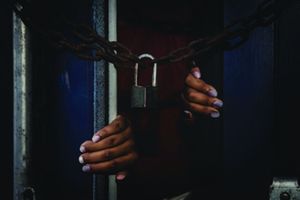
Somali youths are trapped in Libya’s trafficking cells.
Photo credit: Shutterstock
It says that traffickers are also within the vast Eastleigh area in Nairobi, who usually hand them over to brokers based in the capita. The brokers then facilitate their journey through Busia to Uganda, then on to South Sudan, and eventually Libya.
According to Enact, the traffickers bribe border officials to facilitate cross-border transportation. This systemic corruption in Kenya and neighbouring countries is a key facilitator of human trafficking and smuggling.
Abdisalan Aden Mohamed is so familiar with the Eastleigh-based brokers and traffickers who managed to convince his family that they would take him to Europe, only for him to end up in a trafficking cell in Libya.
His connection to Kenya took place through WhatsApp and when he realised that he was out of Somalia and the journey was going on, he believed that he was heading to Europe. However, that was never the case.
Mohamed said that he was being bundled into different lorries throughout the journey. Once he arrived in Libya, things worsened as he knew no peace. He was thrown into a cell and the smugglers then demanded Sh1.5 million to set him free.
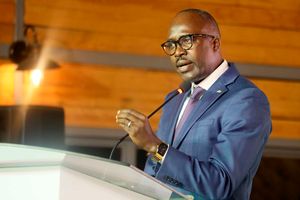
His family reached out to his uncle, Mr Abshir Aden Ferro, a former French military officer and founder of Cruzen Group, and informed him of the predicament that they were facing.
Mr Ferro, a Somali national, decided that he would not send money but instead head to the country and find out what was really happening.
“I was very familiar with Libya’s reputation as a hub where migrants are detained, abused, and extorted. But I didn’t expect the scale of it,” he said.
What began as a rescue mission for his nephew quickly grew into something else. Ferro discovered hundreds of Somalis trapped in cells.
“That’s how the journey to free more than 400 Somalis began. Some had travelled from Somalia, others through Kenya, only to end up in these prisons,” he said.
Enact says that the issue of the smugglers demanding for money has been in existence since 2017 when the gang was formed.
It says that the Magafe is notorious for engaging in ransom smuggling, which involves kidnapping migrants and demanding money in exchange for their release.
In addition, the refugees usually face harsh conditions as they head to Libya, in some cases others fall ill or even die.
“Once in Libya, victims are frequently subjected to violence, acts of slavery, organ trafficking, forced labour and extortion. As a transit country en route to Europe, Libya faces persistently high levels of human trafficking activity,” Enact says.
“Vast ungoverned areas in several regions, the fragile status of the current Libyan regime, a lack of governmental oversight and inadequate capacity to respond ensure the continued appeal of the country as a transit route for human trafficking activities.”
The collapse of Muammar Gaddafi’s regime in 2011 left Libya fractured and lawless. Smugglers thrive in this vacuum, running vast networks that stretch across Africa. Migrants are treated as commodities, passed from one group to another, and traded like goods.
The law in Libya has gaps when it comes to human trafficking. The current Libyan penal code does not provide adequate preventative and protective measures against trafficking.
Currently, Articles 418, 419, and 410 of the Libyan penal code criminalise some form of sex trafficking and prescribes a penalty of up to 10 years of imprisonment and a fine.
Other measures include Article 425 which criminalises slavery and prescribes a prison sentence between five and fifteen years and Article 426 which criminalises the buying and selling of slaves and prescribes a prison sentence up to 10 years.
The penal code does not criminalise other forms of trafficking, including labour trafficking or sex trafficking that is induced through coercive or fraudulent means. The penal code also does not criminalise sex trafficking that involves adult male victims.
Lastly, the Libyan government defines trafficking as the transnational movement of victims, which is inconsistent with international definitions.
The Mixed Migration Centre (MMC) notes that the “Eastern Route” — from Somalia through Ethiopia, Djibouti, Sudan, and into Libya — has become one of the busiest yet deadliest migration corridors.
According to IOM’s Missing Migrants Project, at least 2,500 people died in the Mediterranean in 2023 alone, many after departing Libya. Others perish in the Sahara or disappear into unmarked detention sites.
In a 2023 investigation, Human Rights Watch found that migrants in Libya are often forced into labour until their families pay ransom. UN investigators say such abuses may amount to crimes against humanity.
UNHCR has called for urgent international action, pressing governments in Africa and Europe to dismantle trafficking networks and provide safer migration pathways.