A Sh51 million visa scheme that moved through formal business channels and left travellers stranded abroad is unfolding at the Milimani Law Courts, exposing how a travel firm was drawn into an alleged fraud.
Testimony before Magistrate Paul Mutai paints a picture of a seemingly legitimate arrangement between Golden Key Travel Consultants Limited and the accused, Brian Reeves Obare, who is charged with obtaining Sh51.2 million from the travel firm.
He is charged with obtaining the money by false pretences, personation and acquisition of proceeds of crime in a case that prosecutors say ran between January 2022 and January 2024.
He allegedly posed as a Canadian consulate official and promised successful visa processing, claiming he was in a position to facilitate Canadian travel visas.
Bonventure Aradi, a director at Golden Key, told the court the company engaged the accused in good faith, believing he could facilitate Canadian visas through official links.
“Employees of Golden Key were sending money to Brian on behalf of the company,” Mr Aradi testified yesterday, adding that all transactions were processed through formal company systems.
Brian Reeves Obare when he appeared before the Milimani Law Courts in Nairobi on October 31, 2024.
Photo credit: Wilfred Nyangaresi | Nation Media Group
According to his testimony, the firm collected passports and supporting documents from clients and handed them to the accused alongside payments, expecting legitimate visa processing.
The court heard that the payments accumulated to over Sh51 million, routed through multiple transactions handled by different staff members, reinforcing the appearance of a credible operation.
Mr Aradi said the company relied entirely on the accused’s representations that he was connected to the Canadian Embassy and capable of delivering approved visas.
That assurance, the court heard, was never fulfilled as none of the applications succeeded.
Clients who had paid for travel reportedly faced severe consequences. Some were denied boarding, others were arrested or turned back at transit points after their documents were flagged as invalid.
The fallout triggered a financial crisis for the firm. Mr Aradi told the court that Golden Key has refunded more than Sh34 million to affected clients. Others opted to be facilitated to alternative destinations in Europe to mitigate losses.
Another witness earlier testified that former employee Lydia Inyangala told the court the accused was introduced through personal networks as a Canadian Embassy counsellor and handled payments through phone and WhatsApp.
She said fewer than 50 passports were submitted but no applicant travelled, with some clients denied boarding, arrested or turned back in Addis Ababa and Dubai.
“Inquiries confirmed he had never worked for any embassy and none of the visas were valid,” she told the court.
The prosecution further alleges that the accused sustained the scheme by presenting himself as a consular official throughout the transactions.
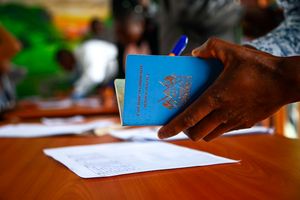
A job seeker holds a passport while filling out a form.
Photo credit: Wilfred Nyangaresi | Nation Media Group
Upon his arrest, investigators recovered additional identification documents, including a Seychelles national identity card and an expatriate employee card bearing his name.
In a separate count under the Proceeds of Crime and Anti-Money Laundering Act, the accused is charged with acquiring a Land Rover Discovery, allegedly using proceeds of the scheme.
Last August the High Court faulted a lower court’s decision that had ordered the release of items seized during the accused’s arrest before trial.
In a revision ruling, the court found that a lower court had erred in ordering the release of items seized during the accused’s arrest before trial.
The High Court held that digital devices, including mobile phones and laptops, were central to the investigation and must remain in custody pending forensic examination.
The judge further noted that the vehicle is suspected to be a proceed of crime acquired during the period of the alleged offence and should not be released before trial.
The case has also seen procedural disruption. It was initially before Magistrate Lucas Onyina, who recused himself after indicating that the defence had approached him in an attempt to compromise the case.
The matter was subsequently reassigned, allowing the hearing to proceed.
Prosecutors maintain the accused orchestrated a coordinated scheme that moved money, documents and clients through a system designed to appear legitimate.