Whether at the Maasai Mara National Reserve, Amboseli Game Reserve or the Tsavo West National Park, the quickest way for a poacher to legally end a pursuit by Kenyan wildlife officers is to cross into Tanzania, a move many suspects often make.
Wildlife is allowed to cross borders freely. But security officers are not.
Human beings will recognise that the Maasai Mara and the Serengeti National Park are different because they are separated by the two countries’ borders. The same applies to Tsavo West and Mkomazi National Park. And to the Amboseli and Kilimanjaro National Park.
For security officers, once a poacher crosses from the Maasai Mara into the Serengeti, the most they can do is to formally seek legal assistance from their counterparts in Tanzania.
KWS personnel examine game meat recovered from a house in Naivasha during a past operation.
Photo credit: File | Nation Media Group
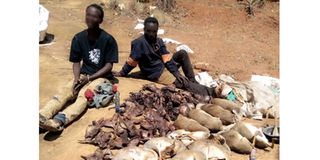
That bureaucracy, coupled with vast differences in wildlife laws enacted by the two countries, has seen several Nairobi residents unknowingly consume more game meat than they would ordinarily opt for.
Within minutes, an individual could change from being a poacher in the Tsavo West National Park, to being a hunter in Tanzania where killing wild animals is legal upon meeting regulatory requirements.
Oswald Sangawe, chief of security operations at the Kenya Wildlife Service (KWS), said the agency’s officers were restricted by national boundaries even when suspects crossed into a neighbouring country.
“Our role is to protect the wildlife in our Kenyan protected areas, and that means that our mandate is in our country. That is the truth of the matter, but it is good to know that our laws are very strict when it comes to dealing with killing wildlife for bush meat,” he said.
The bush meat trade in Kenya is strictly illegal under the Wildlife Conservation and Management Act (WCMA), 2013, which bans the unauthorised hunting, possession, or sale of wildlife, and the Public Health Act (Cap 242), which outlaws uninspected meat to prevent zoonotic diseases.
Offenders face severe penalties, including fines from Sh200,000 to Sh2 million, prison sentences from one year to a maximum of life imprisonment if the trade involves endangered species.
The problem extends beyond the limits of a wildlife officer’s patrol. Kenya generally follows a non-consumptive model of wildlife management, built around conservation, tourism and conservancies, while Tanzania permits regulated hunting of certain species under specified conditions.
For traffickers operating across the shared border, the differences present a complicated enforcement landscape in which authorities must establish whether meat has been lawfully obtained, identify those responsible for illegal hunting and pursue suspects whose activities span two jurisdictions.
A new assessment by WWF Kenya and TRAFFIC International East Africa warned that the trade had become increasingly commercialised, with organised networks linking wildlife-rich areas to markets far beyond hunting grounds.
Jackson Kiplagat, chief executive officer of WWF Kenya, said the two countries operated under fundamentally different wildlife management systems.
He explained that prioritised non-consumptive wildlife use through ecotourism and conservancies, while Tanzania allowed certain species to be hunted for meat or trophies under regulated arrangements, creating conflicting approaches to wildlife management.
“Consumptive and non-consumptive uses conflict in a way, because non-consumptive promotes conservation but consumptive allows targeted hunting either for consumption or for trophies, which is totally a different regime compared to that of Kenya," he said.
The report clarified that hunting for wild meat was generally illegal in both countries, but Tanzania’s legal framework provides some flexibility under special licensing arrangements. Meat from authorised hunting could be sold through licensed game meat outlets, although the regulated sector remained relatively small and faced enforcement challenges.
The report noted that “most wild meat consumption occurred illegally, without permits, raising the stakes for authorities trying to distinguish lawful products from meat obtained through poaching”.
The researchers, who consulted 110 respondents between January and February 2026, identified the Tanzania-Kenya border as a major corridor for an increasingly organised trafficking network operating across the Southern Kenya-Northern Tanzania (SOKNOT) landscape.
The landscape connects the Maasai Mara-Serengeti ecosystem through Amboseli-Kilimanjaro to Tsavo-Mkomazi, with wildlife moving between protected areas, community lands and dispersal zones. The report identified Rombo, Namanga and Tarakea among the important border distribution points from Tanzania to Kenya and vice versa.
Researchers found evidence suggesting that coordinators, particularly those based in Tanzania, worked with local Kenyans to organise hunting, transportation and the transfer of meat. The report also documented “active transboundary trade in wild meat, where dealers exploit porous border areas and use legislative discrepancies to expand networks”.
The scale of the financial incentives helps explain why the trade persists. Wild meat could fetch between $5 (Sh650) and $10 (Sh1,300) per kilogramme in distant markets, compared with $1 to $3 in villages closer to hunting grounds. This makes the trade of the bush meat across the border more lucrative.
The report also cited law enforcement estimates that individual trafficking operations could transport up to 1,000 kilogrammes of wild meat per trip. The combined movement across multiple routes could reach five tonnes a day, although this was an estimate rather than a verified daily tally of seizures.
More than 200 hunting hotspots were identified across the landscape, most outside protected areas and within a 15-kilometre buffer. Plains zebra, Maasai giraffe and Kirk’s dik-dik were among the species targeted.
Even when suspects are arrested in Kenya, however, the question of which country should prosecute them depends on where the alleged offence occurred and the applicable legal processes.
Gladys Tanui, a senior investigator at KWS, said suspects arrested in Kenya could face prosecution under Kenyan law for offences committed on Kenyan soil, irrespective of their nationality.
“Prosecutions happen where the crime happened and that is normally where you are arrested, so if you are arrested in Kenya, we deal with your case here and can only be extradited if a request from your country comes and that is an entire court process on its own,” she said.
The distinction revealed the soft underbelly on the limits of enforcement when criminal networks operate across borders. While Kenyan authorities can pursue cases within their jurisdiction, investigations involving suspects, evidence or activities in Tanzania require cooperation with the relevant authorities there.
Mr Kiplagat said the differences could be addressed through agreements between the two countries and regional mechanisms.
Corporal Dontillah Saru using a binocular to view wild animals from a distance during morning patrols on November 19, 2024 at LUMO community wildlife conservancy
Photo credit: Pool
“These issues can be handled progressively through mutual arrangements and agreements between neighboring countries. It is why we have even the East African Community, which has a natural resource legislation that provides for mechanisms in which countries can address some of these challenges,” he said.
To curb the cross-border illegal bush meat trade challenge, the report recommended stronger intelligence-sharing, joint operations and coordinated enforcement involving wildlife authorities, police, customs officers and prosecutors.
It also called for action against the entire commercial chain, including financiers, dealers, transporters and distributors, rather than concentrating on hunters alone.
Any other way would mean wildlife protection efforts on one side of the border risk being undermined by trafficking networks operating on the other.