An elaborate security operation involving hundreds of uniformed and plainclothes police officers was deployed across Nairobi and other towns to block planned demonstrations over high fuel prices, effectively preventing the protests from taking off.
Officers drawn from the elite General Service Unit (GSU), the Administration Police Rapid Deployment Unit and the regular police were placed on standby to respond to any unrest.
According to a senior officer in Nairobi, commanders had also arranged reinforcements from neighbouring counties, including Kiambu and Murang’a, in case the demonstrations turned violent.
On Monday evening, station commanders were briefed by Regional Police Commander Issah Mohamud and instructed to closely monitor their areas. They were directed to disperse any gatherings, particularly in hotspots such as Mathare, Kawangware and Kibra, where youth mobilisation had been reported.
Deputy Inspector General Eliud Lagat oversaw the operation, with a command centre set up to monitor CCTV footage across the city and major roads.
Police also intensified surveillance of social media platforms overnight to track mobilisation plans.
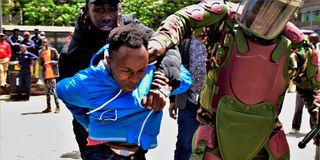
Police officers restrain an arrested protester during demonstrations against high fuel prices and the rising cost of living along Moi Avenue in Nairobi on April 21, 2026.
Photo credit: Billy Ogada | Nation Media Group
By Tuesday morning, heightened patrols were visible across Nairobi, with water cannons, anti-riot officers and plainclothes police deployed in large numbers. Checkpoints were mounted along major routes, including Ngong Road and Valley Road, leading to the Central Business District (CBD).
Despite the heavy presence, only a handful of protesters attempted to assemble in the CBD and were quickly dispersed, with at least 11 youths arrested.
Mr Mohamud said the demonstrations were unlawful, noting organisers had failed to notify authorities as required by law.
WhatsApp Image 2026-04-21 at 11.20.48 (1)
“We have arrested 11 protestors in the Nairobi CBD. Anyone who contravenes the Public Order Act will also be arrested and charged in court. We are aware of calls for protests, but no official notification has been filed,” he said.
By 4pm, no major security incident had been reported in the capital.
However, the heavy police presence and fear of unrest disrupted business activity. Many shops along Moi Avenue, Kimathi Street and Harambee Avenue remained closed, while normally busy areas such as Khoja roundabout and Odeon bus stage were unusually quiet.
Some matatu operators stayed away from the CBD, and traffic flow into the city remained smooth with fewer vehicles than usual.
Police officers arrest a protester demonstrating on the high fuel prices and rising cost of living outside Kenya National Archives on April 21, 2026.
Photo credit: Bonface Bogita | Nation
The situation also caused panic among traders, many of whom closed their businesses fearing looting, as had occurred during previous protests.
Foreign missions, including the United States Embassy, issued advisories urging staff to avoid crowds and monitor developments, warning of possible violence during demonstrations.
Police officers arrest protesters demonstrating on the high fuel prices and rising cost of living outside Kenya National Archives in Nairobi on April 21, 2026.
Photo credit: Billy Ogada | Nation Media Group
While Nairobi remained largely calm, protests erupted in other parts of the country.
In Kitengela, youth led by activist Bob Njagi briefly paralysed transport along the Namanga Highway before police dispersed them with tear gas.
“It’s not about us, it’s about Wanjiku, who is suffering due to high fuel prices,” Njagi said.
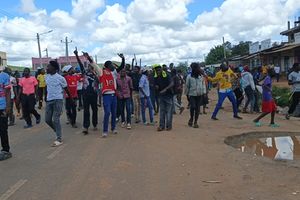
In Embu, youths barricaded roads and lit bonfires, disrupting transport, while in Nyeri and Karatina, businesses closed amid fears of looting. Some motorists reported being extorted by rowdy youths.
Chants as a group of protesters hit the streets of Nairobi on April 21, 2025.
Photo credit: Laban Shaban| Nation Media Group
Machakos also saw clashes between police and protesters, with bonfires, stone-throwing and arrests. Youths even set up a makeshift toll station on the Machakos–Kitui road.
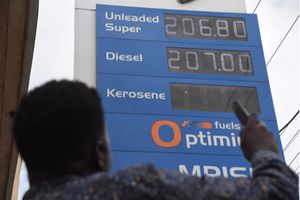
The protests were largely driven by anger over rising fuel prices blamed for the high cost of living. While the government cited the Middle East crisis, critics argued that more should be done to cushion citizens.
Despite scattered unrest, the heavy deployment largely contained the situation, though it disrupted business and daily life.
Reporting by Kamore Maina, Kevin Cheruiyot, Stanley Ngotho, George Munene, Mercy Mwende and Pius Maundu