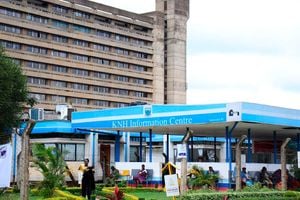
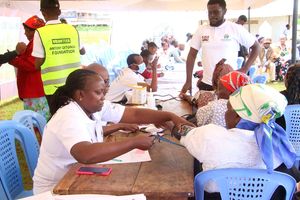
Authorities say the Social Health Authority (SHA) has saved the country Sh10.6 billion by rejecting fraudulent claims involving hospital billing for costlier procedures than those actually performed, charges for ghost patients and conversion of outpatient cases into inpatient admissions.
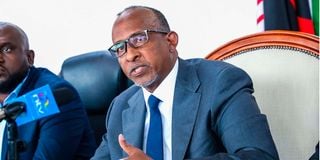
Health Cabinet Secretary Aden Duale said on Monday as a result of the fraud, 1029 rogue hospitals have either been closed or downgraded.
Mr Duale said the authority's comprehensive digital system is exposing the fraud that plagued the defunct National Health Insurance Fund (NHIF).
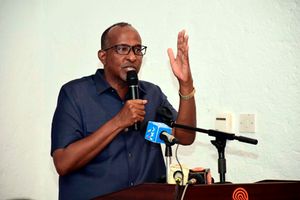
"Since I took office on April 1, 2025, we have intensified the fight," Mr Duale said. "Our comprehensive digital system was specifically designed to detect and eliminate the very vulnerabilities that plagued the defunct National Health Insurance Fund."
The CS explained that the primary function of the SHA digital system is to detect fraud, with facilities finding innovative ways to cheat the system, whilst the digital architecture is designed to detect and flag anomalies at every stage of the claims process.
"Hence, you will find that fraud can be detected and stopped at any point, including at the payment stage, as our AI module becomes more effective with the availability of more data," he said, adding that the more data they collect, the easier fraud detection becomes.
The intensified fight against fraud has resulted in the closure of 728 non-compliant facilities and the downgrading of an additional 301 facilities by the regulator, Kenya Medical Practitioners Pharmacists Dentists Union (KMPDC).
CS Duale: SHA chairman Abdi Mohamed used to own Ladnan Hospital, there's no conflict of interest
"This was based on findings from our rigorous forensic audits. Since then, we have continued our investigations and, as a result, we are in the process of degazetting a further 45 facilities who have been flagged for fraudulent activities, and investigations shall be commencing soon thereafter," he announced.
Addressing journalists in Nairobi, CS Duale provided a comprehensive breakdown of claims processed by SHA.
"Health facilities have submitted claims to SHA totalling Sh82.7 billion. SHA has paid Sh53 billion for claims submitted by health facilities. Claims totalling Sh6.4 billion have been approved and are pending payment—these claims are for a portion of July and will be paid in the next cycle," he explained.
According to Mr Duale, claims worth Sh10.6 billion have been rejected due to fraudulent activities or non-compliance, whilst claims worth Sh3 billion are being re-evaluated due to missing documents and claims worth Sh2.1 billion are under surveillance for further investigation.
"Claims totalling Sh7.6 billion for the month of August are currently under review," he said.
This action is taken under the authority of Section 48(5) of the Social Health Insurance Act, 2023, which outlines penalties for providers who knowingly or fraudulently alter information to defraud the Authority.
CS Duale explained that this rigorous process is a key part of the Authority's function under Section 35(2) of the Social Health Insurance Act, 2023, which mandates the claims office to review, process, and validate medical claims and conduct quality assurance surveillance.
SHA audits have revealed deeply troubling patterns of fraud, including upcoding for more expensive procedures than those actually performed, submitting altered or false medical documentation, illegally billing for inpatient admissions for simple outpatient visits, and submitting claims for services provided to non-existent patients.
Nabuala Hospital, Bungoma: Falsified claims for multiple Caesarean sections on the same patient within days and unsupported maternity claims.
Kotiende Medical Centre, Homa Bay: Fabricated clinical documents with a single person signing off for both day and night shifts over consecutive days, which is humanly impossible.
CS Duale lashes out at NMG's @LeonLidigu: 'Either work for Nation or replace Dr Lishenga
Vebeneza Medical Centre, Nairobi: Converted outpatient visits into inpatient claims and frequently admitted their own employees under suspicious circumstances.
Jambo Jipya Hospital, Mtwapa: Submitted fraudulent claims for Caesarean section when the patient had a normal delivery.
New Manyalo Nursing Home, Wajir: Converted numerous outpatient cases into inpatient claims, exceeding its bed capacity and admitting patients who were also admitted in other facilities concurrently.
Mandera facilities: Al-Masry Nursing Home, Rhamu Dimtu Medical Centre, Balanga Medical Centre, Care Connect Hospital, Al Shamsi Medical Centre, Merti Nursing Home, Zamzam Nursing Home, and Nibil Nursing Home colluded to submit 312 fraudulent claims for patients who were allegedly admitted on the same dates across multiple facilities simultaneously.
"To all healthcare providers, consider this a final warning because we are watching," Mr Duale warned. "Any facility, doctor, or patient found to be involved in fraudulent activities will be held liable and face the full force of the law. We have already initiated the process to recover paid monies and will involve law enforcement to prosecute perpetrators."
The CS urged Kenyans to continue with what he described as the spirit of social accountability and vigilance.
"Please work with us to ensure that every cent of public money is used prudently for its intended purpose: to provide legitimate, quality healthcare to all. Report any concerns or information regarding fraudulent activities to SHA through the toll-free number 147. Your participation is vital in protecting our social health insurer and securing a healthier future for our nation."
But as Mr Duale defended the systems, the procurement of the Sh104.8 billion Healthcare Information Technology Digitization system, which has been criticized by the Auditor General, comes into focus.
The Auditor General has raised concerns about the lopsided agreement that the government signed with a consortium led by a telco that could hamper its operations.
For instance, although the works involved installation of the system in public health facilities, the number of facilities were not disclosed in the contract agreement, according to the Auditor General ‘s report on national government ministries, departments and agencies for the 2023/2024 financial year.
In addition, the contract price covered training, support and customer education costs of Sh7 billion but the number of healthcare workers to be trained on the system and the mode of training to arrive at the costs was not disclosed in the contract agreement.
“This was contrary to Section 150(1) of the Public Procurement and Asset Disposal Act, 2015 which states that an accounting officer or his or her appointed representative shall be responsible for ensuring the goods, works and services are of the right quality and quantity,” the report states.
The Auditor General also raised questions that the contract prohibits the State department from developing another system or a product with similar functionalities to compete with the system being procured, putting the government at risk in the event of growing needs or for technological changes.
The auditor also questioned that ownership of the system, system components and all intellectual property rights shall remain in the ownership of the consortium except for the infrastructure which is to be transferred to the procurement.
In the circumstances, value for money on the procurement of the system at Sh104.8 billion could not be confirmed.
The project is to be financed from projected revenues of Sh111 billion from member contributions to SHA, claims from health facilities and charge for the track and trace solution at a rate of 2.5 percent, five percent and 1.5 percent, respectively.
Further the contract requires the projected revenues be transferred to an escrow account to be held by an escrow agent appointed by both parties. However, details on the signatories to the account were not disclosed in the contract agreement.
Regarding NHIF debt, the CS reminded that all past claims must still undergo a rigorous verification process.
"We have a duty to pay only for services legitimately rendered in full respect of Article 201 of the Constitution on the principles of public finance, as well as the Public Finance Management Act and the Social Health Insurance Act, 2023," he observed, maintaining that their strategy is to build a robust, corruption-proof system.
On August 18, Mr Duale hosted the CEOs of leading medical insurance companies, including Jubilee Health Insurance, AAR Insurance, and Old Mutual, to discuss bridging the financial gap in healthcare.
"We agreed to establish a Joint Anti-Fraud Action to crack down on malpractice and strengthen collaboration. I want to be clear: our work has just begun," Mr Duale said, adding that they will not rest until every Kenyan has access to quality, affordable, and dignified healthcare, free from the burden of fraud.
The CS clarified that the SHA's contractual agreements are made directly with individual healthcare facilities, not with associations.
"Whilst we respect the crucial role played by associations such as Rupha, it is important to clarify that our primary obligation is to pay for genuine claims and to protect public money," CS Duale said, calling out Rupha chairperson Dr Brian Lishenga, whom he says doesn't own a hospital to speak for private hospitals in the first place.
The Rural Private Hospitals Association of Kenya chairman Brian Lishenga.
Photo credit: File | Nation Media Group
"All obligations and accountability vest with the contracted parties—the individual facilities and the Social Health Authority. It is the responsibility of each facility to adhere to its contractual and ethical obligations," he concluded.