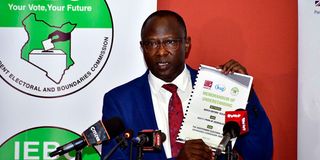
The Independent Electoral and Boundaries Commission (IEBC) in Kenya is set to deploy 12,000 clerks across more than 30,000 centres as it launches a nationwide Enhanced Continuous Voter Registration (ECVR) exercise on Monday, March 30 and targeting 2.5 million new voters.
Speaking in Nairobi during the Memorandum of Understanding signing between IEBC and the Kenya Media Sector Working Group (KMSWG), IEBC Chairperson Erastus Ethekon said that they have a mammoth task ahead, which is the management of the 2027 General Election.
But in the short term, they are currently preparing for the ECVR that will be launched on March 30, 2026.
“We have a huge task ahead, the first being the Enhanced Continuous Voter Registration that will be launched on March 30, 2026. We have trained 12,000 clerks who will start work on Monday, March 30, in over 30,000 registration centres across the country for the forthcoming Enhanced Continuous Voter Registration,” Mr Ethekon said.
According to Mr Ethekon, building on lessons from the Continuous Voter Registration (CVR) exercise, the ECVR has been designed to address specific technical and operational gaps, among them decentralisation for Accessibility, targeting the youth and data-driven resource allocation.
“We are targeting to register approximately 2.5 million new voters during the drive, while bringing registration services closer to citizens by moving from constituency offices to ward level and institutions of higher learning,” he added.
Speaking at the same event, the president of the Kenya Editors’ Guild (KEG), Zubeida Kananu, said that Kenya is stepping up preparations for its next electoral cycle, highlighting the critical role of international partners in strengthening democracy.
“As the country moves from last-minute crisis management to early planning, attention now turns to voter registration, an exercise leaders warn must begin with their own example,” Ms Kananu said.
Kenya Editors Guild president Zubeida Kananu makes her remarks during the signing of an MoU between the Independent Electoral and Boundaries Commission and the Kenya Media Sector Working Group in Nairobi on March 27, 2026.
Photo credit: Francis Nderitu | Nation Media Group
“In 2022, we were firefighting, signing agreements at two minutes to midnight. Today, we are no longer running against the clock; we are setting the pace.”
Ms Kananu added that Kenya’s 2022 election marked a turning point for transparency, with the public portal logging more than 386 million visits as citizens and media alike accessed polling station results in real time. But alongside that milestone came critical lessons on preparedness, coordination, and the safety of journalists that are now shaping a renewed push for a more credible and secure electoral process.
“This is about building trust in the process from start to finish,” she said. “In 2022, we saw the power of real-time access, but also the risks of confusion, late preparation, and threats against journalists. This time, we’re acting earlier: training hundreds of reporters, working towards a shared tallying framework to avoid conflicting results, and ensuring this agreement becomes a real shield for those on the frontlines of informing the public.”
She added that as the country approaches 2027, the fight for fair elections is no longer just about polling stations; it's also being waged across a fragmented, rapidly changing digital landscape. From AI-generated deception to the proliferation of alternative media outlets, the challenge is clear: safeguard the truth, or risk losing it.
She further pointed out that accountability must run both ways. The media expects timely, accurate information, even when it is uncomfortable to shut down rumours before they spread. In return, journalists must uphold the highest standards of accuracy and fairness.
“In an age of synthetic voices and digital distortion, the integrity of an election will depend not just on the vote itself, but on the fight for truth that surrounds it,” she said.
On his part, KUJ President Eric Oduor said the MoU is meant to facilitate collaboration between the media and IEBC and would not compromise either parties' work.
Kenya Union of Journalists Secretary General Eric Oduor makes his remarks during the signing of an MoU between the Independent Electoral and Boundaries Commission and the Kenya Media Sector Working Group in Nairobi on March 27, 2026.
Photo credit: Francis Nderitu | Nation Media Group
“The MoU is meant to cure some of the problems that were highlighted in the previous elections, such as access to information, because the public panics when information is not flowing. We want to see candidates promoting violence disqualified so that journalists and citizens can feel safe,” he said.
Mr Oduor said the collaboration will help the media provide timely, verifiable information to the masses.
“These are very interesting times where we have citizen journalism, we know the impact it can create if there are information gaps when elections are underway. We need to have uniform results from all tallying centres in collaboration with IEBC,” he said.
Mr Oduor said a media task force comprising members from IEBC and the media was formed under the MoU to implement proactive measures.
Rebuilding public confidence
Commissioner Dr Alutalala Mukhwana, Chairperson of IEBC’s Voter Education, Partnerships, Communication and Stakeholder Engagement Committee, emphasized the importance of building a trust-based relationship between the electoral body and journalists.
“The media is critical in helping citizens understand how elections work and countering disinformation that can overshadow facts,” he said.
He further urged journalists to help the public better understand the work of electoral administrators, noting that elections begin long before polling day.
“Help the public understand the work we do. Help them see the role of an electoral administrator. The media is essential in rebuilding public confidence in our democratic process,” Mukhwana said.
The acting CEO of the Independent Electoral and Boundaries Commission CEO Moses Sunkuli makes his remarks during the signing of an MoU between the Independent Electoral and Boundaries Commission and the Kenya Media Sector Working Group in Nairobi on March 27, 2026.
Photo credit: Francis Nderitu | Nation Media Group
Mr Moses Sunkuli, the acting Commission Secretary and CEO of IEBC, also highlighted lessons from previous elections, stressing that elections are a continuous process that requires journalists to understand each stage of the electoral cycle.
“As we prepare for the 2027 General Election, this engagement is both timely and necessary,” he said. “Elections take place within a dynamic information environment where facts, narratives and public trust interact and shape public perception.”
Sunkuli added that strong collaboration between the electoral management body and the media is indispensable in maintaining credibility in the electoral process.
Since last week, Kenyans, the majority of them youths, have raised concerns over delays in the ongoing voter registration exercise, citing the use of a single registration kit at the constituency office as the main cause of inefficiency.
The youths have been turning up in large numbers to enlist, complaining of a shortage of kits, saying that it had significantly slowed down the process, resulting in long queues, congestion and extended waiting hours. They warned that the situation could discourage many eligible voters from registering ahead of the next General Election.
The enhanced voter listing exercise will run for one month as part of a wider push by the Commission to overhaul the voter register, expand access and ensure all eligible Kenyans can sign up ahead of the 2027 general election. The nationwide drive will focus on unregistered citizens, particularly young people who have recently come of age.
The next phase will see the training of voter registration clerks, who will lead the process at the county assembly ward level, taking services closer to communities.
IEBC says staff readiness and professionalism are central to delivering a credible and transparent exercise.
With the rollout imminent, the Commission is calling on all stakeholders, including eligible voters, to take part in a bid to strengthen Kenya’s democracy.