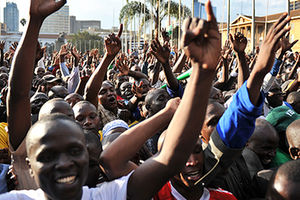
One random Tuesday morning, a party formed outside an Independent Electoral and Boundaries Commission (IEBC) office. It was the kind of party that forms without invitation and grows without permission.
Long, stubborn, sun-beaten lines were filled with laughter and people shouting across the queue when they spotted a friend.
Phones were raised because people wanted proof that they had been there. Woven into that moment, almost casually, was a question that had started to travel through conversations, evoking a mixture of humour and expectation: “Before we go any further, are you a registered voter?”
This question slips into first meetings, group chats, flirtation, plans, activist spaces and concert invites, turning registration into a kind of social currency that decides whether you belong in the room or remain on the outside looking in.
If you didn’t know better, you might think that something was being handed out for free — the kind of rare, irresistible offer that draws people away from their usual routines. Yet nothing was being handed out. People are offering their own time and comfort and their usual indifference in return for something that has always felt abstract and distant: a vote that now feels real and worth the effort.
A week ago, this existed as a feeling more than a movement. I wrote about a small and almost fragile moment where young people had begun to register quietly and a few posts had circulated, hinting at a shift in mood. It felt good, but it still felt early and was still forming and searching for momentum. Now it has become a wave.
Something has opened up across Kenya in an organic and undeniable way. From Nairobi to the coast and from campuses to smaller towns, young people, especially Gen Z, are showing up in large numbers, bringing with them a sense of collective participation and energy.
What used to be a solitary administrative task now feels shared and visible. It was not sparked by any politician, nor was its appeal shaped by any government campaign.
It arrived without speeches or carefully crafted messaging. Rather, it emerged from the fast-moving social media ecosystem that defines this generation: peer influence, shared urgency and a powerful desire to belong to something larger than oneself.
At the heart of it all stands Ademba Allans, a young man who chose action over discussion and simplicity over theory, gathering hundreds of young people and encouraging them to register to vote. This generation moves in intuitive and immediate patterns.
They observe, replicate, and amplify. One action becomes many; one group in one country sparks another elsewhere; a hashtag emerges; a trend forms; and momentum builds faster than it can be tracked. Before long, it has a name — #TukoKadi or #NikoKadi — and a recognisable rhythm.
Scroll through any social media timeline and you will see videos of friends pulling each other out of bed to register, people narrating their shift from postponement to action and university students easily asking “umejiandikisha wapi?” — turning civic engagement into everyday conversation.
In those same conversations, the question lingers again and again, sometimes playfully and sometimes pointedly, shaping how people interact and who they move with. There is an audacity in that transformation.
For years, young people in Kenya have been viewed through narrow lenses that oversimplify their complexity. They have been cast as either apathetic and unserious or angry and disruptive. They have rarely been acknowledged as organised, intentional or capable of shaping systems beyond confrontation.
Here, a generation emerges that is capable of taking one of the most monotonous processes imaginable and reshaping it into something urgent, social and energising. This reveals a depth of awareness that has always existed beneath the surface.
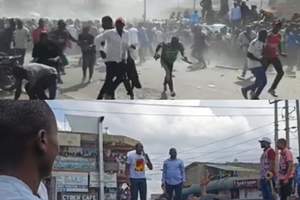
Watching this unfold brings 2024 into focus: a year that unsettled young people across the country and awakened something deep within them, forcing them to confront power and violence, as well as the consequences of action and silence.
This turned politics from something distant into something lived and personal. At that time, the streets became the language; now, the ballot box is emerging as a different kind of language altogether.
This shift reflects growth, even amidst the messiness and lack of formal structure. The same networks that once organised protests are now organising queues. The same digital spaces that once conveyed outrage are now conveying information, transforming scattered energy into something more focused and intentional.
It is a transition from resistance to strategy. Outrage burns quickly and leaves behind exhaustion. Moments like this begin to answer the question of what comes next, suggesting that power also lies in participation and deliberate, conscious engagement that extends beyond the immediate reaction.
At the same time, this movement has a deeply human element beneath the surface: it is driven by the desire to belong to something alive.
It grows through the quiet pressure of watching friends take part. It feeds on the fear of being left behind and the thrill of documenting and sharing a moment with others moving in the same direction. Individual action becomes collective identity, and in that sense, voting has become cool.
This shift raises an important question about why civic engagement has long been presented as something dull and heavy, disconnected from the ways people actually live and interact. Participation has always carried the potential to feel immediate and personal.
Making it cool becomes less about aesthetics and more about accessibility. It meets people where they are and allows participation to feel natural rather than forced.
What unfolds here runs deeper than trends or hashtags. It reveals a generation testing its power, learning how to move together, and discovering that it can shape direction rather than simply respond to it. This remains a beginning, even with all its momentum.
Registration forms the first step. The real work unfolds in sustaining that energy, in showing up on election day, in maintaining awareness, and in holding onto the collective spirit that made this moment possible.
Attention will follow from political actors seeking to align themselves with this energy or redirect it. That tension will test the independence that defines this movement.