Independent Electoral and Boundaries Commission (IEBC) Chairperson Erastus Ethekon has said that the lack of trust among Kenyans is the reason why the country holds some of the most expensive elections in the world.
The commission had been allocated Sh1.046 billion to conduct the November 27 by-elections in 24 electoral areas, and is pushing for at least Sh61 billion for the 2027 General Election.
A large portion of the funds will got towards the procurement of at least 46,000 Kenya Integrated Election Management System (Kiems) kits, election officials and security officers allowances, printing of “more secure” ballot papers and logistics.
“This issue of trust deficit makes us paranoid. The day we call ourselves to order as Kenyans, we will celebrate it because it will be cheaper, for instance, to print ballot papers locally than outsourcing to foreign firms,” said Mr Ethekon.
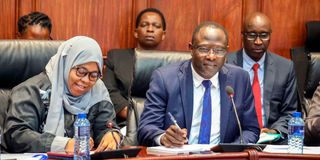
Independent Electoral and Boundaries Commission (IEBC) Chairperson Chairperson Erastus Edung Ethekon during a forum with Civil Society Groups, the media and CBOs at Mombasa Beach Hotel on August 13, 2025.
Photo credit: Wachira Mwangi | Nation Media Group
The IEBC boss further noted that Kenya’s election is the most legislated and regulated compared to “our peers within the East Africa region and other jurisdictions”.
“How come we don’t trust our systems? We are regulating everything to manage our anxieties in terms of verifiability and accountability. But let me ask, do all these regulations serve us or are they a cost unto themselves?” he asked.
In 2022, IEBC spent Sh44.18 billion to conduct the General Election, which is about Sh2,200 or $20 per registered voter, exceeding the international average cost per registered voter index benchmark of $5 (about Sh646).
This placed Kenya behind only Papua New Guinea where the cost of election stood at $48.84 (Sh6,300) per voter. In 2017, the cost per voter was about Sh2,000.
At $0.07 per voter, Ghana has the least expensive elections in Africa, comparatively. It cost Rwanda $.05 per voter in the 2017 election, Uganda $4, Tanzania $5.16 and Nigeria $8.61.
According to Mr Ethekon, the high cost of elections in the country is triggered by requirements that can be avoided “if we trust ourselves and the systems”. He highlighted the many security features on ballot papers.
“One ballot paper has 11 security features, making it even more secure than our currency notes. Our currency notes used to be printed locally before a foreign firm was outsourced,” said Mr Ethekon.
“We have the capability of having the ballot papers printed locally at a discounted rate and still serve the purpose, but because we do not trust ourselves, foreign companies come in.”
Ms Anne Nderitu, the IEBC Commissioner in charge of voter education, said that the lack of trust results in suspicion when election officials use government vehicles during the elections.
“It is an issue that we need to deal with. We have our peers using state resources including government vehicles during elections, which makes the cost cheaper,” she said.
Currently, IEBC hires private transport companies that charge exorbitant fees.
The Elections Act limits the number of voters in a polling station to 700 so as to expedite the process of voting and also deal with the challenge of overcrowding. In the 2022 elections, at least 46,000 polling stations were gazetted. In 2027, the country is likely to have close to or more than 50,000 polling stations.
Each polling station must have a number of officials, who must be paid.
“We can easily reduce the polling stations to half the number and allow at least 2,000 voters per polling station, something that should not depend on Parliament as is the case now. IEBC can determine the number of voters per polling station administratively,” said Ms Koki Muli.
Mr Mule Musau, the national coordinator of the Elections Observation Group-Kenya said that IEBC using polling stations as the cost drivers is problematic. According to him, the use of polling stations assumes that all registered voters will turn up, which is never the case, thus wasting resources.
He added that “estimates for possible litigation are also usually high”, and this could be addressed by conducting transparent elections.