Kenya is likely to head into the 2027 General Election without a review of electoral boundaries. The constitutionally mandated exercise, which redraws constituencies and wards to reflect population changes, now faces delays and uncertainty.
The boundary review is among the most politically sensitive undertakings in the electoral cycle, as it determines whether constituencies are split, merged, or scrapped, with direct consequences for political representation and careers.
The last review was carried out in 2012, when 27 constituencies that fell short of the minimum population threshold were “protected” to save them from abolition. Then, lawmakers, whose approval was required, refused to endorse their removal.
Since then, population growth has raised the average constituency quota — calculated by dividing the national population by the constitutionally fixed 290 constituencies.
This means that if the formula were applied strictly today, even more constituencies would fall below the threshold, putting them at risk of being scrapped.
In fact, based on the 2019 census, the Independent Electoral and Boundaries Commission (IEBC) last year flagged at least 40 constituencies as failing to meet the population requirement.
IEBC Chairperson Erastus Ethekon yesterday told the National Assembly’s Constitution Implementation Oversight Committee (CIOC) that the commission simply cannot complete the delimitation exercise before the 2027 polls.
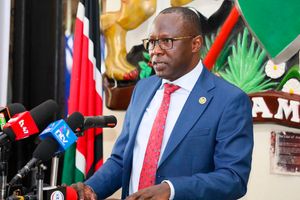
Independent Electoral and Boundaries Commission Chairperson Erastus Edung Etheko at a past event.
Photo credit: Wachira Mwangi | Nation
He explained that the process requires two to three years, a timeline already rendered impossible by constitutional deadlines that have lapsed.
“It is a constitutional crisis that requires MPs, who hold the sovereign power of the people, to do something about it,” he said, describing the exercise as “emotionally charged” and noting the immense political pressure and legal hurdles the IEBC faces.
The Constitution requires boundary reviews at intervals of not less than eight years and not more than 12, with the process to be concluded at least 12 months before a General Election.
The 2012 review started the constitutional clock: the minimum eight years ended in 2020 and the 12-year maximum lapsed on March 6, 2024. But IEBC was in no position to act.
It was left without commissioners for more than two years after the exit of the team led by the late Wafula Chebukati in January 2023. It was only reconstituted this year, leaving the timelines irretrievably overshot.
Faced with this crisis, the IEBC secretariat sought guidance from the Attorney-General, who advised them in April 2024 to seek an advisory opinion from the Supreme Court.
In July 2024, the secretariat filed a reference asking the court to clarify whether the commission could conduct boundary review without commissioners in office, whether it could undertake the review outside the constitutional window, and if timelines could be extended, by whom and under what conditions.
But on September 5, 2025, the Supreme Court struck out the application, ruling that only a fully constituted commission — not its secretariat — could bring such a matter before it. This has left the IEBC with no legal clarity and little time, forcing Mr Ethekon to plead with MPs to intervene.
He challenged them to consider amending the Constitution to extend the timelines and promised to report back to the committee within a month on whether any form of review is feasible before 2027.
However, CIOC chairperson Caroli Omondi (Suba South) warned the IEBC against relying on external proposals such as the National Dialogue Committee (Nadco) report, which last year recommended extending the review period to between 10 and 12 years. “I will encourage you not to consider the Nadco report. If you appear to be influenced by external forces, you risk exposing yourself to legal challenges,” Mr Omondi said.
Boundary delimitation has long been resisted by political leaders, who stand to lose their seats if constituencies are merged or abolished. Ahead of the 2022 elections, the Chebukati-led commission sidestepped the issue altogether, wary of antagonising MPs. Former Ndaragwa MP Jeremiah Kioni insists that scrapping constituencies is untenable.
“To protect the protected ones, we need to increase the number of constituencies and find a mechanism to harmonise the large ones,” he argued. Such proposals would require constitutional amendments — a politically fraught process likely to provoke further disputes.
The IEBC also faces difficulties in obtaining reliable population data to guide the exercise. The Kenya National Bureau of Statistics (KNBS) has yet to clarify whether the 2019 census figures can be used as the legal basis for delimitation.
Meanwhile, the 2009 census was declared inaccurate by the High Court, though that decision is under appeal, leaving the status of the data in limbo.
Without accurate figures, the commission cannot determine which constituencies fall below the threshold or plan fairly for voter distribution.
Article 89 of the Constitution caps the number of constituencies at 290 for National Assembly elections and requires IEBC to review their boundaries every eight to 12 years.
It also mandates periodic review of ward boundaries. In 2012, the review raised the number of wards to 1,450. Any future review must take into account population density, geographical features, community interests, means of communication, and public participation, among other factors — all of which add to the complexity of the task.
The delay has created what IEBC itself describes as a constitutional crisis. The commission is under pressure to prepare for the 2027 elections while also grappling with unresolved questions on delimitation.
Its document to the CIOC admits to “competing commission activities and the necessity of the boundary delimitation exercise” — a balancing act that appears increasingly impossible.
For now, the fate of constituencies that fall below the population threshold remains uncertain, with the prospect of another election held under outdated boundaries. As Mr Ethekon put it: “There are issues that might come out, and it is upon us to call upon Parliament to do certain things. We may also call upon the Supreme Court for another advisory.”
Whether Parliament and the courts will act in time remains to be seen. But with less than two years to the next General Election, the likelihood is that Kenya will once again head to the polls without a fresh review of electoral boundaries — a lapse with far-reaching implications for representation and fairness.