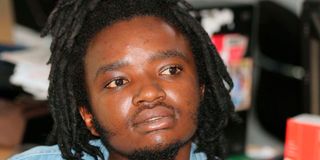
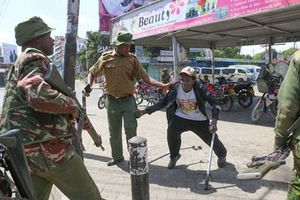
Allan Omondi, who was allegedly attacked by rogue police officers near Jomo Kenyatta University of Agriculture and Technology during 2019 protests as he walked to the hostels.
The High Court has ordered the Inspector-General of Police and the Director of Public Prosecutions (ODPP) to jointly pay a university student Sh8 million for police brutality and a years-long failure to deliver justice.
The court found that police breached Allan Omondi's constitutional rights by assaulting and unlawfully detaining him during a 2019 incident near Jomo Kenyatta University of Agriculture and Technology (JKUAT) on his way to the hostels.
It also ruled that the DPP violated his right to access justice after deciding the case should proceed through diversion instead of prosecuting the four police officers who assaulted and injured him. The DPP never implemented that decision, leaving Mr Omondi without any remedy.
Diversion is a DPP policy that allows eligible criminal cases to be resolved outside the courts through restorative justice instead of prosecution, with the aim of providing victims with an effective remedy while avoiding unnecessary trials. The process can culminate in a formal agreement requiring offenders to apologise, compensate victims, perform community service, and undergo counselling or rehabilitation, or undertake other restorative measures agreed by the parties.
The Director of Public Prosecutions (DPP) Renson Ingonga speaks during the launch of the “Mimi ni Mkenya” initiative at Serena Hotel in Nairobi on March 26, 2026.
Photo credit: Bonface Bogita | Nation Media Group
The court held that an unimplemented diversion process cannot be reconciled with the Constitution because it denies victims effective access to justice.
Justice Patricia Nyaundi said the assault and detention violated Mr Omondi's rights to human dignity and freedom from cruel, inhuman and degrading treatment guaranteed under Articles 28 and 29 of the Constitution.
The court further declared that the DPP breached Article 48 by failing to operationalise the diversion process after concluding there was sufficient evidence to charge the officers with assault causing actual bodily harm.
"The violent assault and subsequent arrest and detention of the petitioner occasioned a violation of the right to human dignity, freedom from cruel, inhuman and degrading treatment," the court ruled.
It added: "A diversion decision that is never implemented is, in effect, no decision at all, and the resulting vacuum cannot be reconciled with the constitutional obligations that bind the 2nd Respondent."
The petition arose from an incident on November 11, 2019, when Mr Omondi, then a JKUAT student, said he was walking back to his hostel after buying food during student protests over insecurity.
He told the court four uniformed police officers stopped him without warning, beat him with batons and kicks, handcuffed him inside a police vehicle and continued assaulting him while accusing him of belonging to the outlawed Mungiki sect because of his dreadlocks.
He testified that officers later took him to Juja Police Station, where the assault continued before he was locked in a crowded cell without medical attention despite informing officers that he suffered from a chest condition requiring an inhaler. He was released later that night after his mother intervened and sought treatment at AAR Hospital.
The assault attracted national attention after a video of the incident circulated widely on social media platforms and mainstream media. The Independent Policing Oversight Authority opened investigations, interviewed witnesses and identified officers involved before forwarding its file to the ODPP in March 2021.
The ODPP subsequently concluded there was sufficient evidence to support criminal charges of assault causing actual bodily harm. However, it directed that the matter be resolved through diversion after noting that administrative disciplinary action had already been initiated against the implicated officers.
In opposing the petition, the DPP said it lawfully exercised its constitutional discretion by opting for diversion. It argued the petitioner had not shown bad faith, abuse of power or irrationality to justify the court interfering with its prosecutorial decision.
But the court found that no diversion agreement was ever prepared or implemented despite repeated follow-ups by Mr Omondi, leaving the process unresolved for years.
"The attempt by the DPP to shift responsibility for finalising the diversion in this matter is not plausible. The inertia exhibited by the second respondent (ODPP) left the petitioner without a remedy and, in doing so, compromised his right to equal protection and equal benefit of the law," the court said.
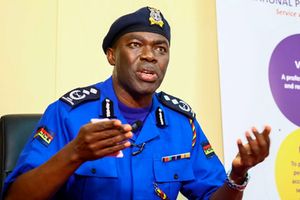
Inspector-General of Police Douglas Kanja.
Photo credit: File | Nation Media Group
The judge said the court would not interfere with the ODPP's constitutional independence by directing prosecutors to charge the officers. However, the court stressed that prosecutorial independence does not shield the office from constitutional scrutiny where its actions or prolonged inaction infringe fundamental rights.
"Independence carries constitutional responsibilities, and it does not excuse institutional inertia that undermines the rights of a complainant or leaves a diversion decision suspended in a state of non‑implementation," the court ruled.
Besides the damages, the court awarded Mr Omondi the costs of the petition against the Inspector-General and the DPP. The Attorney-General and the Independent Policing Oversight Authority escaped liability after the court found no constitutional violations attributable to them.
The Inspector-General, through the Attorney-General, had urged the court to dismiss the petition, arguing it did not precisely identify any constitutional violations attributable to his office.