Auditor-General Nancy Gathungu has expressed concerns over procurement of the Sh41.9 billion Bomas of Kenya renovations project, stating that it was conducted illegally and irregularly.
Ms Gathungu's damning revelations, presented in Parliament in the Ministry of Defence's latest audited accounts, put Principal Secretary Patrick Mariru in a tight spot for violating procurement law.
Ms Gathungu also found that the renovations had not been included in the budget, which exposed Mr Mariru to sanctions for possibly abusing public funds by spending money that had not been authorised by the National Assembly, contrary to the Public Finance Management (PFM) Act. The audit notes that Mr Mariru approved the request for authorisation of direct procurement after the procurement proceedings had already begun.
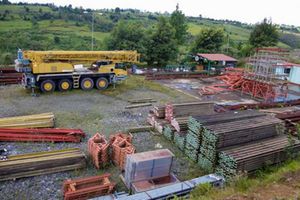
A fenced wall at the ongoing construction site at Bomas of Kenya.
Photo credit: Evans Habil | Nation Media Group
The audit notes that PS Mariru approved the request for direct procurement on February 17, 2025, “while the procurement proceedings had already started as evidenced by the tender invitation documents and site visit certificate dated February 13 and 14, 2025.”
“This was contrary to the Public Procurement and Asset Disposal Act of 2015,” the audit states adding; “in the circumstances, the Management was in breach of the law and the government is likely to incur penalties and charges where there is a delay in making payments.”
The renovation works aim to upgrade the cultural facility to Bomas International Convention Centre (BICC) with an enhanced seating capacity of up to 11,000.
Procurement approvals made retrospectively
Section 69 (2) of the procurement law states that no procurement approval shall be made to operate retrospectively to any date earlier than the date on which it is made, except on procurements in response to an urgent need. This comes as the immediate former Tourism Fund (TF) Board of Trustees chairperson, Mr Samson Some, had revealed in an interview with Nation that Tourism Fund is financing part of the Bomas renovations - phase II- through a Public-Private Partnership (PPP) arrangement.
Tourism Fund Board Chairman Mr Samson Some.
Photo credit: Jared Nyataya | Nation Media Group
Mr Some, whose term as TF Board of Trustees chairperson ended on February 16, 2026, while putting to rest doubts over the source of funds for the Bomas renovations, revealed that the financing is a PPP model through TF collections.
“A percentage of our levy collection will be committed annually by the fund as a repayment to the people who are investing in the project,” says Mr Some had said.
Former Deputy President Rigathi Gachagua , last year, caused uproar when he sensationally claimed that the country’s cultural facility had been sold by the government to a foreign entity, a claim that the government denied.
Mr Some had disclosed that “what the government was very clear about is that by mobilising private sector money, we could get this facility available to the industry immediately...Then what would happen is that this repayment would be done through collections internally from the industry, and it couldn’t have come at a more opportune moment,” the former TF Board of Trustees chairperson said.
The audit notes that the contract agreement provided for a repayment plan of nine instalments payable within 24 months. However, the National Treasury-approved financing provided for a deferred payment plan over 10 years, which was inconsistent with the contract agreement.
The procurement was originally to be overseen by the State Department for Culture, Arts and Heritage, headed by Principal Secretary Ummi Bashir, over a period of 24 months. However, the State Department for Culture, Arts and Heritage transferred responsibility for procuring the design, construction and equipping to the Ministry of Defence.
However, the audit shows that “a review of the budget for the State Department for Culture, Arts and Heritage for the financial year 2024/25 revealed that it does not include development budget allocations towards design, construction and equipping of the BICC.”
The PFM Act and its accompanying regulations explicitly prohibit the procurement or spending of public funds without an approved budget, as it enforces budgetary controls.
Sections 68 and 149 of the Public Finance Management (PFM) Act require all accounting officers of public entities at national or county level to ensure that their resources are used lawfully and with authorisation.
The accounting officers are, specifically, required to ensure that all expenditure is within the approved budget for that financial year and any procurement without a budget is classified as an offence by a public officer or financial misconduct.
This means that public officials who authorise such spending can be held personally liable for any losses incurred by the government.