Kenya loses billions of shillings every year through corruption, ghost projects, scandals and state capture, undermining economic growth and social development.
Bribery, nepotism and embezzlement of funds have made households search for private solutions to public challenges.
Buying public goods at inflated prices and other large-scale corruption often force citizens to seek private and more expensive alternatives.
A substantial amount of the billions of shillings sent to devolved governments makes “instant village millionaires”.
Counties and national institutions like Parliament, the Judiciary, the National Police Service and the Teachers Service Commission have become dens of corruption.
Records from the Auditor-General, the Ethics and Anti-Corruption Commission and the Project Management Institute (PMI) reveal that the country loses more than Sh600 billion in stalled, abandoned and mismanaged projects due to poor planning, corruption and weak fund management.
The amount, according to the African Development Bank, is about five per cent of Kenya’s GDP – enough to fund health, education or agriculture.
“Sh600 billion can finance the construction of 3,000 well-equipped Level Four hospitals and end the suffering of travelling long distances to seek healthcare. The money can fund several mega dams,” Mr David Kimani, an economist, said.
Erode investor confidence
PMI says systemic failures in how state projects are conceived, funded and executed undermine development and erode investor confidence.
“Stalled projects cut across transport, technology, water and energy,” PMI Kenya Chapter President Maureen Mbithi said.
“Causes of project failures include delayed contractor payment, corruption, red tape and unqualified personnel overseeing them. We need professional project managers to ensure efficiency and accountability.”
PMI is lobbying Parliament to pass laws that would regulate project management, ensuring that only certified professionals oversee state programmes.
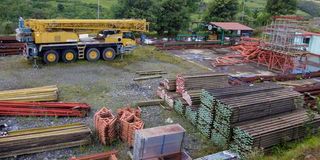
Abandoned equipment at Kipsaiya in Elgeyo Marakwet where Arror dam was to be built.
Photo credit: File | Nation Media Group
The Itare dam in Nakuru and the Arror and Kimwarer dams in Elgeyo Marakwet were launched with huge budgets but have since stalled.
After the stalling of the Sh38 billion Itare dam, the government has in the last three years spent more than Sh3 billion on boreholes in Nakuru.
“Residents pay high levies for tapped water from the Nakuru Water and Sanitation Services Company, yet billions of shillings were sunk into Itare dam,” People’s Power Watch lobby Chairman Jesse Karanja said.
National Assembly's Finance and Planning Committee led by its chairman Kuria Kimani (in pink shirt) on a fact-finding mission at the alternative Data Recovery Centre in Naivasha, Nakuru County on December 4, 2023.
Photo credit: Boniface Mwangi | Nation Media Group.
A report by Auditor-General Nancy Gathungu covering the 2023/24 financial year showed the National Treasury initiated the project in 2009 with the objective of having back-up for government data.
Some Sh782 million was awarded to the contractor, the initial timeline being 96 weeks. However, the scope of the project was later expanded and split into three phases.
The first phase cost Sh899 million, while the second was Sh205 million. Both were completed and paid for, bringing the project to 68 per cent completion.
“A disagreement arose when Treasury failed to settle a Sh193 million claim meant to compensate for idle resources and expenses due to the delays,” the report says.
“The contractor took the matter to arbitration and was awarded Sh4.1 billion for loss of profits and other associated costs. As of June 30, 2024, the outstanding amount had grown to Sh5.5 billion.”
The arbitration decision was adopted by the High Court and the Attorney-General indicated that the chances of success on appeal were slim. They advised the National Treasury to negotiate with the contractor but there is no evidence of talks.
Treasury argued that the third phase was a separate tender requiring new bidding. The Auditor-General blamed Treasury for mishandling the contract.
“The expenditure would have been avoided had management handled the contract in accordance with the applicable laws,” Ms Gathungu said.
Auditor-General Nancy Gathungu.
Photo credit: File | Nation Media Group
She also pointed out that the facility remains unused despite the massive expenditure, raising questions about wastage in government.
A recent visit to the site by MPs revealed that equipment valued at more than Sh100 million had been stolen or vandalised.
A 2025 audit showed that 249 projects valued at Sh20 billion initiated by 33 counties were stalled or abandoned.
A report for the financial year ending June 30, 2024, revealed that at least Sh12 billion projects in 10 counties had stalled.
The projects included health centres, roads, early childhood classrooms and stadiums. The counties were Nairobi, Kiambu, Baringo, Nakuru, Turkana, West Pokot, Tana River, Kitui, Nyamira and Trans Nzoia.
Kenya ranked 121 out of 180 countries in the 2024 Transparency International Corruption Perceptions Index.
During the campaigns in 2022, then-Deputy President William Ruto promised to set up a quasi-judicial commission of inquiry into state capture within 30 days of taking power – a pledge that has never been kept.
High-profile financial scandals that have rocked the country in the last three years include the reported loss of Sh11 billion by the Social Health Authority, a Sh2 billion embezzlement at the National Youth Service, the loss of Sh6.6 billion through the importing of edible oils via the Kenya National Trading Corporation, Sh3.7 billion through mosquito net procurement irregularities at the Kenya Medical Supplies Authority, Sh3.5 billion through the fake fertiliser programme and Sh550 million by Kenya Pipeline Company.