The government’s failure to implement the report of Auditor-General Nancy Gathungu may have contributed to the worsening drought situation in the country.
This comes as the number of the affected Kenyans in the 23 Arid and Semi-Arid Lands (ASAL) counties, severely hit, escalated from 2.1 million in January to 3.3 million by mid-February 2026.
Climate Tracker
Kenya Satellite Analysis
Developed by Geoffrey Onyambu • © 2026 Nation Research Desk
The performance audit report on the management of drought in Kenya by the National Drought Management Authority (NDMA) tabled in the National Assembly in December 2020, identified weaknesses and recommended practical solutions to mitigate against the phenomenon.
The implementation of the report that continues to gather dust on the shelves of parliament would have ensured efficiency in the expenditure of at least Sh56 billion spent towards drought mitigation in the last 11 years.
The audit covered a period of four years- from July 2015 to June 2019- and was limited to four of NDMA's activity areas- drought resilience, contingency planning and response, drought information and drought coordination. The audit covered all 23 ASAL counties in which NDMA operates.
However, inspection of NDMA's operations was carried out in seven sampled counties of four arid and three semi-arid. The sampled counties were Baringo, Marsabit, Isiolo, Turkana, Laikipia, Kajiado and Kitui.
“The audit was conducted following public concern on the government's approach to drought management, expressed through discussions in parliament and reports in the media,” the audit reads.
The audit identified gaps in the early warning system that had weaknesses, posing a risk to the reliability of information and insufficiencies in drought preparedness projects under the European Union (EU) Drought Management and Coordination (DRMC).
The audit also highlighted insufficiencies in the Hunger Safety Net Programme (HSNP) and insufficiencies in the Asset Creation Programme (ACP)- protracted relief and recovery, among others, all of which have been blamed for the current situation.
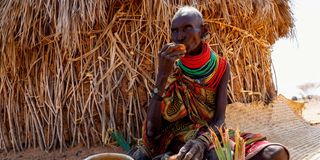
Echakan Amaja 76, eats wild doum palm fruit (Hyphaene thebaica), outside her shelter in Loperot village in Turkana County on February 16, 2026. The county has been hit by severe drought.
Photo credit: Pool
The audit reveals that insufficient mapping of stakeholders and a lack of continuous monitoring of drought management activities of other actors left NDMA with limited knowledge on the status of implementation of activities, the information needed to follow up on projects being implemented to ensure that the intended objectives were met.
It reveals that despite having early warning systems, NDMA’s actual response activities “often started after the drought reached emergency levels due to slow approval of response plans” by the government.
It also highlights planning gaps, noting that NDMA only adopted a ward-based contingency planning in 2018, and even then, coverage was limited to only five wards per county, leading to insufficient information on local vulnerabilities.
“Good preparations can make the effects of drought less severe and hence less costly for taxpayers. Despite this, the audit revealed that drought preparedness is still faced with challenges,” the audit says.
The audit notes that all the observed shortcomings were serious and affected the country's level of drought preparedness.
“The Office of the Auditor-General wants to underline the importance of a functioning drought management system. It requires action and commitment not only from NDMA, but also from the national government line ministries, county governments, involved agencies and legislators,” says Ms Gathungu.
The NDMA management led by CEO Lt. Col. (Rtd) Hared Hassan Adan did not respond to our inquiries sent through the organization’s email address.
However, Public Service, Human Capital Development and Special Programmes Cabinet Secretary Geoffrey Ruku said that the government has already spent Sh6 billion in December 2025 and January this year, to help mitigate the effects of drought in the affected areas.
“This was to ensure that we have enough food for the affected families distributed by the State Department for Special Programmes across the 23 ASAL areas,” said CS Ruku.
The CS allayed fears towards the mitigation, noting that the government has enough food reserves for the affected families.
The CS revealed that the distribution is based on the data from NDMA, a State agency under the Ministry of East African Community (EAC), the ASALs and Regional Development that collects data on a day-to-day basis on the drought situation in the country.
CS Ruku pledges government food relief to Kajiado residents amid drought
CS Ruku disclosed that four counties- Mandera, Wajir, Kwale and Kilifi are severely affected, with others in the critical stage.
Those in the “very critical” stage, according to the CS, include Kajiado, Marsabit, Laikipia, Turkana, Isiolo, Tana River, Kitui, Narok, Lamu, Baringo and Samburu.
Established in 2011 as the lead government agency in drought management, and in 2016 through the NDMA Act, NDMA's early warning manual defines drought as a prolonged period of poorly distributed rainfall, which does not come at the expected time and which results in deterioration of natural resources.
Though a normal climate phenomenon in ASALs, the severity and increased frequency of drought in the wake of climate change have become an issue of concern for economic development in the country.
Drought management is characterized by a complex system involving many actors that include the national government, line ministries, county governments and a range of non-governmental organizations.
The Authority's overall mandate is to establish mechanisms to ensure that the effects of drought do not escalate to an emergency and that the impacts of climate change are sufficiently mitigated.
According to the audit, drought management has attracted significant amounts of funding from the government and donors.
Data shows that between the fiscal period 2015/16 and 2018/19, NDMA was allocated Sh24.82 billion towards drought mitigation efforts.
The expenditure could be more as NDMA at times receives funds from other sources not factored into the national budget, hence the expenditures in excess of the budget.
In the 2015/16 period, Sh5.58 billion was allocated, 2016/17 Sh6.16 billion, 2017/18 Sh7.16 billion, and 2018/19 Sh5.92 billion. Between the 2019/20 financial year and the current financial year, Sh30.88 billion has been spent towards drought mitigation.
In the 2019/20 financial year, Sh2.3 billion was allocated and spent, in 2020/21 Sh4.4 billion, 2021/22 Sh4.1 billion, 2022/23 Sh6.43 billion, 2023/24 Sh5.7 billion, 2024/25 Sh2.28 billion and 2025/26- Sh5.67 billion.
“It was necessary to establish whether there was value for money on these expenditures, especially in the area of drought preparedness,” says Ms Gathungu.
In early 2024, National Assembly Speaker Moses Wetang’ula directed departmental committees to prioritize performance audit reports, noting that “this is the first time such reports are being scheduled for dedicated discussion alongside traditional financial audits.”
Despite the Speaker’s instructions, the findings and recommendations of the report continue to gather dust in the shelves of parliament.
This, even as Ms Gathungu noted that the availability of relevant legislation would “not only provide clear guidance on expected outcomes at each stage in the contingency process, but also ensure the availability of funds for timely activation.”
Fixed timelines for steps in activating the contingency plans could reduce delays during activation.
A cow's carcass out in the open in Hirimani area, Tana River County on February 13, 2026. The current drought has caused the deaths to hundreds of livestock in the county.
Photo credit: Kevin Odit | Nation Media Group
“To further improve the system, NDMA should follow up with the Ministry of ASALs and the National Treasury to fast-track the enactment of the National Drought Emergency Fund Regulations, 2017.”
The audit also advised NDMA to revise the Kenya Drought Response Guidelines and ensure clear guidance is provided on timelines for the steps on the activation of contingency plans, stakeholder involvement, national level contingency planning and update and approval requirements.
Although drought management has a complex system involving many actors from the national and county governments, and non-governmental organizations, “the audit found a lack of commitment from the actors.”
This lack of commitment, the audit established, was displayed through failure to enact the relevant guiding laws and policies, lack of participation of high-level representatives in the coordination meetings and lack of action on the early warning bulletin recommendations.
Lack of implementation of the partner's respective components of the strategic preparedness projects was also established.
While contingency planning and response are key components in drought management, the audit notes that due to unclear guidelines, the contingency process is faced with planning deficiencies leading to delays during activation, hence putting lives and livelihoods at risk.
“Though intended to be used as a tool for early action, the audit has found a time lag during activation of contingency plans and a lack of action on recommendations of the early warning bulletins, casting doubt on effective use of early warning information in the contingency processes.”
Further, despite investments in several projects for strengthening the climate resilience of communities in ASALs, the communities still remain vulnerable.
This as the audit found several shortcomings in the implemented programmes, such as incomplete implementation of project components, extremely small-scale nature of activities implemented and limited facilitation of beneficiary communities.
According to the Controller of Budget (CoB) Dr Margaret Nyakang’o, the State Department for the ASALs and Regional Development promotes ASALs policy, coordination of planning and development for ASALs.
The State Department is also tasked with the implementation of Special Programmes for the development of Arid and Semi-Arid Areas, implementation of ASALs programmes, coordinating research for sustainable ASALs resource management and development of livelihoods.
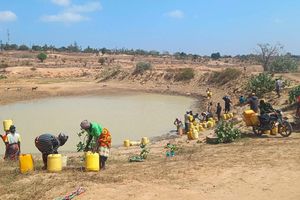
Women and children fetch water from a concrete water tank in Lopii village, Turkana East Sub County. The county has been hit by severe drought.
Photo credit: Sammy Lutta | Nation Media Group
There is also promotion of livestock development, marketing and value addition of resources within Arid and Semi-Arid Areas, enhancing livelihood resilience of pastoral and agropastoral communities.
The others include coordinating responses against drought and desertification, special programmes, food relief management and humanitarian emergency response, and peace building and conflict management within the Arid and Semi-Arid Area.
Further, there is management and promotion of integrated cross-border activities in identified ASAL counties, regional development policy implementation, oversight and management, coordination of regional development authorities and projects in response to displacement impacts.
In addition to the NDMA Act, 2016, several policy documents exist to guide NDMA's drought management activities.
At the global level, drought management is guided by the Sendai Framework for Action, 2015-2030, which seeks to substantially reduce disaster risk and losses.
The framework requires states to put in place measures that enhance disaster preparedness for effective response and to "Build Back Better" in recovery, rehabilitation and reconstruction.
Women fetch water at Mbogo water pan in Bandari location, Bamba, Kilifi County on February 11, 2026. Of the five water pans dug in Bandari, only Mbogo has water.
Photo credit: Valentine Obara | Nation Media Group
At the national level, Sessional Paper No. 8 of 2012 on National Policy for the Sustainable Development of Northern Kenya and other Arid Lands is key in drought management.
This policy document seeks to facilitate and fast-track sustainable development in Northern Kenya and other arid lands.
One of its objectives is to strengthen the climate resilience of communities in the ASALs and ensure sustainable livelihoods, which falls within the mandate of NDMA.
The government has also developed a strategy document for ending drought-related emergencies, published in 2015.
The Common Programme Framework for Ending Drought Emergencies (EDE) is a six-pillar approach with the overall expected outcome being resilience of communities in drought-prone areas through fast-tracking of development.
The EDE pillars are peace and security, climate-proofed infrastructure, human capital and sustainable livelihoods.
The others are drought risk management, institutional development and knowledge management, whose implementation lies under NDMA.