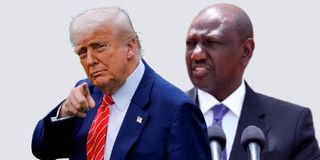
Slightly more than a year after President William Ruto’s high-profile state visit to Washington, where he was hosted by President Joe Biden at the White House, Kenya is under scrutiny in Congress over international relationships and its human rights record.
One of the highlights last year was the privilege of being a US non-NATO ally. The status refers to a country that is not part of the North Atlantic Treaty Organization (NATO) yet has strategic and security partnerships with the United States.
Idaho Senator and Chairman of the Senate Foreign Relations Committee Jim Risch now wants the US-Kenya ties reviewed.
“Kenya plays a vital role in regional counter-terrorism and stability. But as our newest Major Non-NATO Ally, Kenya’s ties with China are troubling. Widened diplomacy with America’s greatest competitor is not an alliance – it’s a risk for the US to assess,” he said.
Risch, whom President Donald Trump has endorsed for re-election in the 2026 Senate race, went further: “That’s not just alignment to China; it’s allegiance. Relying on leaders who embrace Beijing so openly is an error. It’s time to reassess our relationship with Kenya and others who forge tight bonds with China.”
President William Ruto with his Chinese counterpart Xi Jinping at the Great Hall of the People in Beijing, China.
Photo credit: PCS
In 2024, the Ruto administration was realigning Kenya firmly into the American orbit on foreign policy matters, but his visit to China and the declaration that Kenya and the Asian giant were partners in forging a new world order caught many in Washington by surprise while infuriating the Idaho senator – a Trump confidant.
In April 2025, President Ruto stated that Kenya and China were not just trade partners, but co-architects of a new world order. He said the new order “is one that is fair, inclusive and sustainable”.
“Let’s measure our success not just in GDP growth or trade volumes, but in how many lives we uplift, how many futures we secure and how much dignity we restore,” he said.
That was the part of his speech that riled allies of President Trump, whose administration romped to power in large part due to its anti-Chinese stance and emphasis on containing China as an existentialist threat to American hegemony.
At the heart of the critique from the Trump administration is alignments with China that undermine US interests, claims of ties to rogue armed groups like Sudan’s Rapid Support Forces (RSF) and rights abuses centred on abductions, torture and extra-judicial killings.
Dr Milton Allimadi of the John Jay College City University, New York, highlights the opaqueness and contradictions in Trump’s Kenya foreign policy.
“It’s hard to figure out US foreign policy today. Logically, one would think Kenya would be cut some slack since it contributed women and men to the operation meant to stabilise Haiti, for example. Then again, it’s also correct to take action because of the Ruto government’s reported support for the RSF.
"Much of the non-NATO ally status is propaganda and has no substance. Ironically, the US did not hike Kenya’s tariff rate recently, which remains at 10 per cent. Uganda’s went to 15 per cent, Brazil’s as high as 50 per cent and South Africa’s rose to 30 per cent as relations between Pretoria and Washington deteriorated,” Dr Allimadi said.
Veteran US-based journalist and media consultant Paul Ndiho is of a different opinion on the predicament of Kenya’s Non-NATO status.
Chinese President Xi Jinping and Kenyan President William Ruto attend a welcome ceremony at The Great Hall of The People on April 24, 2025, in Beijing, China.
“The Trump administration is taking a different position because of Ruto’s relationship with Biden. The goal is to destroy anything Biden did,” he said.
Prof Eric Otenyo of the University of Phoenix’s Political Science Department feels Kenya has invested in lobbyists to buttress the country’s standing in Washington.
He differentiates the position of Senator Risch with the official driver of US foreign policy, the Executive under Trump. Risch’s opinion might not necessarily reflect that of the State Department and the Trump foreign policy position.
“The Trump administration is transactional and, until recently, was only concerned about mineral contracts and immigration. As far as l am aware, Kenya is on the radar of the Senate’s Foreign Policy Committee. The Executive may be firming its position but Kenya has hired lobbies that are working around the clock to soften the punches,” he said.
Former Africa Report consultant and media analyst Wanderi Kamau sees President Ruto as a victim of a change of guard in Washington.
“Ruto was Joe Biden’s blue-eyed boy in Africa. This closeness largely contributed to Kenya’s elevation as a Major Non-NATO ally. It is this closeness that also made Biden release millions of dollars to facilitate Kenya’s police mission in Haiti. Trump’s moves are a mixture of policy change – putting America’s interests first – as well as the undoing of Biden’s perceived ‘anti-American’ policies,” he said.
Mr Wanderi adds that Dr Ruto has been ostracised and frustrated by Trump’s America-first policies. President Ruto has been angling himself as the modern Pan-Africanist spokesperson.
He adds that in reaching out to China, Dr Ruto is just hedging against the US, balancing between two global powers in their tit-for-tat rivalry to gain geopolitical advantage.
Time will tell if Washington will push stricter positions on Kenya in line with the new American geopolitical and strategic realignments..