When US President Donald Trump returned to the White House in January, President William Ruto and Kenya seemed to have been thrown off the table of privilege where they had been placed during the previous Joe Biden administration.
With “America First” being Mr Trump’s clarion call, aid programmes were halted without warming, many of Mr Biden’s foreign policies were trashed, and Africa didn’t appear to matter much to Washington — unless it needed to be warned against “genocide” as with South Africa and, lately, Nigeria.
For Kenya, Mr Trump’s second term began after the US ambassador to Nairobi, Ms Meg Whitman, had quit. She resigned just a week after the 2024 election where Mr Trump defeated the Democratic Party’s Kamala Harris.
Former US Ambassador to Kenya Meg Whitman during the 20th anniversary of the United States President’s Emergency Plan for AIDS Relief (PEPFAR) in Nairobi on January 23, 2023.
Photo credit: File | Nation Media Group
And when earlier this year the US Senate’s Foreign Relations Committee discussed taking action against Kenya for its dalliance with China, it seemed that Kenya would fall further down with its status as a major non-Nato US ally, which it got under Mr Biden, was put under the spotlight.
The chairperson of the Senate’s foreign relations, Mr Jim Risch, said on May 13 that Kenya’s status, which is enjoyed by 19 other countries, had to be reconsidered.
“Many African nations maintain troubling ties with China, including key national security partners,” said Mr Risch. “Just last month [April], President Ruto declared that Kenya, a major non-Nato ally, and China are ‘co-architects of a new world order’. That’s not just alignment to China; it’s allegiance...Relying on leaders who embrace Beijing so openly is an error. It’s time to reassess our relationship with Kenya and others who forge tight bonds with China,” he said during a session themed “East Africa and the Horn: At a Turning Point or Breaking Point?”
President William Ruto and US President Joe Biden during a joint Press Conference at the White House, Washington DC.
Photo credit: PCS
With that, the prospects for Kenya looked bleak. The results of Dr Ruto’s lavish state visit to the US in May 2024, where Mr Biden announced that Kenya would be granted that status, appeared destined for the shredder.
At the same time, however, Mr Risch’s remarks showed that even with its inward-looking policies, the US is wary of the growing influence of China in Africa.
Last month, there seemed to be a hint of ties warming up in the form of a visit to Kenya by Mr Trump’s vice president, JD Vance. However, this was called off because the US boycotted the G20 Summit that happened in South Africa on November 22-23. Mr Vance’s trip to Kenya was tied to the summit appearance.
But things seemed to have changed as the US took interest in the eastern Democratic Republic of Congo (DRC) and Sudan conflicts, with Mr Trump’s mission as a prospective Nobel Prize winner for resolving conflicts providing context.
Come Thursday December 5, and there was the peace agreement signing ceremony in Washington between the DRC and Rwanda where the Kenyan President, who also chairs the Eat African Community, was invited.
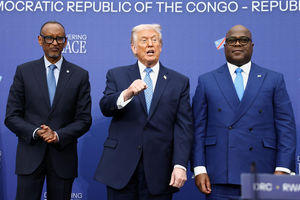
US President Donald Trump (centre), with President Paul Kagame (left) of Rwanda and President Felix Tshisekedi of the Democratic Republic of the Congo pose for a picture following a signing ceremony at the US Institute of Peace in Washington DC on December 4, 2025.
Photo credit: Reuters
This gave Dr Ruto the stage to preach about his Pan-African ambitions on the world stage, and to try to recalibrate his ties with Washington. President Trump did not hide America’s commercial interest and push to boost its influence in the region — with the help of allies like Kenya despite the growing Chinese footprint.
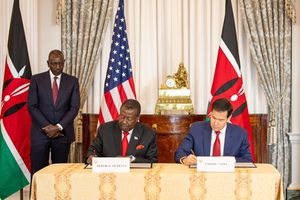
Also on Thursday, Dr Ruto signed a historic agreement that reconfigures the American aid arrangements. The Kenya-US Health Cooperation Framework, signed in the presence of US Secretary of State Marco Rubio, was the first such pact that Washington was entering into, following Mr Trump’s discarding of most American aid models that had existed for years.
By agreeing to it, Kenya has committed to keep the US informed of the infectious diseases in the country by giving updates to Washington and sending data, samples, and any material that may be required. From America will come $1.6 billion in aid to Kenya over the next five years.
In an interview with journalists in Nairobi on Friday to explain the deal, Ms Susan Burns, the Chargé d’Affaires of the US embassy in Kenya, explained that the five-year framework is a result of intense negotiations between both governments that started in September.
“So how do Americans benefit? The threats of HIV and tuberculosis and other communicable diseases are global challenges, and so strengthening Kenya’s health system also makes America safer. The investment that we’re making is in things like purchasing commodities, the salaries for our health care workers, as well as helping Kenya build a digital system of managing medical records and things so that Kenya is able to manage an effective health system at the end of the five years,” she said.
However, back home, Dr Ruto has a mountain to climb. The DRC had been a tricky area for him. At the turn of the year, two things had happened: Kenya’s two diplomats had been rejected by Kinshasa and Nairobi’s embassy there had been vandalised by goons amid perception that Kenya was supporting rebels in the east of the Congo.
Months earlier, a Kenya-led regional military mission to the Congo (EACRF) had been rejected and replaced by another woeful one from the Southern Africa Development Community.
There has been no clarification what roles Kenya as a guarantor will play in the peace deal. But on Thursday, Dr Ruto took advantage of the stage offered by US President Donald Trump to speak of the Congo’s importance to Kenya and the region.
“A peaceful eastern DRC can unlock one of Africa’s greatest economic opportunities. Our vast resources and youthful talent, connected through regional infrastructure and the African Continental Free Trade Area, can ignite an unprecedented transformation,” Dr Ruto said at the signing ceremony at the Donald Trump American Institute of Peace.
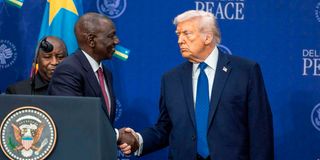
President William Ruto delivers his speech during the historic signing of a peace deal between President Donald Trump, President Félix Tshisekedi of the DRC and President Paul Kagame of Rwanda in Washington DC on December 05, 2025.
Photo credit: Reuters
“The protracted conflicts on our continent continue to hold Africa back. Our current three percent share of global trade is stark evidence of how far we remain from our potential.”
But it wasn’t Pan-African speeches that roped Dr Ruto back. Interviews with diplomats say the President profited from both his stated ambitions as well as the weaknesses in peers to become a relevant player.
A month ago, his relationship with DRC President Felix Tshisekedi was so bad that the Congolese leader reportedly declined proposals for tête-à-tête with the Kenyan President. On the sidelines of a summit in Qatar, whether both leaders were in attendance, a Kenyan diplomat said Nairobi’s request for a meeting with Tshisekedi on November 5 was declined.
“He didn’t want anything to do with us. He didn’t agree to the meeting,” the official told the Daily Nation , requesting to remain anonymous.
Kinshasa had for months protested Kenya’s alleged backing of rebels in eastern Congo, including allowing them to hold meetings in Nairobi. And days before the Qatar Second World Summit for Social Development, former Congolese President Joseph Kabila, now a political enemy of Tshisekedi, had gathered another group of politicians allied to the M23 and the Congo River Alliance (AFC) in Nairobi. It angered Kinshasa more.
For Nairobi, though, there were lots of things at stake if Kenya didn’t play a close role. President Ruto himself dismissed allegations of meddling, stating his country was only offering an environment for discussions about the future of their country.
As it would turn out, however, Qatar itself became pivotal in ensuring Kenya stayed on the team. Doha mediated the peace deal between the M23 and Kinshasa, signed last month on November 15. But Qatar Emir Sheikh Tamim bin Hamad Al Thani was of the view that Congo’s neighbours were crucial to guarantee the deal.
“They host refugees. They do trade with the Congolese. It didn’t make sense to leave anyone out,” the official added.
As such, Mr Trump invited Congo’s East African neighbours: Burundi, Uganda and Kenya. Kenya and Burundi’s heads of state attended in person while Uganda sent Vice-President Jessica Alupo. Tanzania, which has recently run into a diplomatic nightmare over post-election violence, did not show up in Washington.
Officials said Kenya, having tried to mediate between rebels and the government, was needed to provide institutional memory and political support to the pact.
Former Kenyan President Uhuru Kenyatta was invited alongside Olusegun Obasanjo, the former Nigerian President. Both were co-facilitators for the Congo peace process in the merged Nairobi and Luanda peace processes. These processes didn’t succeed per se. However, they had built ground for other mediators to utilise — and officials in Nairobi took credit for it.
“This accord represents a major breakthrough for a region that has endured decades of conflict and human suffering. The Nairobi and Luanda processes have been instrumental in guiding this journey, consistently placing the safety, dignity and rights of civilians at the forefront of negotiations,” said Musalia Mudavadi, the Prime Cabinet Secretary and Foreign and Diaspora Affairs Cabinet Secretary.
Prime Cabinet Secretary and Cabinet Secretary for Foreign and Diaspora Affairs Musalia Mudavadi.
Photo credit: File | Nation Media Group
“This milestone gives the region a genuine chance at lasting stability and a peace that future generations will rely upon.”
Dr Ruto himself said the deal came out of “relentless regional effort”, and even though Washington didn’t bring in African mediators, the Kenyan leader argued there had been linkages between the talks in Qatar, Nairobi and Luanda.
“The coordinated Nairobi, Luanda, and Washington processes created the essential pathway that brings us to this pivotal moment,” Ruto said.
Dr Ruto also profited from problems facing neighbours and he now sees the Congo conflict, just as much as the Sudan war, as critical areas to showcase his diplomatic prowess. Ugandan leader Yoweri Museveni is facing an election and had spent the last year fighting for image in Washington after court decisions to detain the opposition figures.
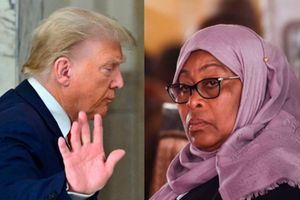
In Tanzania, a police crackdown on protesters has pinned President Samia Suluhu on the wall, with Washington vowing to “review” relations. Burundi, at loggerheads with Rwanda over rebel support, may be too preoccupied with its own peace and security challenges.
In Washington, there were regional dynamics: Angolan President Joao Lourenco, chairman of the African Union, was also present just as AU Commission Chairperson Mahmoud Ali Youssouf. Kenya, holding the chairpersonship of the East African Community, was present to give a local blessing to the peace deal. Not that Mr Trump needed them, especially since he single-handedly policed the DRC into holding talks with M23 rebels, following months of refusing and sentencing its leaders to death for “terrorism” and “treason”.
Yet in joining other leaders in Washington, the opportunity for Dr Ruto was that he could speak into Mr Trump’s own ambitions: tapping into the Congolese minerals. Trump said a peaceful DRC will provide everyone with the opportunity “to make money”.
“We will be involved in sending some of our biggest and greatest companies over to the two countries and we are going to take out some of the rare earths, and some of their assets and pay,” Mr Trump said, referring to the Washington Accords and two bilateral agreements with DRC, and Rwanda.
Dr Ruto said Kenya will take part in ensuring no effort is spared to “ensure this agreement is fully realised, mobilising every resource and partner to secure peace and unlock the region’s immense economic promise.”
And he said Kenyan private sector players too, can invest there to harvest benefits of peace, citing recent examples in Kenya where private players have taken on public-private partnerships.