President William Ruto’s ambitious global agenda is facing headwinds from an increasingly inward-looking Trump Administration.
Once buoyed by a cooperative partnership under President Joe Biden, Kenya now finds itself navigating a diplomatic minefield shaped by unilateralism, skepticism of multilateral institutions, and a transactional approach to foreign relations.
As Ruto pushes for climate leadership, regional security initiatives, and deeper trade ties, Trump’s America-First doctrine has thrown cold water on Nairobi’s aspirations—exposing a widening rift between Kenya’s globalist vision and Washington’s nationalist pivot.
These frustrations recently showed as Ruto toured the US to attend the UN General Assembly in September.
Ruto, has campaigned for restructure of the global lending system led by the World Bank and the International Monetary Fund. He has campaigned for climate change funding and a robust multilateralism for which Trump has little enthusiasm. Trump is also reluctant to shoulder the Haiti burden or even channel Washington’s policy through NATO.
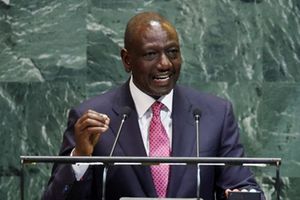
President William Ruto addresses the 80th United Nations General Assembly (UNGA) at the UN headquarters in New York on September 24, 2025.
Photo credit: Reuters
Where Ruto championed multilateralism, Trump preferred unilateralism. Where Ruto sought Kenyan leadership on climate change through the Nairobi Declaration in alignment with the Paris Agreement, Trump dismissed climate change as a hoax and an unnecessary tax on Western economies.
Where Ruto promoted Kenyan leadership in Haiti via the Multinational Security Support Mission (MSS), Trump saw another “forever war” in a strategically peripheral island nation. Where Ruto embraced multinational security alliances and courted Washington by securing Kenya’s designation as a Major Non-NATO Ally (MNNA), Trump openly questioned the value of continued US support for NATO.
Some of these frustrations showed at the UN. At a sidelines event on Haiti and the then Kenya-led Multilateral Security Support (MSS) mission, Ruto thanked the US, but thanked the US but then crossed a diplomatic line:
“I must commend the United States for giving us vehicles. Unfortunately, most of them were second-hand, and they broke down and put our people in grave danger when it happened in hostile areas. We did not get any useful support from any other quarters,” he said, citing these malfunctions to the death of three officers of the 602 Kenya sent there.
For Ruto, the MSS was a political risk he took, having ridden both political and legal challenges at home. He had argued the country was deploying troops to Haiti as part of Kenya’s global responsibility. He banked on donors to come through. But that kitty established at the UN remained empty.
“I must be as candid as possible. I believe the situation can be solved. It is not mission impossible,
“I believe the international community must do right by Haiti. The women and children must do better. What is going on that we cannot marshal support to drive out gangs is unacceptable, indefensible and simply wrong.”
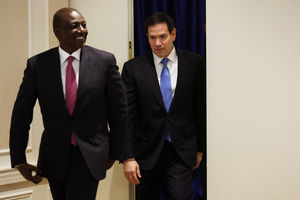
US Secretary of State Marco Rubio and Kenyan President William Ruto arrive before their meeting as part of the 80th session of the United Nations General Assembly, in New York, US, September 24, 2025.
Photo credit: Reuters
Later, while addressing the UN General Assembly, Ruto spoke of Kenya’s commitment to multilateralism; the idea that the world should be under some globally accepted rules and obligations for nations.
“For decades, we have placed our troops and police in harm’s way for peacekeeping missions across Africa and beyond— from Somalia to the Democratic Republic of Congo; from South Sudan to, most recently, Haiti,” he told the audience on September 22.
A few days later, Trump made an indirect jab, telling an audience of military chiefs that it wasn’t US duty to protect Kenya or Somalia, but their American homeland. The deduction from that speech was that Trump was heavily focused on what his homeland needs, not perpetuating traditional support for faraway countries who can’t stand on own feet.
Last week, however, the very US co-authored a resolution to create the Gun Suppression Force (GSF) to replace the MSS. Kenya supported it.
“Having led the MSS and cognisant of the challenges the Mission faced as recently articulated by President William Ruto at the 80th UNGA, and having co-sponsored Resolution 2798 in her capacity as a member of the Standing Group of Partners, Kenya certainly welcomes the transition of the MSS to the GSF,” said Korir Sing’oei, Kenya Foreign Affairs Principal Secretary.
Whether Kenya takes part in the GSF is debatable. But the way the US wants the new force to function will somewhat eclipse Kenya’s credits, were Nairobi to send in troops.
“The United States remains committed to working with international stakeholders to support Haiti’s path toward peace, stability, and democratic governance.
“We call on all nations to join us in this critical effort,” said a statement from the State Department.
Overall, it appears honeymoon phase of Ruto’s foreign policy under the Biden Administration—during which Kenya became a central ally in American foreign policy—has been replaced by a Trump Administration skeptical of Kenya’s sincerity as a Major Non-NATO Ally (MNNA).
President William Ruto with his Chinese counterpart Xi Jinping at the Great Hall of the People in Beijing, China.
Photo credit: PCS
Earlier, Trump confidant, Senator Risch, lambasted Nairobi for cosying up to Beijing. He criticised President Ruto’s remarks at Peking University, where Ruto expressed a desire to co-create a New World Order with China. Ruto’s comments implied a challenge to the post–World War II status quo established by the United States.
Risch questioned how Kenya could claim to be a reliable MNNA while simultaneously undermining the very American hegemonic structure from which it benefits.
Trump’s worldview centers on major power competition. He has identified China as the primary existential threat to US hegemony. Ruto’s close ties with Beijing have therefore become a source of frustration for Washington.
Additionally, Trump’s skepticism of multilateralism has led to funding cuts for the United Nations, the US Agency for International Development (USAID)—which supported numerous development projects abroad—and the gutting of the US Agency for Global Media (USAGM), the parent organisation of Voice of America.
These cuts have reduced US support for previously USAID-funded programmes in Kenya and underfunded the MSS mission in Haiti. Moreover, many Kenyan staff lost their jobs after the Voice of America was closed.
There is also uncertainty surrounding the future of the African Growth and Opportunity Act (AGOA), which allowed Kenyan firms duty-free access to the US. It has come amid delays in signing a Free Trade Agreement between Kenya and the US.
In response, Kenya engaged former Trump ally Carlos Trujillo for a lobbying fee of approximately Ksh271 million to advocate on its behalf before an increasingly unpredictable, US-centric, and introverted American regime.
More recently, the $100,000 (Sh12.9 million)fee for H-1B visas for Kenyans and other foreign nationals seeking employment in the US has undermined the Ruto Administration’s efforts to expand the Kazi Majuu programme.
Kenyans hoping to work in the US now face diminished opportunities, as companies may opt to hire American citizens rather than incur the high cost of sponsoring foreign workers.
Ruto’s frustrations with Trump extend beyond aversion to “forever wars” and multilateral alliances. His violent crackdown on Gen Z demonstrations raised concerns in Washington, particularly among the influential Kenyan diaspora.
Ruto’s engagement with BRICS—a bloc of nations disillusioned by the US’s weaponisation of the dollar-centric international system—has also drawn scrutiny. BRICS seeks to overturn the Bretton Woods system and establish a New World Order free from American hegemony.