The Judicial Service Commission (JSC) has convened a broad stakeholder forum ahead of shortlisting candidates for a vacant Supreme Court seat, placing public participation at the centre of the recruitment process.
The one-day engagement forum, scheduled for Monday, comes after the commission received six applications to fill the position left vacant following the death of Justice Mohamed Ibrahim last December.
The applicants include four serving judges — Joseph Kiplagat Sergon (High Court), and Court of Appeal judges Mohammed Warsame, Katwa Kigen and Francis Kipruto Tuiyott — and two senior advocates, Anne Waceke Kiratu Makori and Lilian Wanjiku Wachira.
JSC Head of Public Affairs and Corporate Communication Sophia Wanuna said the forum will bring together voices from across society to shape expectations on the next Supreme Court judge.
“This is a stakeholder engagement session held before any recruitment of judges. We invite diverse groups to share their perspectives on the process and the qualities expected,” Ms Wanuna told Nation .
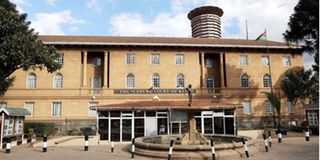
The Supreme Court in Nairobi.
Photo credit: Reuters
She said the session will not focus on individual applicants but on the broader integrity and structure of the recruitment process.
Stakeholders invited include Judiciary leadership, civil society, religious organisations, professional bodies and representatives from academia, trade unions and the private sector.
They range from the Law Society of Kenya and the Federation of Women Lawyers to faith-based organisations such as the Supreme Council of Kenya Muslims, Evangelical Alliance of Kenya, Hindu Council of Kenya and Seventh Day Adventist Church.
Other participants include the Kenya Private Sector Alliance, as well as internal Judiciary groups such as the Kenya Magistrates and Judges Association and judicial staff representatives.
Each group will be given time to outline its expectations, including the kind of Supreme Court judge the country needs and how interviews should be conducted.
“They will submit on what kind of process they want to see, the do’s and don’ts, the questions to be asked the candidates and areas of focus,” Ms Wanuna said.
She emphasised that the session is not a platform to discuss the personalities of applicants, noting that any concerns must be formally lodged with the commission for investigation.
“If there are issues with any applicant, one is required to register a complaint formally and the same is investigated,” she said.
The engagement forms part of the commission’s constitutional obligation to ensure transparency, accountability and public participation in judicial appointments.
Under Chapter Six of the Constitution, State officers must be selected based on integrity, competence and suitability, standards the JSC says guide the vetting process.
The commission conducts reference checks on the candidates, background investigations and consultations with key institutions before interviews.
These include the National Intelligence Service, Kenya Revenue Authority, Higher Education Loans Board, Law Society of Kenya, Directorate of Criminal Investigations, Advocates Complaints Commission and the Ethics and Anti-Corruption Commission.
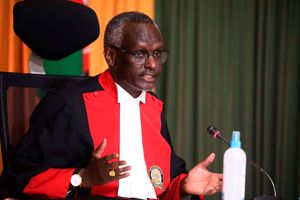
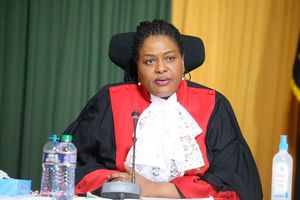
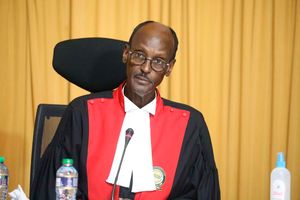
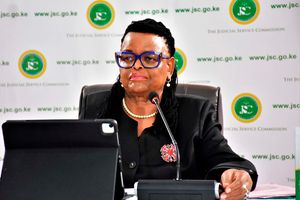
Chief Justice Martha Koome and Judicial Service Commissioners at Supreme Court of Kenya on July 11, 2024.
Photo credit: Evans Habil | Nation Media Group
The JSC also invites members of the public to submit memoranda or complaints on candidates, which are treated as a continuous process.
“Once a complaint is received, the applicants are informed so that they can respond. Previously we have had candidates dropping out ahead of interviews because of the complaints raised against them,” Ms Wanuna said.
After the stakeholder forum, the commission will proceed to shortlist candidates and announce interview dates.
The recruitment has drawn attention due to the Supreme Court’s central role in determining presidential election disputes and constitutional questions.
The six applicants bring a blend of long-serving judicial experience and distinguished legal practice, spanning the High Court, Court of Appeal and senior advocacy.
Justice Joseph Kiplagat Sergon has served as a High Court judge since 2002, while Justice Mohammed Warsame has handled major constitutional and commercial disputes at both the High Court and Court of Appeal and previously served on the JSC.
He joined Judiciary in 2003 as a High Court judge before his elevation to the Court of Appeal in 2012. Justice Katwa Kigen joined the Court of Appeal in 2026 after private practice including representing President William Ruto at the ICC.
Justice Francis Tuiyott joined the Judiciary in 2011 when he was appointed a High Court judge, serving in the Commercial and Tax Division before his elevation to the Court of Appeal in 2021. Previously he served as chairman of Sugar Arbitration Tribunal between 2010 and 2011.
Ms Anne Waceke Kiratu Makori, a former IPOA chair, and Lilian Wanjiku Wachira bring extensive experience in public service, litigation and corporate governance.
The appointment will restore the apex court to its full bench as the country prepares for the 2027 General Election.
Separately, the JSC will on Tuesday begin interviews for 50 shortlisted candidates seeking appointment as Environment and Land Court judges.
The candidates are competing for 10 vacancies, with the exercise expected to conclude on April 9, 2026.
The commission said the ongoing recruitment drives are part of broader efforts to strengthen the administration of justice and enhance public confidence in the Judiciary.