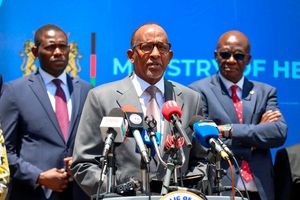
The Judiciary has approved an Election Dispute Resolution curriculum for judges and magistrates as part of preparations to handle electoral disputes that may arise from the 2027 General Election.
The curriculum is expected to guide training and capacity-building for judges, judicial officers and relevant Judiciary staff ahead of the electoral cycle.
The move is part of wider reforms in the Judiciary targeting case delays, judicial performance, accountability, the fight against corruption and public confidence in the administration of justice.
Election Dispute Resolution (EDR) curriculum covers the judicial handling of disputes arising from elections. The Judiciary’s preparations include training, operational planning and tools for managing electoral cases within strict legal timelines.
The scale of the Judiciary’s preparations is underscored by the previous two elections. In 2022, the Judiciary handled 219 election petitions, including nine presidential petitions, 12 challenging governors, two senators, four women representatives, 28 National Assembly seats, 77 MCAs and 87 party-list cases.
That was a decline from 388 petitions filed after the 2017 elections, comprising 35 for governorship, 15 senatorial, 12 women representatives, 98 National Assembly, 139 MCA and 89 party-list petitions.
According to a joint communiqué issued on Friday by the Judicial Service Commission (JSC) and Judiciary Leadership Team (JLT) after their deliberations, the Judiciary approved the curriculum to guide training and capacity-building ahead of the General Election.
"The JLT discussed the Judiciary’s preparedness for Election Dispute Resolution (EDR) and approved the EDR curriculum to guide the training and capacity-building of Judges, Judicial Officers and relevant staff ahead of the electoral cycle," says the communique released by Chief Registrar Winfridah Mokaya. She is also JSC and JLT secretary.
The EDR programme covers electoral disputes and offences, scrutiny of election materials and preparation of related reports, with the Judiciary previously developing a Bench Book and electronic filing system for such cases.
The communiqué does not specify the curriculum’s detailed contents, the number of judges or staff to be trained, or the timetable for the training.
The curriculum sits within a wider programme covering judicial preparation, court management, accountability, public communication and infrastructure.
The JSC and JLT said they were responding to concerns raised by court users, advocates and the wider public about delayed judgments and rulings, judicial and staff performance, registry services, responsiveness and transparency. Other concerns touched on professional integrity, complaints handling and transparency.
Both JSC and JLT agreed on a broad package of reforms to strengthen judicial accountability, tackle case delays and backlog, improve integrity and complaints handling, and rebuild public confidence in the justice system.
The preparation comes alongside a plan to improve how courts manage cases and monitor the performance of judicial officers. The communique says Heads of courts and stations will take greater responsibility for their institutions.
They will be expected to act on case backlogs, delayed judgments and rulings, absenteeism, underperformance, misconduct and registry problems.
“Performance, integrity and backlog management will be regularly reviewed at leadership and court-management levels to ensure that emerging concerns are identified and addressed early,” the communiqué says.
The institutions also agreed to strengthen active case management through measurable and time-bound measures aimed at reducing delays and backlog.
They will rely more on performance dashboards, court data and technology-enabled monitoring to identify delays. Staffing and workload decisions will increasingly use data to determine where judicial resources are most needed.
The reforms also affect how individual judges’ performance will be reported. The JSC and Judiciary said information released to the public must be accurate, verified and reflect work actually undertaken.
They will review existing criteria to account for multi-judge benches, shared judicial work, case complexity and other responsibilities. Individual performance information will be published after the underlying data and methodology have been sufficiently verified.
The reforms come as the Judiciary faces renewed scrutiny over complaints and performance. The Law Society of Kenya staged a nationwide court boycott on July 22, 2026, citing delays, registry inefficiencies and concerns over judicial accountability. It then targeted specified judges and judicial officers in an indefinite boycott.
The JSC also says it engaged Parliament’s Committee on Delegated Legislation on May 14 over regulations intended to establish a clear and fair framework for complaints against judges and judicial officers.
"The Commission will follow up with the Committee on the finalization of the Regulations, which are intended to establish a clear, predictable and procedurally fair framework for the handling of complaints concerning Judges and Judicial Officers, thereby strengthening accountability, transparency and public confidence in the complaints-handling process," says the statement.
The institutions also reaffirmed zero tolerance for corruption and misconduct. They will review integrity structures to clarify mandates, remove duplication and improve coordination, follow-up and reporting.
The Judiciary says it will give greater attention to misconduct involving registry and frontline staff because their dealings with court users affect confidence in the justice system.
It also promises better communication with litigants, advocates and members of the public. Court leaders and relevant offices will be expected to improve responses to letters, complaints, enquiries and representations.
“At the same time, judicial independence cannot be invoked to shield corruption, misconduct, incompetence or other conduct inconsistent with the Constitution and the judicial oath,” the communiqué says.
The JSC and JLT also approved an Infrastructure Masterplan covering court construction, rehabilitation, maintenance, ICT, digital infrastructure, alternative and green energy, and model constituency courts.
They said success would be measured through faster justice, reduced backlog, stronger integrity, credible performance reporting, better responsiveness, greater transparency and increased public confidence.