President William Ruto’s administration faces a fresh constitutional dispute after the High Court ruled that Kenya’s next presidential election was due on August 11, 2026, but suspended the decision to avoid disruption.
Justice Mugure Thande said Article 136(2)(a) requires a presidential election on the second Tuesday of August in the fifth year after the previous election. She suspended the declaration until after the next General Election, citing logistical challenges and the risk of instability.
Justice Mugure Thande.
Photo credit: File | Nation Media Group
The ruling has triggered debate over President Ruto’s mandate and presidential powers after August 11. Advocate Willis Otieno, who represented the petitioners, argued that the President would thereafter serve under temporary incumbency provisions until a successor is elected.
“They only serve until the next election date. Then the President becomes a temporary incumbent,” he said.
Mr Otieno said the court had not extended the President’s term but only allowed the Independent Electoral and Boundaries Commission (IEBC) time to prepare for an election.
Under Article 134, a president under temporary incumbency restrictions cannot make certain appointments, including judges, Cabinet secretaries, senior State officers and diplomats, or exercise powers such as granting mercy and conferring national honours.
IEBC said it would study the judgment before deciding its next steps. Commission chairperson Erastus Ethekon said the ruling offered guidance but declined to speculate on elections before August 2027 or the President’s status after August 11.
“Let us not overthink,” he said, adding that the commission would follow the law. Attorney-General Dorcas Oduor said there was no immediate cause for concern, citing the court’s suspension of the declaration until after the next General Election.
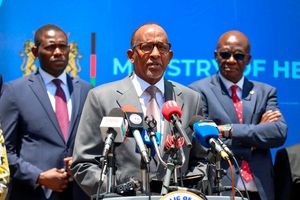
The Independent Electoral and Boundaries Commission (IEBC) Chairperson Erastus Edung Ethekon briefs the media on April 30, 2026, on the completion of the Enhanced Continuous Voter Registration (ECVR).
Photo credit: Francis Nderitu| Nation Media Group
“A declaration of invalidity of the (next) election is suspended until after the next General Election is held to allow the IEBC to correct the defect,” she said.
Law Society of Kenya President Charles Kanjama criticised the judgment, saying it misinterpreted the Constitution and should be challenged on appeal.
He argued that temporary incumbency under Article 134 begins on the date of the presidential election, not before. Advocate Peter Wanyama also disagreed, saying the President’s term runs from August 2022 to August 2027.
Law Society of Kenya (LSK) President Charles Kanjama.
Photo credit: Bonface Bogita | Nation Media Group
The competing views are expected to shape an appeal over presidential tenure and election timelines. Ford Asili Party welcomed the ruling and urged IEBC to hold elections within 90 days.
Its Secretary-General Njeru Kathangu described the judgment as ending what he called “16 years of constitutional misinterpretation” — a political claim, not a court finding. Safina Party leader Jimi Wanjigi argued that presidential powers would be limited after August 11 under temporary incumbency provisions.
However, the High Court did not order an immediate election, citing logistical challenges and advanced preparations for the 2027 poll.
The ruling is expected to be tested on appeal, with the petitioners arguing that constitutional election dates, rather than inauguration anniversaries, determine presidential tenure.