The Judiciary wants Parliament to amend the Constitution to peg its budgetary allocation to at least 3.5 percent or Sh56 billion and address tension between the arms of government on judicial appointments.
The Judicial Service Commission (JSC) told the National Assembly’s Constitutional Oversight Implementation Committee (COIC) that the changes should also result in full operationalisation of the Judiciary Fund by ensuring direct transfers of the annual budget from the Consolidated Fund.
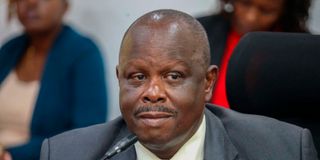
The commission vice chairperson, Issac Ruto, and commissioner Fatuma Sichale said the proposed constitutional changes should include the JSC as a direct beneficiary of the Judiciary Fund established under Article 173 of the Constitution.
Lady Justice Fatuma Sichale, a commissioner of the Judicial Service Commission, appears before the National Assembly Constitutional Implementation Oversight Committee at Bunge Tower, Nairobi, on Thursday, July 17, 2025.
Photo credit: Dennis Onsongo| Nation Media Group
“The Judicial Service Commission faces chronic underfunding, limiting its ability to discharge constitutional mandates,” Winfridah Mokaya, the JSC secretary and the Judiciary Chief Registrar, said.
“The Judiciary's current budgetary allocation is less than one percent of the national budget, which is insufficient for infrastructure development in over 140 court stations, recruitment of judges, and support staff, and technology adoption for e-justice systems.”
The JSC appeared before the COIC, chaired by Tiaty MP William Kamket, to present a report on the extent of the JSC's discharge of its constitutional mandate pursuant to Article 171 of the Constitution.
The JSC told lawmakers that it requires an annual budget of Sh45 billion, but the Treasury has continued to allocate it half, or Sh22.7 billion, in the past three financial years.
“We appeal to this House to peg the Judiciary and JSC budget to at least 3.5 percent of the national budget through constitutional or statutory amendment,” Ms Mokaya, who presented the JSC report, said.
Ms Mokaya said there have been occasions of delay or refusal by the Executive to appoint judges recommended by the JSC.
The JSC said persistent attacks on Judges on decisions made undermine constitutional expectations and strain inter-arm relations.
The commission warned that the tensions between the arms of government signals possible encroachment on judicial independence protected under Articles 160 and 172 of the Constitution.
“The impact of the tensions between arms of government affects public perception of politicisation of the bench,” Ms Mokaya said.
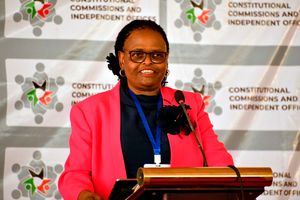
The Judiciary Chief Registrar Winfridah Boyani Mokaya appears before the National Assembly Constitutional Implementation Oversight Committee at Bunge Tower, Nairobi, on Thursday, July 17, 2025.
Photo credit: Dennis Onsongo| Nation Media Group
“There is a need for respect by each arm of its mandate and powers and constant engagement to reduce tensions.”
Ms Mokaya asked MPs to amend the law to eradicate the duplication of structures for the administration of the Judiciary Fund, where the Controller of Budget comes in to determine access to the funds is an affront to the independence of the Judiciary.
The JSC said the Judiciary has huge pending case backlogs, which currently stand at 257,000, which are mostly civil.
“Increased number of judges, if recruited, will reduce the number of case backlogs that we have at the Judiciary,” Ms Mokaya said.
The commission told MPs that the Judiciary currently has 202 judges, unlike 53 when the Constitution was promulgated in 2010.
Ms Mokaya said there are seven judges at the Supreme Court, 28 at the Court of Appeal, 95 at the High Court, 52 at the Environment and Land Court and 21 at the Employment and Labour Relations Court.
“We are in the process of recruiting an additional 15 Court of Appeal Judges, 20 High Court Judges and 10 Environment and Land Court Judges,” the JSC said in its report to MPs.
The commission asked MPs to amend Article 162 of the Constitution to allow cross-deployment among High Courts and courts of equal status.
The JSC said judges in specialised courts such as the Employment and Labour Relations Court (ELRC) and the Environment and Land Court (ELC) cannot be cross-deployed to the High Court or other divisions, creating inefficiencies and limiting career development.
“We require about Sh45 billion to enable us clear all pending projects. Without this allocation, it is impossible for us as JSC to implement them,” Mr Ruto said.
“Let us have a robust debate on the percentage of the shareable revenue to the Judiciary. The one percent stipulated in the Constitution is not enough.”