The Kenya African National Union (Kanu) party has escalated its long-running legal battle to stop the auction of its Nakuru property after the Court of Appeal allowed it to file a late appeal challenging a 2023 High Court ruling.
The appellate court in Nairobi extended time, effectively reviving Kanu’s challenge against the planned sale of land to recover a Sh212.8 million electricity debt owed to the State’s Kenya Power and Lighting Company (KPLC).
The dispute centres on a property known as Nakuru Municipality Block 9/31, a parcel registered in the name of Kanu’s Nakuru branch, located in Nakuru town and long linked to the party’s regional operations.
The court ruled that although Kanu’s delay in serving the notice of appeal was lengthy, it was excusable and should not defeat substantive justice.
“The omission was inadvertent and not deliberate,” the single-judge bench said, adding that the appeal “raises substantive questions warranting determination on merit.”
The court further found that striking out the appeal would deny Kanu a hearing, noting that “procedural lapses should not defeat substantive justice where no prejudice is occasioned.”
The ruling means Kanu’s appeal dated December 10, 2024 is now deemed properly on record, clearing the way for a full hearing of its challenge against the auction.
The case arises from a protracted dispute dating back to 2004, when Kenya Power sued Kanu for unpaid electricity bills. This was two years after Kanu was ousted from political power through the 2002 General Election. In 2009, the High Court entered judgment against the party for Sh212.8 million.
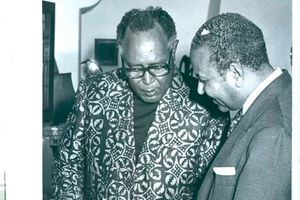
Former President Daniel Moi hands over to his successor Mwai Kibaki in 2002.
Photo credit: File
That judgment triggered a long chain of execution proceedings, objections, appeals and stays spanning more than 15 years.
In a separate 2009 decision, the High Court dismissed an earlier suit related to the dispute on grounds that it was time-barred, shaping subsequent litigation over enforcement timelines.
Over the years, Kanu and its officials repeatedly challenged efforts to attach and sell the property, arguing that the land belonged to the party’s branch and should not be used to settle liabilities of the national body.
However, courts consistently rejected that argument. In a 2016 ruling, the High Court held that Kanu, as a registered political party, is a corporate entity whose assets include those held by its branches.
“A branch of a political party is not a separate and distinct legal entity from the mother party unless there is a legal instrument or legal provision separating them,” the court ruled, affirming that the Nakuru property could be attached to satisfy the debt.
Execution efforts intensified in the following years. Kenya Power obtained orders for attachment, and auction processes were initiated multiple times, often stalled by fresh applications from Kanu.
The independence party is also embroiled in separate legal disputes over ownership and control of several properties, including battles over party assets in Nairobi, Nanyuki and Nakuru, as well as internal wrangles over management of branch properties.
The disputes extend to past litigation involving its headquarters and other registered assets, reflecting a broader pattern of contested control following its exit from power.
In June 2022, auctioneers moved to sell the Nakuru property after advertising the sale in the press, but the process was again halted by court applications.
In the November 2023 ruling now under appeal, the High Court declined to stop the auction, finding that Kenya Power had initiated execution within the legally permitted 12-year window from the 2009 judgment.
The court held that the execution process was valid and not time-barred, although it ruled that interest accruing after six years could not be recovered.
That decision effectively cleared the way for the sale of the property, prompting Kanu to lodge an appeal.
However, the party failed to serve its notice of appeal within the required seven days, exposing the case to dismissal on procedural grounds.
Kanu attributed the delay to the relocation of its advocates’ offices, misplacement of files and closure during the December holidays. Its officials, George Wainaina and Kennedy Kigen, said the omission was inadvertent and not deliberate.
The Court of Appeal accepted that explanation, noting that Kenya Power had prior knowledge of the intended appeal and would suffer no prejudice if time was extended.
“The respondent was aware of the notice of appeal and therefore no demonstrable prejudice will be occasioned,” the court said.
The appellate court also emphasised that the appeal is not frivolous, pointing to arguments raised by Kanu on alleged irregularities in the auction process and the High Court’s exercise of discretion. In the appeal, the former ruling party will be seeking to overturn the 2023 decision and block the auction.
The outcome will determine whether Kenya Power can finally recover the over two-decade-old debt through sale of the land or whether Kanu can retain the asset after years of litigation.