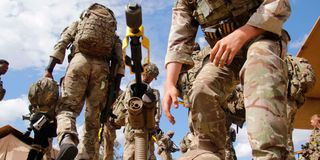
Kenya has delayed ratifying a defence cooperation agreement signed with Britain in 2021 as a dispute over legal jurisdiction and accountability for British soldiers threatens to strain decades of military cooperation between the two countries.
At the heart of the standoff is Britain's push to retain primary jurisdiction over its troops deployed in Kenya, even in cases involving serious offences committed while on official duty.Kenya, however, is demanding the right to prosecute British soldiers in Kenyan courts for crimes committed on its territory.
The disagreement has been fuelled by unresolved high-profile cases, including the murder of Agnes Wanjiru, allegedly by a British soldier, which has intensified public pressure on Parliament to strengthen legal safeguards before approving the pact.
While Britain wants the agreement ratified in its current form, Kenyan lawmakers insist it must be amended to guarantee greater accountability for visiting troops.
Defence Cabinet Secretary Soipan Tuya did not respond to questions sent to her known mobile number on when the agreement is expected to be ratified.
The deadlock over the agreement, which underpins counter-terrorism cooperation and the continued presence of the British Army Training Unit Kenya (Batuk), has now reached the highest levels of government in both countries.
The agreement, approved by Kenya's Cabinet in 2021 and subsequently forwarded to Parliament, was intended to replace the previous defence cooperation agreement signed in 2015, which expired on October 6, 2021.
Five years later, however, the treaty remains unratified because of concerns over provisions that appear to shield British soldiers from prosecution in Kenya, including for alleged human rights violations.
The amount Britain pays Kenya for the use of military training facilities has also emerged as a point of contention.
Belgut MP Nelson Koech, who chairs the National Assembly's Defence, Intelligence and Foreign Relations Committee, said the agreement remains under consideration because Parliament identified key issues that must be resolved before ratification.
“The Kenyan and UK governments are actively engaging to address these outstanding issues,” Mr Koech said.
He added that consultations held on June 10, 2026, reaffirmed both countries' commitment to expedite implementation of the agreement once the outstanding concerns are addressed.
In a report tabled before the National Assembly in 2023, the Koech-led committee recommended approval of the agreement, but only after amendments were made to key provisions it said conflict with the Constitution.
Under Article 6(5), lawmakers want murder expressly included among offences that fall under the jurisdiction of Kenyan courts.
As currently drafted, the agreement excludes certain serious offences from the definition of “official duty”, giving Kenya primary jurisdiction over those cases. However, murder is omitted from that list, leaving room for Britain to claim jurisdiction over such cases — a loophole Kenyan lawmakers want closed.
The committee also wants Article 23 amended to require Batuk to undertake mandatory corporate social responsibility (CSR) programmes in communities where it operates.
Although the article requires visiting British troops to respect local customs, compensate for damage and address sexual exploitation, it contains no obligation for structured community investment.
“In addition to recommending ratification, the committee called for stronger accountability measures, including jurisdiction over serious offences, enhanced protection of local communities and implementation of recommendations arising from the Batuk inquiry,” Mr Koech said.
Following his meeting with Prime Minister Starmer during the G7 Summit in Evian-les-Bains, France, on June 17, 2026, President Ruto reiterated Kenya's commitment to concluding the agreement.
“The Kenya-UK defence cooperation agreement has delivered significant benefits. We remain committed to its timely implementation,” President Ruto said.
He added that the agreement would strengthen trade, investment and job creation while advancing shared goals in climate action, information and communication technology, regional peace and security.
The tougher stance adopted by Parliament reflects longstanding concerns over alleged abuses linked to British military activities in Kenya.
Among the cases that have shaped public opinion is the killing of Agnes Wanjiru in Nanyuki, a case that remains unresolved and has become a symbol of demands for greater accountability.
A memorandum submitted by the Laikipia County Government to Parliament highlighted allegations of deaths, injuries and other harm linked to Batuk's activities in the county, while also noting that affected communities had received little or no compensation.
Although the memorandum was submitted after the public participation deadline, the committee considered its concerns and noted that the issues were being addressed jointly by the national government and Batuk.
Nevertheless, lawmakers concluded that the current wording of Article 6(5) leaves room for cases similar to that of Agnes Wanjiru to recur because murder is not explicitly listed among offences triable by Kenyan courts.
Similarly, while Article 23 requires visiting forces to respect local traditions and culture, the committee found that it falls short by failing to require Batuk to undertake corporate social responsibility initiatives.
The Kenya Defence Forces and the United Kingdom's armed forces have maintained a longstanding defence partnership focused on military training, defence cooperation and the exchange of personnel through military institutions.
Separetly, the British government has pledged to fully investigate allegations of human rights abuses and environmental damage linked to British troops training in Kenya, as scrutiny over the activities of the British Army Training Unit Kenya (BATUK) intensifies.
British High Commissioner to Kenya Matt Baugh acknowledged that some incidents involving British soldiers had resulted in deaths and environmental damage, saying the UK was committed to ensuring accountability.
“Some have lost their lives, the environment has been damaged and the standards have not been as high as we wanted them to have been historically. We therefore take every event and action seriously,” Mr Baugh said. He said Britain remained committed to working closely with the Kenyan government and local communities to investigate the allegations and address longstanding concerns surrounding BATUK's operations.
His remarks in Nanyuki town come amid renewed scrutiny of British military activities in Laikipia and Samburu counties, where residents have for years complained of alleged human rights violations, environmental degradation and the presence of unexploded ordnance left behind after military exercises.
The comments also come as Kenya and the United Kingdom continue negotiations over a new Defence Cooperation Agreement, with Parliament pushing for stronger accountability measures, including greater jurisdiction over British soldiers accused of committing offences in Kenya.