Kenya’s push to secure Judge Phoebe Okowa’s re-election to the International Court of Justice faces a diplomatic test on November 3 , when the UN General Assembly and Security Council vote in New York.
Nairobi officials cast Okowa’s return as evidence of Kenya’s ability to defend a rules-based international order, rather than an expectation that she would serve national interests on the bench.
Judges on the bench of the International Court of Justice must always come from member states of the UN, and candidates must be nominated by a member state. Yet they are also allowed to sit on benches hearing cases involving their home countries.
It is a unique tribunal, created by the UN, to hear suits between states. It should not be confused with the International Criminal Court (ICC), which is a non-UN body created to hear cases of individual crimes.
On November 3, the UN is set to elect five judges to the ICJ’s 15-member bench. Okowa had been serving the remainder of the term of Somali judge Abdulqawi Ahmed Yusuf, who had resigned. She is seeking election to a full nine-year term.
To be elected to the International Court of Justice (ICJ), a candidate must obtain an absolute majority in both the UN General Assembly and the UN Security Council.
Both organs vote separately but at the same time. Unlike elections for the UN Secretary-General, elections for ICJ judges are not subject to a Security Council veto, although it is possible for one person to win in the Assembly and fail in the Council.
For Kenya, the initial contest is how to galvanise an African vote. Okowa’s seat is seen as representing the African Group, which has so far produced two candidates. Africa’s other contender is Charles Chernor Jalloh of Sierra Leone.
Last time out, Prof Okowa defeated Jallow after the vote went into four rounds. A divided African vote often makes it harder for an African nominee to secure the required majorities in New York.
“Our submissions urged the members of the UN present to reflect on the kind of Court our international community needs,” said Korir Sing’oei, Kenya’s Principal Secretary for Foreign Affairs, at the end of campaigns in New York on Wednesday.
“The principles that must guide its composition; and the qualities required of those entrusted with interpreting and applying international law at this consequential moment in our shared history. Prof Okowa answers these demanding standards admirably and we commended her candidature to all.”
Kenya says it is defending multilateralism, international cooperation and respect for international law, which have been at the centre of its foreign policy.
The race, overall, has 10 candidates seeking to fill seats held by Kenya, France, India, Brazil and Jordan. Kenya is eligible for re-election because Okowa only served the remaining term of the Somali judge.
Kenya has used its consistent participation in regional peace and security efforts, its defence of its role in those efforts and its participation in the United Nations, the African Union and other international institutions to defend a rules-based international order.
But Nairobi had to launch Okowa’s campaign just as soon as she won the seat in November 2025. Her current tenure runs until 2027. If she wins, it will mean she stays on the bench until 2036.
Prof Okowa’s presence on the ICJ bench, Kenya argues, reflects decades of service to international law as a scholar, practitioner and adviser to states.
Prof Okowa is a distinguished Kenyan international lawyer and jurist whose career spans academia, legal practice and global judicial service.
She previously made history as the first African woman to serve on the International Law Commission, where she played a key role in the development and codification of international legal norms. Her work has been consulted by governments, international organisations and legal practitioners across the globe.
With more than three decades of university teaching, Prof Okowa has trained generations of lawyers too. She has also served as counsel before the ICJ.
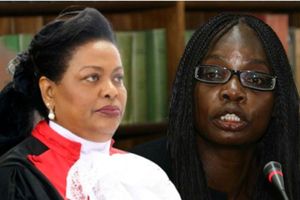
Justice Njoki Ndung'u is seeking election to the International Criminal Court (ICC) for the 2027–2036 term.
“Together, these candidacies reflect Kenya's continued commitment to a rules-based multilateral system, sustained investment in international judicial service and its ambition to contribute to the institutions that interpret, apply and develop international law,” said Tom Amolo, former Political and Diplomatic Secretary in the Ministry of Foreign and Diaspora Affairs, now heading Kenya's ICC Candidature Secretariat.
He said the two candidacies reflect Kenya's sustained investment in international judicial service and its ambition to contribute to the institutions that interpret, apply and develop international law.
The ICC, which is not a UN organ, addresses individual criminal responsibility for the gravest international crimes under the Rome Statute. Both courts are important to the international legal order, and both depend on the independence, competence and integrity of their judges.
The ICC, though, has faced sanctions and scrutiny from the US after it started looking into crimes in Gaza and in Afghanistan. In the past, the ICC was also criticised in Africa, including Kenya, for targeting political leaders. Cases in Kenya mostly collapsed.
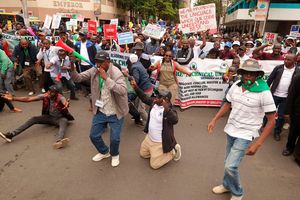
Most recently, Nairobi rejected calls by opposition and civil society groups to have the International Criminal Court (ICC) investigate the political goonism crisis in the country. Kenya said the Court has an important role to play, but not where local authorities can handle a problem.
“This reflects the established practice of States presenting qualified nationals for service across different international institutions, each with its own mandate and election process. Kenya's parallel candidacies are best understood within this wider tradition of multilateral engagement,” Amolo said.
For the ICC, the immediate question is the kind of judicial leadership required at this stage in its history.
Diplomatic conversations in New York and The Hague suggest that States Parties are paying close attention to the professional experience, independence and personal qualities of the candidates, alongside the regional considerations that traditionally shape international elections.
Kenya believes that Judge Ndung'u's candidature speaks directly to these considerations. The Court's present challenges have brought the qualities of individual judges into sharper focus. The ICC’s vote will come in February, still in New York, where the Assembly of States Parties will gather.
“Her candidature therefore represents a meaningful intersection of Kenya's judicial diplomacy and its longstanding commitment to multilateralism: the contribution of experienced and independent jurists to institutions whose strength ultimately rests on their ability to uphold the law, deliver justice and command public confidence,” Mr Amolo said.
Phoebe N. Okowa (Kenya) Charles Chernor Jalloh (Sierra Leone) Dapo Akande (United Kingdom) François Alabrune (France) Taoheed Olufemi Elias (Nigeria) Mahmoud Daifallah Hmoud (Jordan) Luz del Carmen Ibáñez Carranza (Peru) Rena Lee (Singapore) Paik Jin-Hyun (Republic of Korea) Marcelo Vázquez-Bermúdez (Ecuador)