Despite the government citing falling food prices, more registered farmers, and better access to fertiliser as signs of food security, a new Food and Agriculture Organisation (FAO) and World Food Programme (WFP) assessment warns that Kenya faces a worsening hunger crisis, highlighting growing risks from climate, conflict, and economic pressures.
This is according to the Hunger Hotspots: Early Warnings on Acute Food Insecurity outlook, November 2025 to May 2026, where Kenya has re-emerged as a hunger hotspot for the first time since 2024.
The situation, the report establishes, is driven by poor rainfall forecasts, high food prices, intensifying conflict over scarce resources, and shrinking humanitarian funding—factors that could leave millions dangerously exposed.
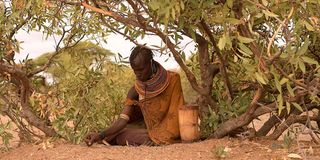
Pastoralist communities in Turkana and Garissa are losing livelihoods as rains vanish and temperatures rise.
Photo credit: File | Nation Media Group
The report uses an IPC classification ranging from Phase One, food secure, to Phase Five, catastrophe or famine. Phase 3 marks the point where households face serious food gaps and begin selling productive assets or skipping meals. Phase 4 indicates severe shortages that heighten the risk of malnutrition and death.
Kenya’s rising numbers in Phases 3 and 4 therefore signal a structural deterioration rather than a short-term hardship. The survey indicates that Kenya is delicately balancing between IPC Phase 3 and 5, a reality that will see millions dangerously exposed.
“Kenya is expected to see an increase in the number of people facing heightened food insecurity, with two million projected to be acutely food insecure at IPC Phase 3 or above in late 2024, a two percent increase compared to the same period the previous year,” the report states.
This new reality contrasts directly with President William Ruto’s recent projections that the country is food secure and that the State has managed to stabilise the food economy.
Praising farmers in Nakuru in late October 2025, he said reforms were important and that government interventions were beginning to ease pressure on households.
“You are excellent farmers and have produced a lot of food. Some people were protesting, covering their heads with sufurias , but have since stopped because we have reduced the fertiliser prices, seeds, and are ensuring that our farmers are helping us produce food and get rid of hunger in our country,” he said.
However, the WFP-FAO report has established that from November 2025 to May 2026, Kenya will face a decline in food security.
“About 160,000 people, predominantly located in the eastern Horn region, Nairobi, and parts of the Rift Valley, are expected to be in Emergency, IPC Phase 4,” the assessment shows.
Malnutrition rates are climbing, with 742,000 children under five projected to be acutely malnourished between April 2025 and March 2026, including 179,000 suffering severe acute malnutrition. More than 109,000 pregnant and breastfeeding mothers also require nutritional support, representing a 22 per cent increase in the highly food-insecure population.
At the centre of the crisis is the likelihood of another poor rainy season. Climate models indicate an elevated probability of below-average short rains between October and December 2025, especially across eastern Kenya. These rains are crucial for pastoral and marginal agricultural counties, including Turkana, Marsabit, Wajir, Isiolo, Garissa, Makueni, Kitui, and Tana River, which rely heavily on the season for grazing, water, and crop performance.
In Kitui South, Makueni East, and Tharaka North, crop failures reached between 80 and 100 per cent, leaving households with little to no harvest. Satellite data from late August 2025 shows declining vegetation cover across eastern Kenya, signalling poor pasture regeneration and declining livestock productivity.
Weaker livestock will limit pastoral income at a time when competition for grazing areas is intensifying.
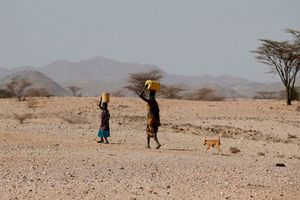
A gilrl pushes a jerrican of water at Lowareng’ak village in Turkana County on October 12, 2022 amid a biting drought.
Photo credit: EVANS HABIL | NATION MEDIA GROUP
National maize prices were 15 per cent higher in June 2025 than a year earlier, driven by reduced output and market uncertainty. Another failed season, FAO and WFP caution, will constrain supplies further, likely triggering new price spikes. For households that rely heavily on markets, particularly in arid counties, even small price increases severely restrict access to food.
Beyond climate shocks and economic pressures, Kenya is confronting growing conflict linked to scarce natural resources. Pastoralist communities in the north and northeast face rising tensions over water, grazing corridors, and migration routes.
A woman at the Kishenyi dam in Wundanyi, Taita Taveta County. Taita Taveta is reeling from the effects of changing weather patterns that have led to the drying up of two major dams that humans and livestock depend on.
Photo credit: File I Nation Media Group
Clan disputes, banditry, and cross-border incursions continue to disrupt livelihoods. Human-wildlife conflict in Laikipia, Samburu, and Taita Taveta further limits access to farmland and pasture. Combined, these pressures increase the risk of violence and displacement, both of which undermine food security.