The United States is pushing for tough new sanctions aimed at stopping Russian agents from recruiting Kenyans and other Africans to fight in the Ukraine war.
Bipartisan legislation before Congress imposes sanctions on “foreign persons and foreign governments participating in or facilitating the recruitment of foreign nationals from African countries for the purpose of fighting in the war in Ukraine”.
Sponsored by representatives Joe Wilson, a senior member of the House Committee on Foreign Affairs (Subcommittee on Europe) from South Carolina, and Jonathan Jackson, a member of the House Committee on Foreign Affairs (Subcommittee on Africa) from Illinois, the bill targets recruiters luring desperate individuals with false lucrative job offers and government officials profiteering from the recruitment rackets. Mr Wilson is a longtime ally of President Donald Trump.
According to the sponsors of the bill, Russia's invasion of Ukraine has occasioned a protracted war and strained its military, leading to the “deceptive and coerced recruitment of Africans”.
They say the abduction and forced recruitment of African nationals to support the Russian war machine in Ukraine constitutes human rights violations.
“It is unacceptable that some African government officials have knowingly participated in or benefited from these recruitment operations at the expense of their citizens,” said the two.
According to the bill, Kenya’s Foreign ministry has described as ruthless the Kremlin-linked recruiters tricking young men to join the war with false job promises. The agents masquerade as working with the Russian government and use unscrupulous methods, including falsified information, to lure innocent Kenyans onto the .
Former Kenyan athlete Evans Kibet.
Photo credit: Pool
On arrival in Russia, he was told to sign work papers in Russian, and that if he did not sign, he would be killed. He was then sent to a military camp.
The congressmen also state that Kenya arrested a Russian Embassy employee in Nairobi, and a Kenyan accomplice, accused of recruiting local men as mercenaries to fight for Russia. This was after a group of more than 20 Kenyan men – promised jobs in Russia but were set to be sent to fight in Ukraine – were rescued from a suspected human trafficking ring following a raid on a residential complex in Nairobi.
Foreign Affairs Principal Secretary Korir Sing’oei.
Photo credit: File | Nation media Group
Foreign Affairs Principal Secretary Korir Sing’oei told the Nation that Kenya is not aware of the bill, but the government would welcome any legislative effort that would stave off the unlawful recruitment of Africans to the Ukraine conflict.
“We have made it clear as a government that the recruitment is an illegality that will not be permissible under our laws, and I think you are aware that a Russian who was involved in this (recruitment) was thrown out of the country,” Mr Sing’oei said.
Asked whether such unlawful enlisting of Kenyans was still going on covertly, the PS said he could not say with certainty that the recruitment had stopped, but added that the Kenyan government would not allow the illegality to continue. “I have no information on whether it is going on below the radar, but we have sent out a clear signal that this is unacceptable. The Prime Cabinet Secretary was in Moscow to secure the support of the Russian government with respect to ensuring there was no facilitative effort given to this activity.”
According to the congressmen, African women are lured through a recruitment scheme targeting those aged 18–22, with the promise of professional training in logistics, catering, and hospitality. However, the women end up being subjected to hazardous factory conditions and used to build drones, with estimates pointing to more than 1,000 women having been recruited from Africa to work in Alabuga’s weapons factories.
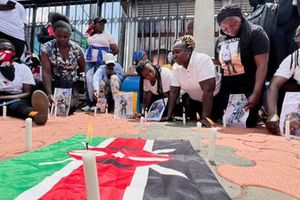
For a year now, casualties, missing bodies and hopelessness have continued to dominate the Russia-Ukraine war script as Kenyans continue to pay the price for a war they had little stake in except for the allure of quick money. Families burying banana stalks for bodies that will never return home and relatives clinging to distant memories of their kin enlisted in the Armed Forces of the Russian Federation have now become part of heartbreaking stories, with no end in sight to their harrowing ordeal.
The government, early this month, announced that at least 19 Kenyans had died fighting on the Ukrainian frontline and 32 others were missing.
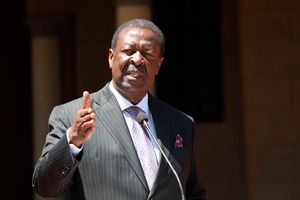
During a Senate committee session two weeks ago, Foreign and Diaspora Affairs Cabinet Secretary Musalia Mudavadi said the number of Kenyans enlisted for the Russian army had risen to 291 from the previous figure of 250. His numbers seem like a drop in the ocean compared to figures in a classified report tabled in Parliament in February by the National Intelligence Services. According to the report, more than 1,000 Kenyans have been recruited and deployed to fight in the war after being lured by recruiters with false promises of lucrative jobs.
Despite a promise by the government in March that there would be no further enlisting of Kenyans to fight for Russia in Ukraine following an agreement between the two countries, documents from Ukrainian authorities revealed that Kenyans continue to be deployed even after Mr Mudavadi’s visit.
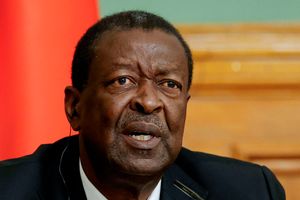
Members of the delegations, led by Russian Foreign Minister Sergei Lavrov and Kenyan Foreign Minister Musalia Mudavadi, hold talks in Moscow, Russia, March 16, 2026.
Photo credit: Reuters
According to details by the Ukrainian military intelligence service, some three Kenyans were killed over the last month. With little help in ending the enlisting and death of Kenyans in the faraway war, the bill introduced before the United States Congress on May 7 offers hope that, finally, some action could be taken, albeit by a foreign power.
The bill – Countering Russia’s Forced Recruitment and Kidnapping in Africa Act – aims to impose stiffer sanctions but must be passed by the US House and Senate in identical form, then be signed by the American president to become law. The legislative proposal calls for several sanctions, including blocking property of identified individuals or entities, prohibiting financial assistance, and ensuring that US contracts do not involve parties to the recruitment.
This is in addition to restricting access to US financial institutions, prohibiting loans and exclusion of specific individuals from entering the US. Specifically, the bill wants foreign individuals engaged in recruiting Africans to be banned from entering the United States for up to five years.
This is by having the individuals declared inadmissible to the United States; ineligible for a Visa or other documentation to enter the US, as well as being ineligible to be admitted to the US or to receive any other benefit under the Immigration and Nationality Act. For individuals already with US Visas, the bill wants the document immediately revoked.
Festus Arasa Omwamba, the 33-year-old man whom the National Intelligence Service has accused of recruiting 1,000 Kenyans to fight for Russia in its invasion of Ukraine.
Photo credit: Pool
The bill – in the first stage of the legislative process – is pushing to have fingered individuals blocked from all transactions in all property and interests in property within or under the control of the US. Further, it wants the US to prohibit any loan, loan guarantee, equity investment, project assistance, or any other type of support to a listed foreign person or foreign government, as well as not to procure, or enter into any contract for the procurement of any goods or services.
It says the US government may not procure, or enter into any contract for the procurement of, any goods or services from a foreign person or government.
This is in addition to prohibiting US financial institutions from making loans or providing credits to the foreign person or foreign government totalling more than $10 million in any 12-month period.
The Secretary of State will be required to prepare a list of foreign persons and governments participating in or facilitating the recruitment of nationals from African countries into the Ukraine war, not later than 90 days after the date of its enactment.
“Not later than 30 days after the list required by Section 4 is created by the Secretary of State, the President may impose the sanctions described in paragraphs 1 through 7 of subsection b on each foreign person and foreign government identified on the list,” the bill reads. “Any sanctions imposed pursuant to this Act shall terminate on the date that is five years after the date of the enactment of this Act.”
The bill, however, gives the US President the powers to waive imposition of the sanctions on individuals or terminate the same if such a waiver is vital to the national interests of the US, but has to, not more than 15 days after issuing the waiver, submit to the appropriate congressional committees a notification for the reasons behind the waiver.
On the other hand, termination will occur if credible information exists that the person did not engage in the activity for which sanctions were imposed; the person has credibly demonstrated a significant change in behaviour, has paid an appropriate consequence for the activity for which sanctions were imposed, and has credibly committed to not engage in the activities that led to the sanction; or the termination is in the vital national interests of the US. The proposal highlights the use of deceptive and coercive methods to recruit individuals from African countries, often promising them legitimate job opportunities or training, only to force them into combat roles.
The congressmen said Russia-backed entities are working to recruit civilian and military personnel across Africa to participate in the war, with Ukraine reporting that more than 1,400 citizens from 36 African countries are fighting alongside Russian forces. The bill observes that Africans are often forced to take the most dangerous combat roles in the most dangerous areas because Russians believe their lives are less valuable.
“Videos from the conflict show African recruits with landmines strapped to their chest and ordered by Russian soldiers to fight or die. Africans are regularly referred to as expendable and cannon fodder by Russians in the conflict areas.”
Another affected African country is Cameroon, where Russia is using local networks of recruiters to directly enlist Cameroonian soldiers, with estimates that 65 had been killed in the war.
According to Ukrainian media, Ukrainian forces captured two Cameroon nationals who claimed they had come to Russia to work—one to make shampoo and the other to fix teeth—before they were instead sent to fight for Russia.
But the cruelty of the recruitment is also being witnessed in South Africa, where, the bill observes, Duduzile Zuma-Sambudla, the daughter of former South African President Jacob Zuma, has been accused in multiple lawsuits of luring 17 South Africans and two Batswana to Russia by telling them they would be training as bodyguards for her father’s political party or attending a personal development course.
The two American congressmen note that accounts of recruitment in South Africa highlight that victims are regularly misled under false pretences, but when they arrive in Russia, their clothes and passports are often burned, and their phones are taken away.
“If a contract was presented upon recruitment, it is often switched for one written in Russian with the express intent of exploiting the victim for their service or labour. Other cases reveal that victims believed they were travelling to Moscow for advanced military training but were instead sent to fight on the frontlines in Ukraine.”