At first, they thought the Russian government would help them return home on compassionate grounds.
When that did not happen, they thought Prime Cabinet Secretary Musalia Mudavadi’s visit to Moscow would lead to a deal with the Russian Federation and help them fly to their families in Kenya.
Two weeks after Mr Mudavadi’s return, several Kenyans are still in the hospital after sustaining injuries while fighting for Russia in Ukraine.
Battlefield tales reveal how deception, human trafficking, and laxity by the government played a big part in the deployment of hundreds of desperate jobless Kenyans to the frontline.
Some have serious injuries, while others have had their limbs amputated, with little direction on where to go or what to do next. Mr Mudavadi told the National Assembly on Thursday that the 38 are among the 252 Kenyans enlisted as mercenaries to fight for Russia in Ukraine.
The number, however, could be higher.
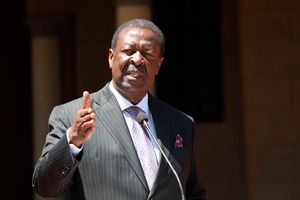
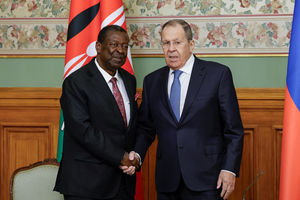
Members of the delegations, led by Russian Foreign Minister Sergei Lavrov and Kenyan Foreign Minister Musalia Mudavadi, hold talks in Moscow, Russia, March 16, 2026.
Photo credit: Reuters
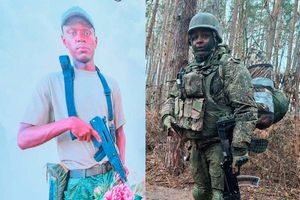
As Christopher* explained how he suffered serious injuries while fighting in Ukraine, faint voices in Russian could be heard in the background.
Christopher said the language barrier is another burden as he does not know his next course of action. He fears his arm will be amputated.
“I have witnessed Kenyans die on the frontline. Others have been seriously injured. In fact, this is my second injury,” Christopher said.
“The first was a slight fracture near my head, which I recovered from though not fully. I have not been lucky with this second one. The drone that attacked us shattered my arm from one end to the other.”
“The healthworkers here have begun removing the bandages from my arm. It means I could be returned to the unit in the next one week,” he said.
“From there, I could be sent to the battlefield once more. That is what happened with my first injury.”
Christopher’s journey to Russia began in 2025. He said it stemmed from the frustration of years of unemployment.
He says after years of trying, he got casual work as a driver. It was then that a friend at the organisation informed Christopher of a Russian who was looking for Kenyans to work in his country.
“He did not explain the nature of the work but since he knew I was a driver, I thought that was the job he was alluding to,” he said.
“He mentioned that I would need to raise Sh150,000 to facilitate my travel, visa and agency fees.”
With employment in the military falling outside what he believed he would be hired to do, Christopher said he scrambled to raise the money.
“The Russian agent I met in Kenya welcomed us to Russia. Strangely, he was in a military uniform. It was weird but I brushed it off, assuming that is how Russians did things,” Christopher told the Daily Nation.
“We boarded a vehicle and when we reached what the man said was our destination, I realised it was a military camp.”
Christopher said he went through two weeks of military training, during which he and several other Kenyans were shown the basics of using weapons.
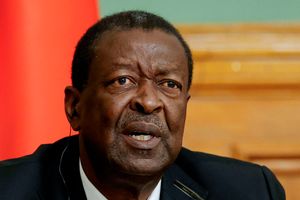
Russian Foreign Minister Sergei Lavrov shakes hands with Kenyan Foreign Minister Musalia Mudavadi during a press conference following their talks in Moscow, Russia, March 16, 2026.
Photo credit: Reuters
He said that for months, he held onto the hope of returning home.
Later, Christopher suffered his first injury.
Then he got information that Mr Mudavadi would be in Russia from March 16 to 18, 2026.
“We began to put aside everything we had gone through, knowing that the Prime Cabinet Secretary’s visit would ensure our safe return home,” Christopher said.
“Several weeks later after his visit and there is no progress. Other Kenyans and I have been making phone calls to the Kenyan embassy but there is no response. After Mudavadi’s visit we contacted the embassy again but officials there said there was little they could do because we signed contracts. What they forget is we signed these contracts under duress.”
The Daily Nation team asked him about this issue, which the government says is the hurdle it faces in attempting to locate the stranded Kenyans and returning them home.
“It is the Russian agent who deceived us. He told us that getting an employment visa while in Kenya was a lengthy process which would be shortened if we were in Russia,” Christopher added.
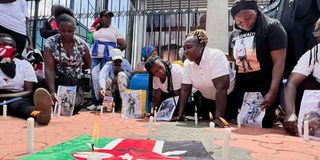
Relatives of Kenyans recruited to fight in Ukraine for Russia pray outside Parliament Buildings, calling for clarity on the suspected involvement of State officials in the recruitment.
Photo credit: Reuters
“He advised us to start with tourist visa and while there, they would immediately change it to an employment visa through the correct channels. We acted out of desperation and ignorance.”
Leonard* is in a similar situation in Russia. His leg was shattered in a Ukrainian drone strike while he was on the frontline.
“We plead with the government to rescue us from Russia and return us home,” Leonard said.
Mr Mudavadi, who is also the Foreign and Diaspora Affairs Cabinet Secretary, told lawmakers that many of those fighting in Ukraine were deceived into joining the Russian military.
He said 165 Kenyans are involved in what Russian President Vladimir Putin and his administration refer to as a special military operation in Ukraine.
“Sixteen Kenyans have been reported as missing in action, some 47 have been rescued, and two are prisoners of war in Ukraine, Mr Mudavadi said.
The Prime CS added that the recruitment is being done by unregistered agencies in Kenya, Russia and third countries, including Qatar and the United Arab Emirates, using tourist visas to evade scrutiny at points of entry.
Kenyans recruited from the Middle East held regular jobs before abandoning them to fight for Russia, he said.
Investigations into the recruitment are being spearheaded by the Ministry of Foreign Affairs and the Directorate of Criminal Investigations, with assistance from the National Intelligence Service and the Office of the Director of Public Prosecutions.
Mr Edwin Kamau Gituku and Mr Festus Arasa Omwamba of Global Face Human Resources were arrested and arraigned for human trafficking in September last year. The agency had been deregistered.