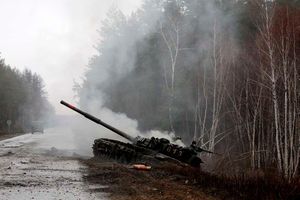
Until James Kamau Ndung’u, 33, and Charles Waithaka, 30, found themselves on the frontlines of the Russia–Ukraine war, they were strangers whose paths had never crossed, whose families did not know of each other’s existence. Even in death, that remains true.
But fate, in its cruel indifference, has bound them to the same end. Both are gone, as casualties of a war in which they had little stake outside the money promised to them upon enlisting in the Armed Forces of the Russian Federation.
Both young men knew they were going to work either as cooks or drivers. But even after suffering the same battlefield fate, without ever knowing each other, their bodies will never return home despite the fact that their families have already buried them.
The cold, unemotional hand of destiny has left the families of James, Charles and many other youths who have died in battle with only one painful arrow in their quiver – to hold mock burials and lay banana stalks in place of their departed kin’s bodies.
Russian authorities provided two choices to the families of James and Charles, neither of which involved the return of their bodies for burial in line with most African cultural norms.
The bodies would either be cremated and the ashes sent home, or be laid to rest in what authorities described as a dignified manner, but on foreign soil.
For some, however, even these difficult options remain out of reach. They are trapped in a limbo of unanswered questions, still uncertain whether their loved ones are dead or alive.
An emotional Hannah Kamau (left), mother of the late James Kamau Ndung’u, and Jane Karinge, widow of the late Ndung’u, both seated, take part in a candle-lighting session during a symbolic burial ceremony at the family home near Mboroti Shopping Centre in Kwa Wakihuria, Limuru, on March 6, 2026.
Photo credit: Wilfred Nyangaresi | Nation
“Mom is still struggling to accept that James is no more,” James’s sister, Margaret, told Nation on phone.
“He was our mum’s favourite”, Margaret added.
Minutes before James, 33, flew to Russia, he called his sister Margaret Wairimu Ndung’u. James told Margaret that he was leaving home, to change home.
His priorities, his Margaret said, was to buy land, become self-reliant and support his family financially. He and his sister are their mother’s only children, a bond that made his loss even more devastating.
He was not one to speak much, she said, and often kept his plans close to his chest.
Charles was an affable, generous and hardworking young man, his mother, Bibiana Waithaka, told the Nation. James, on the other hand, was humble, reserved and deeply loved.
James’ journey to the battlefield was neither direct nor deliberate. For years, he had unsuccessfully tried to join the military in Kenya. Back home, he eked out a living as a bead worker, earning just enough to get by. So, when an opportunity arose to work abroad as a driver or a cook, he took it without hesitation. It would prove fatal.
Days after holding a mock burial in search of closure, the family received what they thought would finally bring answers. A government official, the family said, confirmed that his body had been found. But instead of relief, the confirmation ushered in a new wave of anguish.
“They said that the body had been found. But they only have two options. Either they cremate and bring the ashes or they bury him in Russia with the respect of the military.”
Charles Waithaka, a Kenyan national who died in the Russia–Ukraine war on December 25, 2025, is pictured in military attire.
Photo credit: Pool | Nation
But the two options are unimaginable. The family customarily does not cremate, but also bringing the body home is way out of their financial ability. And now, they are caught between choosing cultural beliefs and practical realities.
“In our family, we don’t cremate unless someone has left a will and says so,” James’s sister said.
Like James, Charles also hoped to make it abroad. They are both dead, according to their families. But for Charles’s mother, Bibiana Waithaka, the pain is compounded by the circumstances under which her son left Kenya.
He had been promised a monthly salary of Sh800,000. But that promise quickly unraveled. Within weeks, he was struggling financially, even asking his mother for Sh10,000 just days before last Christmas.
“It hurts to have your child borrow money from you for sustenance. It is even worse when the child is out of the country. It makes you feel helpless as a parent,” a distraught Bibiana narrated.
“Mum, mum today… he was crying. He did finish the sentence before the phone went silent,” Bibiana said. That was the final call. The last time he ever heard his voice.
Though the government has yet to officially confirm his fate, a friend who survived the frontlines told the family he was among those who did not make it out alive.
A tent shelters the portrait of Charles Waithaka during his symbolic burial in Mukurweini, Nyeri County, on 5 February 2026. The ceremony took place after attempts to repatriate his body from Russia failed.
Photo credit: Mercy Mwende | Nation
While rejecting the claims that some Kenyans knowingly signed up for war, Bibiana questioned the narrative.
“Who would in their normal sense leave a peaceful country for war?” she wondered. “We only want our sons dead or alive.”
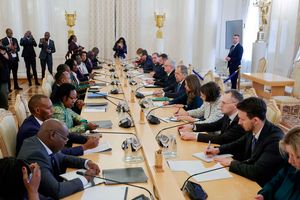
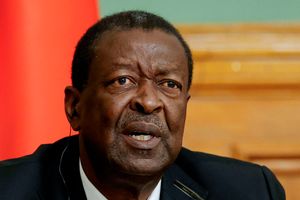
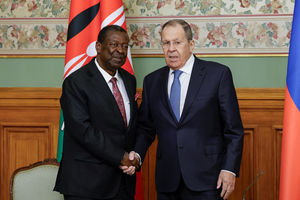
The government has largely scattered around the matter. While in Moscow, Prime Cabinet Secretary Musalia Mudavadi said Kenya had reached an agreement with Russia to stop the enlistment of Kenyans into the conflict.
"His excellency has conversed with us on the issue of the welfare of Kenyans who are in Russia and more specifically those who are involved in the special operation," Mudavadi said at a joint news briefing with Russian Foreign Minister Sergei Lavrov.
"And I want to make it clear that we have now agreed that Kenyans shall not be enlisted through the (Russian) Ministry of Defence - they will no longer be eligible to be enlisted," Musalia said. "There will be no further enlisting."
At the same time, the government has distanced itself from those already caught up in the war, saying it bears no responsibility for their fate.
“Since the State was not a party to those agreements, there is no legal basis for compensation. Responsibility lies with the terms agreed upon between the individuals and the recruiting entities. The government cannot assume liability for arrangements made without its knowledge or authorization," Mr Mudavadi said.
However, civil rights groups and families say this position ignores the realities of how many of the young men ended up on the battlefield.
“As Vocal Africa we are very much shocked and disappointed by how the CS gave little attention to concerns of families of Russia recruits. In fact, his choice of words was like the government is okay but it’s the families complaining,” said Odhiambo Ojiro of Vocal Africa.
He claimed that many Kenyans were misled, travelling on tourist visas with the promise of civilian jobs, only to be enlisted into the war.
The concerns extend to a group of 50 Kenyans who were flagged off in June 2025 by Labour CS Alfred Mutua to work in Russia, reportedly in food processing factories, with promises of a monthly salary of Sh115,000, free accommodation and meals.
According to Vocal Africa, families have since reported that some of them were instead enlisted into the war.
In Moscow, Mudavadi signed a new labour agreement to send more Kenyans to Russia. But “this new deal is a mockery to our country,” Mr Ojiro said.