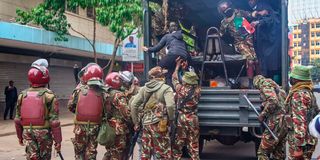
Nearly half of Kenyans have suffered at the hands of police, with a new study revealing that 42.9 percent of citizens experienced misconduct by officers between 2022 and 2024— a stark reminder of the brutality woven into the country’s law enforcers.
A study by the International Justice Mission (IJM) found that abuse of power by police remains entrenched despite constitutional and institutional reforms that have cost taxpayers billions of shillings.
The report shows that corruption and extortion were the most common forms of maltreatment, affecting 55.8 percent of victims, followed closely by harassment at 54.7 percent. Other abuses included arbitrary arrests, physical assault, and even fatal violence.
Men bore the brunt of the violations, accounting for 61.4 percent of reported abuses, with urban residents being overwhelmingly targeted— three out of every four victims.
IJM Country Director Vincent Chahale, who released the report in Nairobi, on Tuesday called on the National Police Service to ensure improved training of officers and recruits on respect for human rights.
Vincent Chahale, International Justice Mission country director.
Photo credit: File | Nation Media Group
“We all agree that victims of police brutality need justice. This report speaks to us on the importance of professionalising the police service and this begins with the recruitment process that is likely to start in the next few days. There is a need for consultations among stakeholders and incorporation of human rights and rule of law in the police training curriculum,” Mr Chahale.
According to the report, Kisumu was Kenya’s capital of police abuses over the study period, registering the highest prevalence across all levels of severity, followed closely by Nairobi and Mombasa.
Young adults, especially those aged 25 to 34, were the most frequent targets, while people with higher levels of education were paradoxically more exposed than their less-educated counterparts.
Police abuse was most pervasive in public spaces, according to the survey, with 33.1 percent of victims experiencing misconduct in public spaces away from their homes, while another 23.9 percent were targeted in public areas within their neighborhoods.
By contrast, incidents in private settings were less frequent: 6.8 percent of victims suffered abuse inside private spaces within their neighbourhoods, and 6.5 percent in private spaces far away.
Surveyed participants indicated the highest likelihood of being victimised on Fridays (54.9 percent), followed by Saturdays (46 percent) and Sundays (23.7 percent).
By contrast, early-week incidents were much lower — Mondays (18.5 percent), Tuesdays (13.5 percent), and Wednesdays (16.4 percent).
Law Society of Kenya President Faith Odhiambo, who attended the report launch, called upon police to ensure accountability.
“This is a reality of what is happening in the country. It is difficult to even see those who have been arrested because of the tricks they use. Some of them do not even record those who have been arrested in the Occurrence Book since they do not want the judiciary to catch up with them,” Ms Odhiambo said.
From the research, it appears even government premises were not safe from police misconduct, with 5.1 percent of respondents reporting violations.
The study also shows that 41.5 percent of abuses happened on roads and highways, places where traffic stops and checkpoints have become extortion points.
Another 31.9 percent occurred in residential neighborhoods, particularly in informal settlements where routine patrols often turned into harassment.
Markets and trading centres accounted for 16.2 percent of reported incidents, while police stations themselves meant to guarantee safety were the sites of 10.4 percent of violations.
Several Kenyans have been brutally attacked and killed inside police cells, including blogger Albert Ojwang, who died in police custody at Central Police Station in Nairobi in June.
A photo of teacher and blogger Albert Ojwang, who died while in police custody.
Photo credit: Pool
At markers, vulnerable groups include matatu touts, hawkers, sex workers, members of the Muslim and cushitic communities, and individuals with visible body features such as dreadlocks, tattoos, or long beards.
“These populations often find themselves trapped in a cycle of suspicion, profiling, and intimidation, where a brush with the police is almost a guarantee of extortion or violence,” reads the report.
In the survey, a majority of Kenyans expressed readiness to seek justice, at least in theory. According to the study, 63.7 percent of participants (3,632 out of 5,700) said they were willing to report police misconduct to formal criminal justice system (CJS) agencies such as the Independent Policing Oversight Authority, the Directorate of Criminal Investigations and the Internal Affairs Unit.
Eighty eight percent of those willing to report (3,203 out of 3,632) indicated they would participate fully in criminal proceedings if given the necessary support.
Yet this willingness often collapses in practice. The study found a huge crime reporting gap: 62.6 percent (1,529 out of 2,444) of those recently victimised by police never reported their cases at all. Fear of retaliation, lack of trust in oversight bodies, prohibitive costs, and slow, frustrating court processes were cited as the biggest deterrents.