Kenya’s road safety crisis is claiming thousands of lives every year, with pedestrians, motorcyclists and passengers bearing the brunt of a growing death toll that has renewed calls for road crashes to be declared a national disaster.
The National Transport and Safety Authority (NTSA) recorded 3,995 road deaths between January 1 and October 4, 2026, a 9.2 per cent increase from the 3,657 fatalities reported during a similar period last year.
The deaths came as the authority identified more than 270 accident black spots across the country, including 199 along the Mombasa-Malaba Northern Corridor, underscoring the dangers confronting motorists and other road users on some of the country’s busiest highways.
The statistics paint a grim picture of a country where road crashes continue to claim lives despite enforcement operations, public awareness campaigns and repeated government promises to improve road safety.
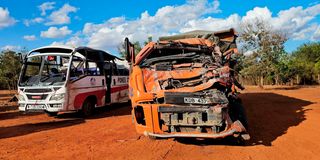
From left: Pastor Joseph Vura of Campaign for Salvation and Healing Ministry Church, Apostle Fonex Paul of River of Restoration Church and Pastor Isaac Juma of Grace Healing Church. The three were among 23 passengers who died in the Mtito Andei road crash on October 25, 2026.
Photo credit: Kevin Odit and Dennis Onsongo | Nation Media Group
In its latest appeal this week, NTSA has called for road safety to be treated as a national emergency, arguing that the scale of the fatalities requires coordinated action across government agencies, rather than leaving the responsibility to the transport regulator alone.
The two crashes brought renewed attention to the dangers along the highway, where vehicles travelling in opposite directions share a single carriageway on some sections.
NTSA Director of Road Safety Andrew Kipalgat has said the authority wants road safety to receive the urgency and resources required to reverse the trend.
“The question you're asking is the question that is keeping us on our toes every day. NTSA exists to bring the numbers down,” Dr Kipalgat said.
He said responsibility for crashes must be assessed across several areas, including the condition of vehicles, road infrastructure, road-user behaviour and emergency response after collisions.
Figures published in the Kenya National Bureau of Statistics (KNBS) Economic Survey 2026 show that 5,009 people were killed in reported road traffic accidents in 2025, up from 4,748 in 2024.
This represents a 5.5 per cent increase in fatalities in one year, while reported road traffic accidents rose from 11,165 to 11,638 over the same period.
The number of people killed or injured increased from 24,245 in 2024 to 24,905 in 2025, according to the KNBS report, which draws its figures from the National Police Service Traffic Department.
The figures suggest that the country's road safety challenge is not limited to spectacular, multiple-fatality crashes. Thousands of people are also dying in individual collisions involving pedestrians, motorcycles, private vehicles, commercial vehicles and public service vehicles.
The KNBS figures are higher than some NTSA year-end totals published in the media, reflecting differences between official reporting series. However, both sets of figures point to a persistently high annual toll.
Death Express; Kenya's killer roads
With 3,995 deaths already recorded by October 4 this year, the country was approaching the 4,000-fatality mark before the latest major crashes on the Nairobi-Mombasa highway.
The deaths are accompanied by a substantial burden of serious injuries, disability, medical expenses and lost income for affected families.
Of the 3,995 deaths recorded between January 1 and October 4, 2026, pedestrians accounted for 1,490, followed by motorcyclists at 1,061, passengers at 662 and drivers at 352.
The figures show that people who are not protected by a vehicle's body are particularly exposed to the consequences of collisions.
Pedestrians must often negotiate busy roads where footbridges, designated crossings and pedestrian walkways may be inadequate, poorly maintained or inconveniently located. At some locations, people cross between moving vehicles because safe crossing facilities are too far away.
Poor lighting, high vehicle speeds and the absence of safe walking infrastructure compound the danger, especially at night.
Motorcyclists are also highly vulnerable because they have little physical protection in a collision. The risks increase when riders or passengers fail to wear helmets, motorcycles are poorly maintained, or riders travel at excessive speeds and weave through traffic.
Passengers, meanwhile, depend heavily on drivers and operators to observe speed limits, maintain safe distances, avoid dangerous overtaking and ensure vehicles are roadworthy.
Senior police officers inspect a church bus that collided with a truck, killing 24 people and injuring scores of others, at Mtito Andei Police Station in Makueni County on October 25, 2026.
Photo credit: Pius Maundu | Nation Media Group
The pattern means road safety cannot be measured only by how drivers behave. The design of roads and the protection provided to people walking, cycling or riding motorcycles are equally important.
The KNBS Economic Survey identifies overloading, driver fatigue, drunk driving, failure to observe traffic rules, reckless driving and poor road infrastructure among the main causes of reported road traffic accidents.
Speeding and dangerous overtaking remain particular concerns on highways where fast-moving vehicles share limited road space with slower traffic.
A driver attempting to overtake a lorry without sufficient visibility or room to return to the correct lane can trigger a head-on collision involving several vehicles. The consequences can be catastrophic when a bus carrying dozens of passengers is involved.
The October 3 crash at Salama illustrated the danger. Police attributed the collision to a lorry driver's unsuccessful overtaking manoeuvre, which triggered a crash involving several vehicles, including a van carrying Catholic pilgrims.
12 of the 17 pilgrims killed in a horrific multi-vehicle highway collision(from left): Florence Atieno, Hilcah Orina, Regina Mwai, Martha Nzyoki, Janet Miito, Veronicah Musyimi, Samuel Muigai, Veronica Ngandi, Scholastica Ochieng, Catherine Joseph, Ann Mwanthi and Josephat Mekonge.
Photo credit: Kevin Odit| NMG
Three weeks later, the Kanga collision again highlighted the risks on the Nairobi-Mombasa highway, although the precise circumstances of a crash must be established through investigation rather than assumed from the number of vehicles involved.
Driver fatigue is another concern, particularly for commercial drivers who spend long hours on the road. Fatigue can slow reaction times, impair judgment and make it difficult to maintain lane discipline.
Alcohol and other intoxicating substances can similarly affect a driver's ability to assess distances, control a vehicle and respond to unexpected situations.
Mechanical failures, including defective brakes and tyre problems, can turn an otherwise manageable traffic situation into a fatal collision. Overloading can also affect a vehicle's stability, braking performance and ability to manoeuvre safely.
However, individual driver behaviour is only part of the problem. Poorly designed junctions, inadequate road markings, insufficient lighting, missing pedestrian facilities and a lack of separation between opposing traffic flows can increase the likelihood of a crash or make its consequences more severe.
NTSA has said vehicle-related factors account for about 17 per cent of road crashes, while emphasising that investigations must also examine infrastructure, road users and post-crash response.
The implication is that enforcement alone cannot eliminate the risks if the roads themselves remain unsafe.
“We have stepped up enforcement, particularly targeting traffic violations associated with crashes at night,” he said.
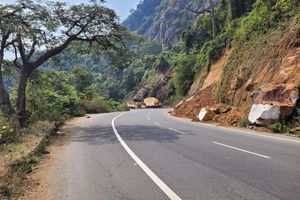
NTSA has identified more than 270 accident black spots nationally, 199 of them along the Mombasa-Malaba Northern Corridor.
“Out of the road safety audits that the authority does, all the blackspots right from Mombasa to Malaba are known. Ideally, we should have separation of traffic, at least those flowing in one direction,” he adds.
The corridor includes the Nairobi-Mombasa highway, a major route for passenger travel and freight movement between the Port of Mombasa, Nairobi and destinations farther inland.
The repeated occurrence of serious crashes along the route has intensified calls for improvements, including separating traffic travelling in opposite directions.
A dual carriageway can reduce the risk of head-on collisions by physically separating opposing traffic flows. However, such upgrades need to be accompanied by safer junctions, appropriate speed management, pedestrian crossings and enforcement against dangerous driving.
“Salama, for example, if the road was dualled, then the vehicles on the other side would have been safer, because actually the people who suffered are the people who were on the other side of the road,” he said.
The Salama and Kanga tragedies have renewed questions about the pace of improvements on sections of the highway where traffic volumes, overtaking manoeuvres and limited separation between opposing vehicles create serious risks.
Other highways and roads across the country also have dangerous sections. The identification of a black spot, however, should not be treated as a substitute for publishing the specific engineering problems at each location and the measures being taken to address them.
The key question is whether the locations identified by authorities are receiving timely, measurable interventions, and whether the effectiveness of those interventions is being monitored.
Families can lose their primary breadwinners, while survivors may face prolonged hospitalisation, rehabilitation, disability and loss of employment.
Hospitals must devote resources to emergency treatment and trauma care, while businesses lose workers and productivity. Police, emergency responders, insurers and public agencies also bear costs associated with crashes and their aftermath.
NTSA has previously estimated that road crashes cost Kenya approximately Sh450 billion annually, illustrating the economic burden associated with fatalities, injuries and damage to property.
The burden falls particularly heavily on households that must meet medical and funeral expenses while coping with the loss of income.
The human cost is harder to quantify. Every fatal collision leaves families, friends and communities dealing with consequences that cannot be reversed through compensation or infrastructure spending.
NTSA's proposal to declare road safety a national disaster is intended to elevate the issue from a transport-sector concern to a coordinated national priority.
Such a declaration could provide a framework for mobilising resources, coordinating agencies, prioritising dangerous roads and setting measurable targets for reducing deaths and serious injuries.
Road agencies would need to assess and improve dangerous sections of highways, while the National Police Service would continue enforcing traffic laws and investigating crashes. NTSA would be expected to strengthen vehicle compliance, licensing, safety education and monitoring.
County governments would also have a role in improving pedestrian facilities, managing traffic on local roads and addressing dangerous crossings and junctions. The health sector would need to strengthen emergency response, ambulance services and trauma care.
But the precise legal and administrative consequences would depend on the instrument used to make the declaration, the powers invoked and the funding and implementation arrangements established.
The declaration would not, by itself, repair dangerous roads, stop speeding or guarantee compliance with traffic laws. Its value would depend on whether it results in clear responsibilities, adequate funding, enforceable deadlines and public reporting on progress.
NTSA has already demonstrated that enforcement operations can identify violations and remove unsafe vehicles from the roads. The larger challenge is ensuring that these interventions are sustained and matched by infrastructure improvements.
With more than 270 black spots identified and thousands of deaths recorded annually, the immediate priorities include improving dangerous road sections, separating opposing traffic where feasible, providing safe pedestrian crossings, enforcing speed limits and tackling fatigue, intoxication and unroadworthy vehicles.
Authorities also need reliable, publicly accessible crash data that identifies where collisions occur, the road users affected, the circumstances of crashes and the corrective measures taken.
The effectiveness of road safety programmes should be assessed against reductions in fatalities and serious injuries, rather than the number of enforcement operations conducted or public awareness campaigns launched.
For NTSA, the call for a national disaster declaration is an acknowledgement that existing interventions have not yet brought the death toll under control.
The challenge now is to turn that appeal into a coordinated programme that addresses the causes of crashes, makes dangerous roads safer and holds the responsible agencies accountable.
Until that happens, Kenya's roads will continue to exact a devastating price in lives lost, families shattered and livelihoods destroyed.