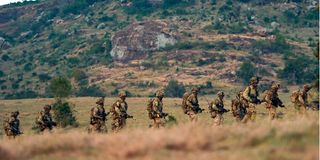
The British Army Training Unit Kenya (Batuk) will resume its suspended military exercise, Haraka Storm, later this year after the Kenyan government agreed to issue the licences and permissions required for the drills.
The annual exercise, which runs from September to November and involves about 1,500 British soldiers, had been suspended last week following a diplomatic standoff between Kenya and the United Kingdom.
The delay followed Parliament's push for amendments to the Kenya-UK Defence Cooperation Agreement, particularly Articles 6(5) and 23, to include murder among offences that fall under the jurisdiction of Kenyan courts. MPs also demanded that the revised agreement incorporate a corporate social responsibility component.
In a statement issued on Tuesday, a UK government spokesperson confirmed that the two governments had reached an agreement allowing the exercise to proceed as originally planned.
“We can confirm that the Kenyan Government has agreed to issue the necessary licences and permissions for Exercise HARAKA STORM to take place in Kenya later this year. We value the close cooperation and shared commitment between the UK and Kenya which have enabled this progress,” the spokesperson said.
The UK government said detailed planning by the British Army had established that the exercise could still be conducted within the originally intended training window despite the earlier suspension.
“As a result, and following detailed work by the Army, we believe that it is possible to deliver the training in Kenya over the same time period as previously planned. Exercise Haraka Storm will now take place later this year,” the spokesperson added.
The UK reaffirmed its commitment to maintaining military cooperation with Kenya, describing the partnership as longstanding and mutually beneficial.
“The UK remains committed to working closely with the Government of Kenya to further strengthen our deep and enduring military partnership, which continues to deliver for both the UK and Kenya and advances our shared aims and interests,”the statement said.
Prime Cabinet Secretary and Cabinet Secretary for Foreign and Diaspora Affairs Musalia Mudavadi welcomed the announcement, describing it as a testament to the enduring defence partnership between the two countries.
In a statement, Mudavadi said the decision demonstrated Kenya's and the UK's ability to resolve challenges through dialogue while safeguarding shared strategic interests.
“The Kenya-UK defence partnership continues to advance Kenya's national interests. It strengthens the capabilities of the Kenya Defence Forces, contributes to regional peace and security, supports jobs and businesses, and delivers economic benefits to communities hosting the exercises,” he said.
Prime Cabinet Secretary Musalia Mudavadi.
Photo credit: Reuters
He added that Kenya remains committed to deepening defence cooperation with the UK to promote peace, security and regional stability.
The announcement was also welcomed by Nanyuki's business community, with traders expressing optimism that the return of the exercise will revive business after months of sluggish trade.
Warwick Hotel Nanyuki General Manager Fidel A'chim said the resumption would provide much-needed relief to the hospitality sector, which has experienced a slowdown in recent months.
He said the hotel, like many others in Nanyuki, partly depends on British military personnel and other foreign visitors associated with Batuk's training activities.
“Batuk activities mean business for us. Whenever the training exercises take place, the hotel records sales of up to Sh800,000 a month. Over the years, we have tailored our menu and services to suit their cuisine and preferences,” he said.
Chandarana Supermarket manager Ali Murtaza said British troops account for about 25 per cent of the store's clientele, noting that the presence of the soldiers significantly boosts sales in the town.
“Nanyuki has a relatively small customer base, so whenever the British troops are here for training, business improves considerably,” he said.