For years, the arrival of large groups of British soldiers in Nanyuki has meant more than just another round of military training exercises. It marked the beginning of a season of booming business and an increase in economic activity for local residents.
Parliament wants amendments made on Articles 6(5) and 23 of the cooperation agreement to include murder as one of the offences within the jurisdiction of Kenyan courts. And this has sparked a stand-off, which resulted in the cancellation of the expected arrival of 1,500 British Army Training Unit Kenya (Batuk) troops in September.
Speaking to the BBC on Friday, Belgut Member of Parliament Nelson Koech, who chairs the National Assembly Defence, Intelligence and Foreign Relations Committee, said the biggest issue with the agreement is the lack of accountability for murders allegedly committed by British soldiers.
"The human rights concerns we have are issues of rape, environmental degradation and murder—some of which have been proven, while others are still under investigation. The major one is that of the murder of Agnes Wanjiru. To date, the culprit has never been repatriated after the courts ordered that he be brought back to Kenya to stand trial. There has to be accountability by the officers who visit our country," he said.
Belgut MP Nelson Koech.
Photo credit: Dennis Onsongo | Nation Media Group
Mr Koech said the military partnership with the UK must have mutual benefit for both countries, respect for human rights, and respect for the Constitution. He said the Defence, Intelligence and Foreign Relations Committee was not a hindrance to the agreement, as it was out to ensure a fair deal.
"I have been trying to contact the team at the High Commission to try and resolve this situation so that the cancellation of the training — which is supposed to begin September — is reversed. We need to resolve the sticky issues that we are uncomfortable with," Mr Koech said.
The permanent service personnel stay in the country for two years, and they live in rented property outside the airbase. It was expected that a training cohort of 1,500 would arrive in the country in September.
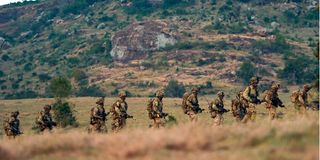
British Army soldiers during a training exercise in Lolldaiga, Laikipia County. on November 14, 2022.
Photo credit: File | Nation Media Group
After weeks of military drills across Laikipia’s training grounds, hundreds of soldiers stream into the town's supermarkets, and restaurants.
They buy souvenirs from curio shops, hire taxis to visit tourist sites and unwind at entertainment spots before returning to camp. Outside Batuk’s main gate, taxi drivers, boda bodas riders and curio sellers eagerly wait for customers when the soldiers are in town.
News of the cancellation of the September training has hit businesses hard. For taxi operator, Mr Richard Kabiro, the slowdown has left him asking himself difficult questions about his future.
About 45 taxis normally operate outside the military base, but that number almost doubles whenever the British troops arrive for training.
"The arrival of around 1,500 soldiers creates a huge demand for transport. Many residents even convert their private vehicles into taxis or offer car hire services because business is good," Mr Kabiro said.
Britain’s Foreign Secretary Boris Johnson (centre) talks to soldiers at the British Training Unit Kenya, popularly known as BATUK, in Ole Naishu, Nanyuki, on March 17, 2017.
Photo credit: File | Nation Media Group
He said that the highest earnings are made during the short breaks of the three-month programme, when soldiers are permitted to leave the training grounds.
"That is when you truly understand Batuk’s economic impact. The soldiers spend about two weeks at training venues before taking a four-day break. During those few days, the town comes alive, and that is when we make money," he said.
Mr Kabiro charges Sh4, 000 a day for car hire, and says that during peak weekends, all of his three vehicles are usually fully booked.
Batuk conducts two major threemonth “Haraka Storm” training exercises every year — from February to April, and between September to November. Mr Kabiro said that the cancellation of the September programme has cast doubt on resident’s investments after years of dependable business.
"With the uncertainty surrounding the September exercise, I don't know whether I should sell some of my vehicles or relocate to another town," he said.
A short distance from the taxi bay, Mr David Mulinge carefully arranges military-themed souvenirs outside his curio shop as he waits for customers.
Mr Mulinge, who has operated his business in Nanyuki since 1976, said that he has never witnessed such uncertainty.