A total of 1,500 British troops who were expected in the country in September will now not report for training following a standoff between Kenya and the UK over the Defence Cooperation Agreement.
The Nation has learnt that at the heart of the disagreement is the amendment of its Articles 6(5) and 23 of the cooperation agreement to include murder as one of the offences within the jurisdiction of Kenyan courts, as proposed by Parliament.
In addition, Parliament has insisted that the new agreement, which is still pending before the House, must be amended to include a Corporate Social Responsibility component by the British Army Training Unit in Kenya (Batuk).
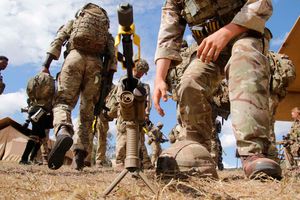
Soldiers troop during a simulated military excercise of the British Army Training Unit in Kenya (BATUK) together with the Kenya Defence Forces (KDF) at the ol-Daiga ranch, high on Kenya’s Laikipia plateau on March 26, 2018.
Photo credit: File | AFP
As currently drafted, the agreement excludes certain serious offences from the definition of “official duty”, giving Kenya primary jurisdiction over those cases. However, murder is omitted from that list, leaving room for Britain to claim jurisdiction over such cases — a loophole Kenyan lawmakers want closed.
The Kenya Defence Forces and the United Kingdom's armed forces have maintained a longstanding defence partnership focused on military training, defence cooperation and the exchange of personnel through military institutions.
A spokesperson at the UK Ministry of Defence on Thursday told the Nation that the UK is considering an ‘alternative location’ for the training.
The spokesperson said the UK will continue to engage closely with the Kenyan Government to support the resumption of training in-country at the earliest appropriate opportunity.
"The UK highly values its relationship with Kenya, which is underpinned by mutual benefit, respect and cooperation. The UK-Kenya Defence Partnership is one of the great strengths of our relationship. Our joint training and operations with the Kenyan Defence Forces are keeping both Kenyan and British people safe,” reads the statement.
"It is with regret that the necessary licences required to allow training to take place in Laikipia later this year have not been forthcoming. As a result, the planned training will now be conducted at an alternative location outside Kenya,” it added.
Britain’s Foreign Secretary Boris Johnson (centre) talks to soldiers at the British Training Unit Kenya, popularly known as BATUK, in Ole Naishu, Nanyuki, on March 17, 2017.
Photo credit: File | Nation Media Group
While regretting the move, the UK clarified that only the September training has been affected and not the one ongoing at the moment.
Parliament, on the other hand, maintained on Thursday, July 23, that it will not relent in its push for amendment of Article 6 (5) and 23 of the cooperation agreement.
“The National Assembly agreed with the report of the committee Defence, Intelligence and Foreign Relations on condition that it only commences upon amendment of its Articles 6(5) and 23 to include murder as one of the offences within the jurisdiction of Kenyan courts; and to include a Corporate Social Responsibility component for Batuk in its engagement with local communities,” Parliament said in a statement.
Belgut MP Nelson Koech, who chairs the National Assembly's Defence, Intelligence and Foreign Relations Committee, said the two countries will continue to engage in order to resolve the sticky issues.
“The Kenyan and UK governments are actively engaging to address these outstanding issues,” Mr Koech said.
While the then Committee on Defence and Foreign Relations of the 12th Parliament was considering the Agreement, the County Government of Laikipia, where it is based, submitted a memorandum raising serious concerns on defence cooperation between Kenya and the UK.
The British Army Training Unit Training in Kenya -BATUK train for war at Lolldaiga training area in Laikipia County on November 14, 2022.
Photo credit: Joseph Kanyi I Nation Media Group
The County Government stated that despite the presence of binding agreements, Batuk had committed serious atrocities against the people of the Republic of Kenya and the environment in general.
These included the Lolldaiga Hills Conservancy fire incident, which led to the destruction of approximately 12000 acres of forest in disregard of the environmental rights of the people of Kenya, and the safety of Kenya's ecological system and the murder of Agnes Wanjiku Wanjiru by Batuk soldiers, where her body was found dumped in a septic tank.Kenya delays UK defence deal over troop immunity row
The public also raised concerns over the manner in which previous Batuk agreements were negotiated, claiming that they were never consulted in the spirit of meaningful public participation as envisioned in the Constitution.
The Kenya National Commission on Human Rights is also on record as having called for prioritisation of meaningful public participation to enhance the effectiveness of the Agreement and to incorporate the unique needs of the host communities and deepen community ownership of the cooperation.
Due to these and other concerns, the 12th Parliament did not complete the processing of the 2021 Agreement.
In May 2024, the Departmental Committee on Defence, Intelligence, and Foreign Relations commenced an inquiry into the conduct of Batuk.
The committee was tasked by the House to investigate the alleged ethical breaches related to ethical misconduct, including corruption, fraud, discrimination, abuse of power, and other unethical behaviour.
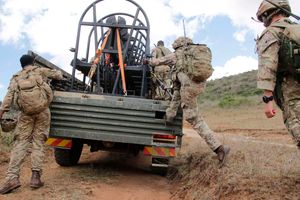
British Army soldiers board a military truck after a battle group exercise during a media engagement at the Lolldaiga training area in Laikipia County on November 14, 2022.
Photo credit: Joseph Kanyi | Nation Media Group
The committee was also tasked to investigate the allegations of Human Rights violations, including mistreatment, torture, unlawful detention, killings or any other violations of the internationally recognised human rights standards.
Further, the committee was also to assess Batuk’s operational integrity, especially safety protocols, compliance with legal requirements and adherence to established military standards.
“The Committee and the House have been insistent on the implementation of the reservations,” an official who works at the Parliament told the Nation.
The committee in its report tabled in the House last year established that the UK soldiers were guilty of sexual abuse of Kenyans, abuse of power, unethical behaviour and human rights violations coupled with blatant disregard of court orders.
The inquiry report revealed how the soldiers raped, sexually abused and left many locals maimed with various injuries.
According to the report, the training of the soldiers has resulted in multiple instances of human rights abuses, including preventable deaths, physical harm and environmental degradation that have significantly impacted livelihoods.