KNCHR begins work on framework to compensate protest victims
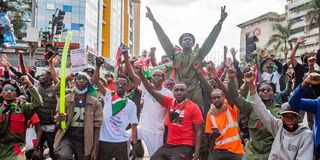
Gen Z protestors along Kenyatta Avenue in Nairobi on June 25.

Kenya National Commission on Human Rights (KNCHR) has begun developing a national framework to compensate and provide reparations to victims of human rights violations, following a court ruling and a presidential directive requiring the commission to submit proposals within 60 days.
In a statement on Friday, March 13, the commission said it had initiated internal technical work, begun mapping areas most affected by protest-related and other violations, and started consultations with stakeholders to guide the process.
“The process of developing a Framework for Compensation and Reparations to victims of human rights violations is ongoing,” said Claris Ogangah, the commission chairperson. “The Commission has initiated internal technical work, begun mapping areas most affected by protest-related and other human rights violations, and started engaging key stakeholders so that a credible framework can be put in place.”


The initiative follows a landmark judgment by the High Court of Kenya in Kerugoya in December 2025, which affirmed the commission’s constitutional mandate to design a reparations framework.
The ruling recognised the authority of KNCHR under the Constitution of Kenya 2010, Article 59 and the Kenya National Commission on Human Rights Act 2011 to spearhead the process.
KNCHR said the work was also prompted by a presidential proclamation issued on March 6 directing the commission to submit a report outlining a framework for compensation and reparations to victims within 60 days under Article 254(2) of the Constitution.
The commission acknowledged the prolonged wait many victims and families have endured.
“The Commission acknowledges the pain, loss and anxiety experienced by victims, survivors and their families as well as the public concern that reparations have taken too long,” Ms Ogangah said.
It emphasised that compensation alone would not constitute a full reparations program.
“At the same time, KNCHR emphasizes that compensation, while important, is only one form of reparations,” Ms Ogangah said. “A just and effective reparations programme includes compensation, restitution, rehabilitation, satisfaction and guarantees of non-repetition.”
According to the commission, technical committees bringing together commissioners, state agencies, oversight bodies, civil society organisations, and representatives of victims and survivors have been established to guide the process.
Public participation will also be part of the framework development, with consultations to be announced through public notices, the commission’s website and social media platforms.
“The Commission will continuously update the public on progress through the media and community-level engagements,” Ms Ogangah said.
KNCHR urged Parliament and the National Treasury to allocate the resources required for the exercise.
“The Commission urges Parliament and the National Treasury to urgently approve and disburse the requisite funds to enable the Commission to discharge this critical national function,” the statement said.
The commission also called on victims of human rights violations, including those affected during protests and demonstrations, to submit supporting documents for verification by April 3.
“The Commission calls upon victims of human rights violations including victims of protests and demonstrations to report to the KNCHR and submit supporting documents … for verification,” the statement said.
Victims can submit information through KNCHR offices across the country, including in Nairobi, Kisumu, Mombasa, Kitale, Nyahururu and Wajir.
The commission said it will submit the final report to the president as required under Article 254(2) of the Constitution and Section 53(3) of the KNCHR Act.
The announcement comes after President William Ruto this week assured that victims affected during protests across the country will receive compensation by June this year, if the ongoing verification and legal process proceed as planned.
During a joint parliamentary group meeting bringing together lawmakers from the ruling United Democratic Alliance and the opposition Orange Democratic Movement, the President said the government has already put in place mechanisms to facilitate compensation for affected families and individuals.
Dr Ruto said the process had taken time because the government wanted to ensure it is conducted within the law and in a transparent manner.
“It is our belief that unless something else happens, we should be able to conclude this exercise by June,” the President said, adding that the government is committed to addressing injustices that occurred during past demonstrations
Follow our WhatsApp channel for breaking news updates and more stories like this.