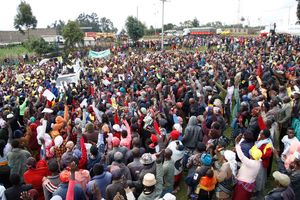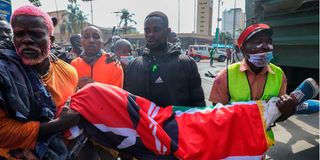
Demonstrators carry the body of a protester who was shot dead at Parliament Buildings during the anti-Tax Bill protests in Nairobi on June 25, 2024.

On Jamhuri Day, as Kenyans stood in stadiums listening to speeches about sovereignty and freedom, I spent my day in a small, crowded room with survivors of protests, families whose loved ones were killed by the police, and others whose relatives are still missing months later.
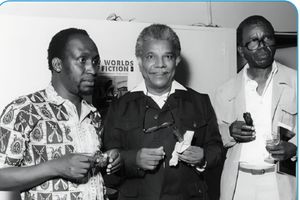
It was a room full of grief and also proof of something that politicians have refused to admit: that Kenya is still living inside the unfinished story that Jaramogi Oginga Odinga wrote in “Not Yet Uhuru”.
One father, speaking with a calmness that should never be required of a grieving parent, asked: “How do we celebrate independence when the state kills our children?” It was a direct challenge to the national narrative, and it explained the core argument of Jaramogi’s book: that independence means nothing if the state continues to treat its citizens the way the colonial administration did.
In Not Yet Uhuru, Jaramogi wrote that the tragedy of post-colonial Kenya was that the new African government inherited the colonial political framework without dismantling it. The oppressive structures remained; only the faces changed. His point was simple: changing leaders is not the same as changing systems.
Freedom of expression
Sitting among families of people shot, maimed, or disappeared during Gen Z protests in 2024 and 2025, it was impossible not to see how accurately those words describe the Kenya of today. The unfinished nature of our independence is more obvious in our politics.
It is especially ironic that ODM, a party founded on Jaramogi’s ideology of principled resistance, has partnered with the government that presided over the deadliest crackdown on freedom of expression. ODM built its identity on resistance. It marched against police brutality. It championed civil liberties.
ODM quoted Jaramogi with pride. The party was led by Jaramogi’s son, the late Raila Odinga. Jaramogi warned in Not Yet Uhuru about “the betrayal of the freedom struggle by those who inherited power but forgot its purpose.” The idea that Kenya is not yet free is not just political commentary; it is observable in daily life. The years 2024 and 2025 have provided some of the clearest evidence that the colonial policing mentality never left.
Jaramogi criticised the post-independence government for retaining the colonial police force without reform. He wrote that unless these institutions were rebuilt, they would eventually turn their weapons against the citizens. That is exactly what is happening.
Young people were shot with live bullets. Some lost limbs. Some lost their sight. Some were killed. Some vanished and have still not been found. These acts do not align with any definition of a free nation.
In the room where I sat on Jamhuri Day, there were families still stuck in endless court delays. One GBV case we were following up on was originally scheduled for this year but was pushed to June 2026 with no satisfactory explanation. Survivors remain displaced, unable to return home because perpetrators roam freely. Jaramogi wrote that independence is meaningless if justice does not protect the weak. Our justice system remains slow, under-resourced, and hostile to those without power.
Jaramogi dedicated much of Not Yet Uhuru to explaining how independence without economic freedom simply creates a local elite to replace the colonial one. More than 60 years after independence, Kenya is still trapped in the patterns that he warned about. The cost of living is rising, jobs are given through networks of privilege, and corruption thrives unabated. Ordinary Kenyans, not state institutions, have been the ones exposing the Adani-linked procurement issues, the fraud in SHA, the budget irregularities, and suspicious parliamentary amendments. These exposures confirm what Jaramogi argued: that state institutions cannot guarantee accountability unless citizens actively demand it.
The national assembly, regulatory bodies, and oversight agencies have become extensions of political patronage. Rather than upholding the rule of law, these institutions often defend the status quo, wealthy elites, and political patrons. This collapse of independence is exactly what Jaramogi predicted when he argued that Kenya adopted a political system designed to centralise power instead of distribute it.
The consequences of this design are visible today in the ease with which harmful laws advance, the difficulty of securing checks and balances, and the near impossibility of holding senior officials accountable.
As I sat in that room, it became clear that the Kenya described in Not Yet Uhuru is not a historical relic. It is in Kenya that these families live every day. Their stories form the real state of the nation, not the speeches, parades, or military displays.
There was a young man who survived a bullet that shattered his leg. Some parents still visit police stations every week to ask for updates about missing children. There are siblings carrying photos because that is all they have left. None of them spoke like people who live in a free country. They spoke like people who have been abandoned by one.
This writer is a journalist and a human rights defender. [email protected]
Yet in that same room, I also saw evidence of something Jaramogi insisted on: the struggle for freedom must be inherited. If one generation fails to complete it, the next must take up the task.
Today, Kenyans are doing exactly that. They have organised protests, filed court petitions, exposed corruption, funded medical bills and burials, documented disappearances, pushed institutions to act, and refused to accept official stories that contradict reality. They are the closest embodiment of the spirit Not Yet Uhuru was trying to preserve.
As long as the state continues to kill protestors, Kenya is not yet Uhuru.
As long as families search for missing loved ones, Kenya is not yet Uhuru.
As long as justice is slow for the poor and quick for the powerful, Kenya is not yet Uhuru.
As long as political parties abandon their principles once they enter government, Kenya is not yet Uhuru.
As long as corruption drains the country while the youth struggle to survive, Kenya is not yet Uhuru
This writer is a journalist and a human rights defender.
Follow our WhatsApp channel for breaking news updates and more stories like this.