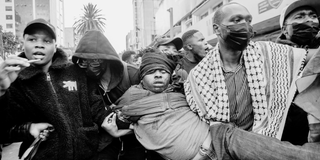
Human rights abuses continue to cast a dark shadow over Kenya. A new report details extrajudicial killings, abductions, enforced disappearances and shrinking media and civic freedoms.
The annual report by the Kenya National Commission on Human Rights (KNCHR), titled “The State of Human Rights in Kenya”, shows Kenyans continue to endure a disturbing wave of abuses; many perpetrated by those meant to protect them.
In its latest review covering December 2024 to December 2025, the commission KNCHR reports receiving and processing 2,848 allegations of human rights violations, with adults aged 35–59 lodging a majority of the complaints at 1,297. This was followed closely by 1,210 cases filed by youth aged 18–34, an unsurprising reflection of a generation pushed to the edge, while 257 complaints came from older Kenyans.
Cases touching on the violation of economic, social and cultural rights topped the list at 1,381, followed by 1,173 violations of civil and political rights, and 299 cases involving group rights. Failure by the State to secure basic social protections — healthcare, housing, food, livelihoods, and welfare — the KNCHR warns, has now become a dangerous trigger for civil unrest.
The frustration bubbling among young people fed directly into the nationwide Gen Z protests, which saw masses taking to the streets against a government they feel has denied them opportunity and dignity.
Those protests were met, not with dialogue, but brute force, worsening violations. Unaddressed historical injustices, poverty, and marginalisation in various regions have further fuelled insecurity, exposing communities to violence and leaving their civil and political rights dangerously unprotected.
“We documented 57 killings between December 2024 and December 2025, many occurring during the peak of youth-led protests in June and July. All these cases were extrajudicial killings executed by state security personnel,” KNCHR Chairperson Claris Ogangah said during the launch of the report.
Among the cases cited were the daylight killing of human rights defender Richard Raymond Otieno in Elburgon; the fatal police shooting of 12-year-old schoolgirl Bridgit Njoki Wainaina in Kiambu; the murder of 17-year-old refugee Gaala Aden Abdi in Dadaab; the shooting of five civilians in Angata Barikoi, Narok; the custodial death of Albert Omondi Ojwang at Central Police Station; and the fatal shooting of protester Joshua Steven Nderitu in Nairobi on May 20, 2025.
Teacher Albert Ojwang who mysteriously died in a police cell.
Photo credit: Pool | Nation
“These are not mere statistics, but human lives cut short, often by those sworn to protect them. We have also noted that security officers have themselves died in the line of duty," Ms Ogangah said. Despite relative calm returning to West Pokot, Baringo, Elgeyo Marakwet, Turkana and Samburu, the commission is still alarmed by reports of extrajudicial killings during disarmament operations.
KNCHR Deputy Chairperson Raymond Nyeris said at least 12 complaints of killings, abductions and torture had been reported from Marakwet East, Pokot Central and Tiaty. While disarmament and other efforts to restore order must continue, Dr Nyeris pointed out that security agencies should operate within the law and pair enforcement with broader development investments to break the cycle of poverty driving insecurity.
“We are investigating to establish what resulted in the 12 death accounts we have received. The Commission supports the disarmament process in the North Rift aimed at making the area peaceful. We will work with other agencies such as the Independent Policing Oversight Authority (IPOA) to follow this matter,” he said.
Elsewhere, in areas such as Mandera, Marsabit, Turkana, Tana River, Wajir and Lamu, cross-border incursions by armed groups continue to destabilise communities and derail security efforts.
The report noted that a large share of that impunity stems from the failure to operationalise the National Coroners Service Act, eight years after it was passed. The law was intended to ensure transparent investigations into violent and suspicious deaths, including extrajudicial killings and deaths in custody. Without it, the truth behind these killings remains buried, and justice remains distant for grieving families.
“We demand the immediate appointment of a Coroner-General, proper funding for investigations, and accelerated accountability processes through agencies such as IPOA,” Ms Ogangah said.
The right to personal freedom and security suffered serious violations. KNCHR documented 661 cases of torture, arbitrary detention and enforced disappearances, including 15 abductions such as that of fisherman Brian Odhiambo , whose whereabouts remain unknown.
A portrait of Nakuru fisherman Brian Odhiambo who disappeared on January 18, 2025 after being arrested by KWS officers at Lake Nakuru National Park.
Photo credit: Boniface Mwangi | Nation Media Group
The Commission also flagged the re-emergence of criminal gangs—now deployed by politicians and businessmen for intimidation, harassment, and sometimes violent eviction of residents.
The return of gang-rule politics, KNCHR cautions, threatens national security and cohesion.
KNCHR Commissioner Marion Mutugi warned that the rising tide of gang violence and intolerance as witnessed in the recently concluded by-elections was alarming, considering the country has less than two years to the next General Election.
“Our officers were prevented from accessing tallying centres in Siakago and Mumbuni North wards. We cannot confirm that the by-elections conducted there were credible,” Prof Mutugi said.
Her sentiments were echoed by Ms Ogangah, who said the KNCHR considered monitoring the by-elections as “crucial” while highlighting the “many infringements on the rights of people who voted or were being voted for.”
She said: “The by-elections were not free and fair.” The Commission received reports of three death incidents during the by- elections; two cases were reported in Kabondo Kasipul Constituency, with the other case being the death of a 70-year-old in a stampede in Kabuchai Constituency.
The right to peaceful assembly, guaranteed under Article 37, has also suffered major setbacks.
During the Gen Z demonstrations in June and July 2025, heavy-handed policing was rampant in Nairobi, Mombasa, Embu and Uasin Gishu. Even more disturbing was the presence of masked civilian gangs on motorbikes who were unleashed into crowds to beat up and terrorise protesters and bystanders alike.
“A total of 661 protesters were injured and 149 arrested, many arbitrarily, before courts stepped in to grant bail and drop unfounded charges...KNCHR condemns the deployment of hooded police officers in unmarked vehicles, an illegal practice that masks accountability and fosters brutality,” part of the report stated.
Journalists covering protests in Majengo, Molo and Nyeri, as well as those reporting at national events such as Madaraka Day in Homa Bay, were attacked, blocked from accessing events, or had their equipment smashed.
Those targeted included journalists from major media houses such as Nation Media Group, Standard Media Group, KTN News, Royal Media Services and Kameme TV.
The Commission also warns that recent amendments to the Computer Misuse and Cybercrimes Act pose a direct threat to free expression online, enabling arbitrary arrests for social media speech. KNCHR has joined a constitutional petition to challenge those provisions.
Even in the civil society space, where citizens organise to demand accountability, obstacles persist. The implementation of the Public Benefits Organisation Act — intended to free NGOs from years of legal limbo — was marred by restrictive provisions, until the High Court struck down sections that undermined privacy, freedom of association, and fair administrative processes.