For 38 days, Kenyan activists Bob Njagi and Nicholas Oyoo were swallowed into a world of silence and steel, deep inside Uganda’s feared detention sites where prisoners vanish without a trace.
They were beaten, blindfolded, chained to chairs, held in dark rooms never reached by sunlight, and only had porridge and beans for food. Paint tins were their toilets.
What began as a brief cross-border visit turned into a brutal test of endurance that neither man will ever forget.
“We went to Uganda because we are East African Community citizens. My passport says so, not just Kenyan but East African. I keep asking myself, what did we do wrong to cross the border legally? Our passports were stamped. We entered Uganda on comradeship because we have friends there,” Mr Oyoo said.
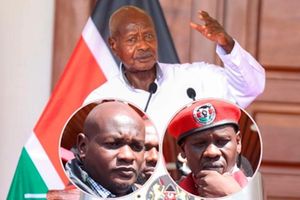
Museveni confirms arrests of Kenyan activists Bob Njagi and Nicholas Oyoo
Mr Njagi, the chair of the Free Kenya Movement (FKM), said that the trip combined friendship, business and solidarity.
“It has been 15 years since I was in Uganda. As East Africans, we thought we should see what is happening there and explore opportunities. I even have a friend who is an entrepreneur. I supplied masks to Uganda through him during the Covid-19 pandemic,” he said.
The two activists attended a manifesto launch by opposition leader Robert Kyagulanyi’s National Unity Platform (NUP) in Jinja. Mr Kyagulanyi is popularly known as Bobi Wine.
“Our trip was not just political. We agreed to join our comrades from NUP at their manifesto event to see what Kyagulanyi was presenting. I was honoured to share a platform with him. After that, we departed for Kampala,” Mr Njagi said.
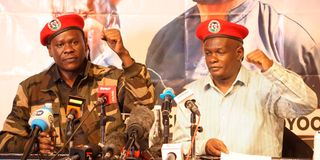
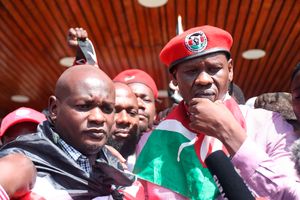
Human Rights activists Nicholas Oyoo (left) and Bob Njagi during a media briefing at Mageuzi Hub in Nairobi on November 12, 2025.
Photo credit: Evans Habil | Nation Media Group
However, their vehicle developed a fault along the way, forcing them to park at a Stabex Petrol Station in Matuga. The petrol station is owned by a prominent Kenyan politician.
“We left the vehicle there overnight for it to be fixed. But at around 10am the following day, about seven heavily armed men confronted us,” Mr Oyoo said.
“When we were at Stabex Petrol Station, we were picked up. I tried to throw my phone out the window to alert someone back in Kenya [if someone checked the last number called], but the soldier beside me closed the window. They started beating me, thinking that I had another phone,” he said.
The two were blindfolded, shoved into military vehicles, and driven away without a word. The activists realised that this was not an ordinary arrest.
“We thought that in two or three days we would be taken to the border and told to go home. But we were wrong,” Mr Oyoo said.
They were taken to a military base in Kisenyi, where they spent 23 days.
“At Kisenyi, we were often woken up by the sound of gunfire, explosions and shouting between 3:30am and 4am. It’s a military training site. At times, we heard bombs and rocket-propelled grenades (RPG). It was my first time hearing a RPG exploding. It was great psychological torture,” Mr Njagi said.
“The camp is home to the Special Forces Command. The soldiers told us that they are next to none, and are only loyal to President Museveni’s son, General Muhoozi Kainerugaba.
“That’s a training ground for the presidential security team. They don’t take command from the Judiciary, Parliament, or even the Executive. We left more than 150 Ugandans in custody there. Some had been detained for up to a year without trial.”
The days at Kasenyi were long and uncertain. Mr Oyoo recounted how he informed his colleague, Mr Njagi, about the death of former Prime Minister Raila Odinga, who passed on in India while receiving treatment on October 15.
Kenyan a ctivists Nicholas Oyoo (left) and Bob Njagi who were detained in Uganda during a press conference at Jomo Kenyatta International Airport in Nairobi on November 8, 2025 upon their return to the country.
Photo credit: Bonface Bogita | Nation Media Group
After 23 days, the soldiers returned for them. This time round they were being transferred from Kisenyi to a safe house — a process that Mr Oyoo described as terrifying.
“We were blindfolded. One of the soldiers told me, ‘We are Special Forces Command, our bullets are not many, but they are meant to kill. If I have five bullets, that’s for five people.’ They said that they only shoot from the chest upwards. I was shaking on that day. I wondered if it was going to be my last day,” said Mr Oyoo.
The activists were moved to a safe house in Ronyo, Entebbe.
“The building is near a football pitch. It has tinted windows, a high perimeter wall, and a banana plantation around it. It’s meant to be a secret location. I’m mentioning it because many civilians are being held there. Some senior officials in the Ugandan government do not even know about its existence,” Mr Njagi said.
“Inside, there was only darkness and silence. We would be locked in there throughout the day. There was no sunshine and no fresh air. We could not see each other. But each of us tried to find ways to know if the other was still alive. We stayed there for 14 days,” Mr Oyoo said, adding that the conditions were brutal.
“We were handcuffed day and night. I was tortured on the second day. They chained me to a chair. Two soldiers stood near me, one in front and one behind me. The one in front beat me while asking questions. ‘Who are your funders? What’s the purpose of this movement? What did you come to do in Uganda?’ After the beatings, they gave us paracetamol. We were denied basic hygiene. We used paint tins as toilets, which were emptied only once a day under escort. That place is a torture chamber,” Mr Njagi said.
Kenyan activists Nicholas Oyoo (left) and Bob Njagi address the media at Jomo Kenyatta International Airport in Nairobi on November 8, 2025, following their return home from Uganda where they had been detained.
Photo credit: Bonface Bogita | Nation Media Group
Mr Oyoo endured the same ill-treatment. “I was whipped after being tied to a chair. They wanted to know about our groups and connections. They kept asking why we were in Uganda and accused us of trying to bring the Gen Zs of Kenya to Uganda. That was insulting. Ugandans don’t need outsiders to teach them how to fight for their rights,” he said.
Food was basic, barely enough to survive. For 38 days, they would be served a cup of porridge in the morning, and ugali with beans for lunch and supper.
“That was our menu for 38 days. I decided to fast and pray. I knew prayers worked. I did not touch my lunch for all those days,” Mr Njagi said.
Every day blurred into the next, the same food, the same darkness, the same fear of the unknown. Their only way of counting time was by the sound of boots in the corridor or a tray being pushed under the door.
“I was with a Nigerian man called Ifeanyi Chukwu Nogwodo Joseph. There were about six Nigerians being held there. None of them had been charged. The Nigerian Embassy should check on them. There was also a wealthy Ugandan man called Mzee Kasiba, who has been held for months. Others are Brian Kwisera and Samuel Nosubuga, all civilians, who have been detained in the military camp,” Mr Njagi said.
As the days wore on, psychological torture replaced physical pain. After two weeks in the safe house, they were told that they would be taken to Busia.
“We were not sure if we were really being taken there or if we were going to be finished. We were blindfolded all through and believed their intention was to deal with us. But somewhere in Kampala, we met our ambassador. I think it was at a military depot. From there, we were escorted in a convoy to the border,” Mr Oyoo said.
They arrived at Busia around 1pm where they were processed until 4pm. They then waited until 5pm when the Busia County Commissioner addressed the media, and the activists were eventually released to their families.
“We call it an abduction because from the moment we were picked up to the time we were released, the Ugandan Government denied having us in custody. I plead with them to release all the political prisoners who are still in those camps,” Mr Njagi said.
“I commend the media. The Fourth Estate has become the true voice of the people. The civil society in Kenya has operated under threats, but they have supported us, especially legally. I thank Vocal Africa, Amnesty International, the Kenya Human Rights Commission, Defenders Coalition, the KNCHR, and others whom I have not mentioned,” Mr Njagi said.
“The torture and abduction will not derail us. We lost our freedom, our dignity, our right to association, but we will continue,” Mr Oyoo said.
Although they were beaten, tortured and held against their will for days, Mr Oyoo said that it is the price they had to pay.
“The torture will not silence us. We will continue fighting for justice, democracy and dignity, not just for ourselves but for all those still trapped in Ugandan cells. We are the people, and power belongs to the people.”
Mr Njagi said that the Free Kenya Movement and the National Unity Platform have had close ties since 2018.
“We both believe all sovereign power rests with the people. We draw strength from the people,” he said.
With regards to their next step, the FKM leader said that they will seek justice through the East African Court of Justice.
“We are working with the civil society to file a petition. We want to sue the Government of Uganda for crimes against humanity,” he said. Much as their wounds are still fresh from the abduction, Mr Njagi said that their primary focus now is the “current crisis in Tanzania”.
“We cannot wait for the court process to handle that. Through Article 37 (of the Kenyan Constitution) we can organise peaceful protests here in Kenya to put pressure on the newly elected Tanzanian government to step down,” he said.