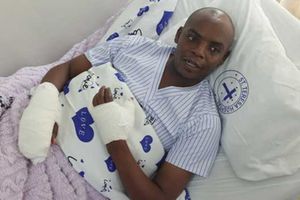
Attack victims, gospel musician Jimmy Gait(left) and Cafune Mung’asia.
Rather than let the huge knife split his head open, Anthony Muoki instinctively raised his right hand to block the blow.
The blade sliced through his palm, leaving a permanent scar that reminds him of how narrowly he escaped death on December 12, 2025.

The irony of the date is not lost on him. It was Jamhuri Day, when Kenya celebrates freedom from colonial brutality and violence, but for him, it was the day when his fight for survival began.
His mistake, he said, was walking to a nearby shop from his single-room house near the Kangemi-Kawangware border, close to the forest locals call the “Mau Mau forest”, divided by the Mau Mau River.
“I had gone to buy milk. It was barely 7pm and I thought I would quickly return home and watch the news before the weekend began,” he said.
Two men emerged from the darkness. One concentrated on slashing him while the other searched his pockets.
“What frightened me most is that they never said a word. I told them I only had Sh50 for milk but they ignored me and continued cutting me,” he said.
A medical report from Kenyatta National Hospital captures the brutality: “Multiple deep cut wounds on the right upper and lower limbs ... secondary to assault by persons unknown.”
Just a building away from Muoki lives another victim, 27-year-old Cafune Mung’asia.
Cafune Mung’asia walks on crutches in Kangemi on May 6, 2026, as he recounts being attacked by robbers while on his way to church.
In early February, around 7am, he left home heading to church, barely 300 metres away. He was hurrying for a special service when two men approached him along the edge of the same Mau Mau forest.
Thinking they wanted to pass, he stepped aside. Instead, they dragged him into the trees near the river. One carried a knife almost the size of a panga.
“They did not demand anything. They just started hacking me. I have never felt such pain,” he said.
As one attacker slashed him, the other searched his pockets and stole Sh400.
His left knee cap was targeted and torn apart, forcing emergency surgery at Mbagathi Hospital.
Nicholas Komu, Muoki’s landlord, said that insecurity has become expensive for residents and landlords alike because they have been forced to hire more guards to patrol the area.
Anthony Muoki, during an interview at his single-room house in Kangemi on May 6, 2026, recounts being attacked by robbers while on his way to a shop.
“One day, while walking with the guards, we were attacked and one of them was injured in the ribs. We retaliated, caught one attacker and took him to the police. They are so brazen,” he said.
On February 23, Nation Media Group’s photojournalist Evans Habil was attacked while walking home after watching a football match.
Nation Media Group photojournalist Evans Habil Kweyu recuperates in a hospital bed at Aga Khan University Hospital in Nairobi on Tuesday, February 24, 2026, following a robbery attack the previous night.
Three men on a motorbike stopped beside him before launching a violent assault using knives and a machete.
“They surrounded me immediately,” he later recounted.
The attackers repeatedly struck his face, eye and head, leaving him with severe injuries that required multiple surgeries at Aga Khan Hospital.
In a twist of cruel irony, Habil’s ordeal came just a day after he had been assigned to cover another stabbing victim—gospel musician Jimmy Gait.
Gospel Singer Jimmy Gait lies on a hospital bed at St Teresa Hospital in Kiambu on February 23, 2026, where he is admitted following an attack by thugs around Runda, Nairobi.
The singer, who rose to fame in the late 2000s, was walking in Nairobi’s upscale Runda estate when he encountered two men.
“I was alone and they were two. One pulled out a very long knife that looked like a sword and the other had a panga,” he said.
“I told them to take everything and spare me. But I realised they wanted entirely something else,” he recalled. “He told me to stay calm because they wanted to kill me slowly.”
Instinctively, Gait grabbed the panga with his left hand.
“It tore my hand and I nearly lost my thumb,” he said.
The musician says the only thing he remembers afterwards was screaming the name of Jesus.
“After I shouted, they suddenly told me to run and not look back,” he said.
In late March, Eastleigh was shaken after teenage boys surrounded another teenager and stabbed him repeatedly in front of dozens of witnesses. The victim later died.
For residents like landlord Daniel Waihenya, the violence has steadily transformed the estate into a place of fear.
“This place has become hell,” he said. “From outside, Eastleigh looks functional, but internally we are very dysfunctional. It began slowly. One case here, another there, and suddenly gangs became normal.”
He links the rise of the violence to youth unemployment, drug abuse and weak law enforcement.
“That is how gangs like ‘Super Power’ emerged. Young people feel untouchable because there are no consequences,” he said.
He also blames “Maslaha”, an informal mediation system where elders negotiate settlements even for violent crimes.
“People arrested for stabbing are taken to the station, then elders intervene and the suspects walk free. That destroys the justice system because the youth know they will escape punishment,” he said.
What confounds residents most is that Eastleigh hosts several police stations including Kamukunji, Pangani, Eastleigh North and Starehe.
Ahmed Dagane, a resident of Eastleigh Section 3, believes authorities have failed to coordinate response.
“This is madness. Young boys ride on motorbikes carrying knives, pangas and even hammers in broad daylight,” he said.
Not far from Eastleigh is the sprawling South C Estate, which is called Eastleigh’s cousin. It, too, has had its fair share of disturbing incidents.
In May last year, 16-year-old Mutawakil Yassir was fatally stabbed in the Midland area of South C. Eyewitness accounts said the altercation involved a 17-year-old male who fled the scene.
Despite efforts to take the victim to hospital, Yassir succumbed to injuries due to excessive bleeding and was announced dead on arrival.
On May 11, about 30 youth stormed a car wash operated by Young Blessing CBO in Huruma’s Comboni area. By evening, chaos had paralysed the neighbourhood. The attackers destroyed three large water tanks, vandalised businesses and slashed at least five members of the community organisation.
Treasurer Samuel Ojode still walks with pain after his knee blocked a panga blow meant for his head. Their chairman, Rodgers Otila, remains hospitalised with injuries to the head, arms and legs.
“The attack started around 4pm and went on until about 7pm. Businesses shut down and children stayed in school until calm returned,” he said.
Nearby, a mandazi seller and a pudding vendor also lost property during the violence.
Weeks earlier, 33-year-old wines and spirits operator John Ouma faced a similarly terrifying ordeal. Three youths drank alcohol worth Sh4,200 at his shop but refused to pay. When they threatened his younger sister, Ouma intervened and overpowered them.
An hour later, about 15 young men armed with daggers, knives and machetes stormed back.
“The slashing started immediately,” he said.
Most businesses had already closed and his sister had gone home, leaving him alone.
He suffered stab wounds on both hands, deep panga cuts running from his forearm to the shoulder and injuries to his head.
Community elder Rone Achoki said residents know many of the attackers by name.
“If we continue suffering in silence, this violence will only grow,” he said when the Nation found him addressing a community meeting at Daniel Comboni Catholic Church.
Achoki said the youth gang, which operates under the slogan “Ikuwe Ikuwe”—loosely translated as “let it be”—openly announced its intentions.
In late 2025, residents allegedly received a letter warning that beginning January this year, the gang would take over garbage collection and neighbourhood security.
“They first attacked the youth working at the dumping site. We recorded at least seven stabbing cases,” Achoki said.
From there, the group began extorting businesses.
“They tell shop owners they have been eating alone for too long. Imagine a child younger than your lastborn threatening you,” he said.
The Nation reviewed letters sent by Kanda Self Help Group, led by Achoki, to National Assembly Speaker Moses Wetang’ula, Directorate of Criminal Investigations boss Mohamed Amin and Internal Security Principal Secretary Raymond Omollo.
One referenced the death of Kenya Medical Training College student Cheryl Adhiambo, who was struck by a stray bullet during a police pursuit of suspected gang members.
Another complained of constant harassment of businesses, including supermarkets and transport agents.
“We continue suffering knife and machete attacks as if there is no government,” Achoki said.
Starehe Police Commander Cyrus Maina Muturi said police were aware of the reports, adding that several arrests had been made.
“Huruma, Mathare and Riruta are areas of interest to us. It is not fair to say police have abandoned residents. Even I was injured during an operation in Huruma earlier this year after the death of the young girl,” he said.
“When police are deployed somewhere, we become part of the community and are affected by whatever affects the community. We are working around the clock to end crime,” he added.
Data from a government investigative agency report covering January 2025 to March 2026 suggests the violence is becoming increasingly widespread.
The intelligence data analysed by the Nation showed cases spread across at least 22 counties: Nairobi, Kiambu, Nakuru, Homa Bay, Bomet, Nandi, Kisumu, Kakamega, Bungoma, Busia, Siaya, Vihiga, Uasin Gishu, Kericho, Murang’a, Nyeri, Kirinyaga, Meru, Mombasa, Kilifi, Kajiado and Laikipia. At least 46 deaths were recorded.
While the patterns differ from one region to another, the reports established that the common thread remains disturbingly similar—anger, desperation, drugs, gangs, domestic conflict and an increasing willingness to use knives as tools of intimidation and death.
“Crimes of passion” emerged as the leading motive in at least 15 cases, while domestic disputes involving intimate partners accounted for at least 11 more incidents.
On January 17, 2025, in Kamakis, Ruiru, a man identified as Conrad was allegedly stabbed 27 times by his girlfriend during a domestic confrontation.
Days earlier, investigators in Kibwareng village in Nandi County reported that a man travelled from Nairobi carrying a written murder-suicide plan before allegedly fatally stabbing his estranged wife and later taking his own life.
Then, on January 26, police in Nairobi’s Mathare area arrested a man accused of killing and dismembering his 19-year-old wife before attempting to dump her remains along the Mathare River.
In July 2025, police launched a manhunt for a suspected serial killer linked to the deaths of at least seven watchmen over six weeks. Investigators said the murders shared disturbing similarities: victims suffered severe head injuries, their tongues had been cut and nothing had been stolen.
The report further documented knife violence linked to political clashes, robbery with violence, rape, gang attacks, arson, aggravated assault and even cannibalism.
Experts now warn that Kenya could be sliding into a dangerous knife-crime culture similar to that witnessed in major European cities, especially London.
National Crime Research Centre (NCRC) Director Mutuma Ruteere said the growing normalisation of stabbings should alarm the country.
“If this trend is not stopped early, Kenya could slowly develop the kind of knife culture witnessed in cities like London,” he said.
Dr Ruteere explained that several factors may be feeding the violence, including imitation of foreign criminal cultures, unemployment, weak policing and the rise of organised gangs.
“A lot of concern comes from where these trends originate. We may be copying violent cultures from elsewhere, while returnees from foreign countries also bring back certain behaviours,” he said. “It is possible that goonism has evolved beyond politics. Violent entrepreneurs are also hiring tough youth to protect businesses in an increasingly violent environment.”
According to the NCRC boss, many gangs operate with a belief that their actions are acceptable because punishment is rare.
“These groups become bolder because they see no consequences. The country must urgently study how organised gangs operate before this grows into a monster of Frankenstein proportions,” he said.
National Police Service spokesperson Michael Muchiri dismissed reports of increasing knife crime, insisting that the overall crime rate had declined.
“There are no stabbings across the country. Crime has gone down. Last year recorded a 5.1 per cent decline compared to the previous year. Even this year, the figures continue to reduce,” he said.
He, however, declined to share the data he quoted showing that knife crimes, to be specific, are decreasing.
The official police narrative sharply contrasts with the experiences of survivors like Muoki, Mung’asia, Habil, Jimmy Gait, Otila, Ojode and Ouma.
Their experiences in the hands of knife and panga-wielding thugs are not abstract. Every scar on their bodies is proof that the violence is already here.
Months after the attacks, Muoki and Mung’asia still struggle with movement. Sometimes, Mung’asia said, he replays the silence of his attackers in his mind.
“No shouting. No threats. Nothing,” he said quietly. “Just knives!”
Tomorrow: How Kenya can deal with the growing stabbing incidents—experts and lessons from London.
Follow our WhatsApp channel for breaking news updates and more stories like this.