On most Sundays, gospel musician Jimmy Gait prefers long, reflective walks as it is his quiet time to pray and think.
But last Sunday, along Kiambu Road, that ritual nearly cost him his life.
That morning, he noticed two men approaching him. Many times, he had crossed paths with strangers before, often exchanging brief greetings as they passed.
“I usually like going for walks, but Sunday was different. I’ve been there many times and I would park my car and walk in the vast open land. I thought this was the same and that they were just passing. But when I was about to pass them, one of them attacked me,” Gait narrated from his hospital bed on Monday evening.
What followed was a brutal assault that mirrors a growing pattern across Nairobi and its environs, with gangs of rogue boda boda riders and accomplices targeting unsuspecting pedestrians.
“‘Don’t shout, we want to kill you slowly,’” Mr Gait recalled them saying.
Gospel Singer Jimmy Gait lies on a hospital bed at St Teresa Hospital in Kiambu on February 23, 2026, where he is admitted following an attack by thugs around Runda, Nairobi.
Photo credit: Evans Habil | Nation Media Group
He tried to run, but the ground was steep, and he fell and rolled.
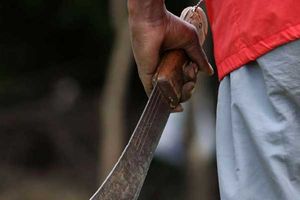
“By the time I stopped rolling, one of them was on top of me. He started choking me and I thought I would die. I used all my strength to pull his hand off and then I saw the other one holding a double-edged sword. He was about to cut my throat. I raised my hand to shield myself and it cut through my fingers.”
Pinned to the ground, Gait said he “saw” death.
“They kept shouting, ‘usipige nduru tunakuua pole pole’ (Don’t shout, we will kill you slowly). I told them to take whatever they wanted and leave me alone. They demanded my mobile banking PIN. I wanted to use my fingerprint, but they refused and ordered me to unlock it using my pattern. They transferred money from my M-Pesa.”
“When I saw the machete aimed at my neck, I used my left hand to protect myself and it literally chopped through it. I saw death and started shouting ‘Jesus’ repeatedly. In the midst of it all, they suddenly let me go.”
Bleeding and disoriented, Gait staggered nearly a kilometre back to his car and managed to drive off, but near Wadi Degla, his strength drained. He stopped and screamed for help. Good Samaritans recognised him and rushed to his aid, eventually getting him to hospital where surgeons fought to save his hand.
“One thing I would say is you never know when your death is coming. As much as authorities need to enhance security, individuals must also take the initiative. We should be able to walk anywhere in this country and feel safe,” he said.
Just hours after covering Gait’s attack, Nation Media Group photojournalist Evans Habil became the next victim. He had documented Gait’s ordeal only to suffer a similar fate hours later.
Habil was attacked early on Tuesday morning (February 24, 2026) as he walked home in Kawangware.
“Three people attacked me on a motorbike. A motorcycle passed me first and when they sensed I was walking alone, it stopped. Two men jumped off and approached me. I turned to run, but they grabbed me quickly. That’s when I realised they were armed with very sharp machetes,” he said from his hospital bed.
Nation Media Group photojournalist Evans Habil recuperates at Aga Khan University Hospital in Nairobi yesterday following an early morning robbery attack.
Photo credit: Dennis Onsongo | Nation Media Group
He had taken the precaution of leaving his phone behind, but that did not save him.
“That is when hell broke loose. They started raining blows on me using machetes and all the strikes were aimed at my head. They were extremely brutal and kept hacking me. They must have believed they had finished me off when they left. My nose was almost severed,” he said.
Left for dead along Ngina Road near Precious Blood Secondary School in Riruta, he was rescued by passers-by.
“Good Samaritans recognised me and contacted my family, who rushed me to hospital in an ambulance. The swift response saved my life. Otherwise, I would probably be dead,” he said.
In Lavington, Elizabeth Njoki recounted a different but equally traumatic encounter.
The homeschooling teacher was walking between Gitanga Close and King’ara Road near Mary Immaculate Hospital when a boda boda rider and his passenger struck.
The theft took seconds, according to her.
“My phone was ringing and I thought if I picked it with my left hand away from the road and close to a fence, I would be safer. I don’t know how the thief managed to get between me and the fence. As soon as I received the call, the bike rode past and the passenger snatched my phone,” she recalled.
“I am traumatised. I cannot take two steps without looking over my shoulder. I clutch my bag tightly. Even if my phone rings in my bag, I cannot pick it up,” she added.
National Police Service Spokesperson Michael Nyaga Muchiri.
Photo credit: File | Nation Media Group
Across Nairobi, similar accounts abound of motorcycles trailing pedestrians, circling back once a phone is spotted, then striking with ruthless speed. Victims say attackers are often armed with machetes and daggers and show little hesitation in using them.
“We are on it. When we secure our cities — Nairobi, Mombasa, Kisumu and Nakuru — it becomes easier to stabilise rural areas,” he said.
At the Coast, police have launched coordinated intelligence-led operations across Mombasa, Kilifi and Kwale, arresting 17 suspects linked to violent robberies, drug trafficking and land invasions after months of surveillance.
Police recovered an AK-47 rifle, ammunition, more than 35 kilogrammes of suspected narcotics, over 40 mobile phones and SIM cards, machetes, clubs and even police uniforms allegedly used for impersonation.
“Through intelligence-led strategies, increased patrols, enhanced surveillance and multi-agency collaboration, officers are proactively addressing emerging security concerns,” police said.