They often walk into county governments carrying little more than a declaration of work experience, a university degree, a certificate, and earnest pledges to serve the public.
A short while later, some are known to own fleets of vehicles, prime properties, luxury homes and millions of shillings in cash hidden in various places — wealth that investigators increasingly say cannot be explained by their known salaries and benefits.
Others become so wealthy that they begin plotting political careers of their own, declaring bids for elective positions while still serving in public office.
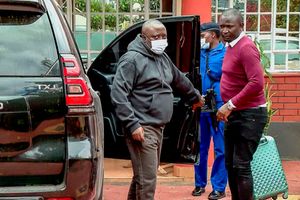
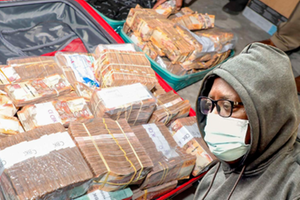
Nairobi County Chief Officer for Urban Planning Patrick Analo (masked) at the EACC offices after his arrest at his Syokimau residence. Detectives reportedly recovered Sh5.3 million in cash during the operation.
Photo credit: Wilfred Nyangaresi I Nation Media Group
The arrest of Nairobi Chief Officer for Urban Development and Planning Patrick Analo this week has once again shone a spotlight on a growing culture of impunity and unexplained wealth within the county governments, where 13 years after the advent of devolution, public office has increasingly become a gateway to personal enrichment.
When Ethics and Anti-Corruption Commission (EACC) detectives raided Mr Analo's residence in Syokimau on Thursday, they recovered Sh51.3 million in cash and another $113,000 (about Sh14 million), bringing the total amount recovered to Sh65.3 million.
The operation also yielded title deeds, motor vehicle logbooks, laptops, mobile phones, iPads, sale agreements and Nairobi County approval plans, documents investigators believe could help explain wealth they say appears disproportionate to the official's known sources of income.
But Mr Analo's case, which is still under investigation, is far from unique.
City Hall is not new to such high-profile arrests. During Governor Evans Kidero's administration, which took office in 2013, EACC successfully pursued the forfeiture of assets owned by former Nairobi County Chief Finance Officer Jimmy Mutuku Kiamba after courts found he could not satisfactorily explain the source of his overnight wealth.
Through decisions upheld by the High Court, Court of Appeal and Supreme Court, Mr Kiamba lost seven prime properties in Runda, Dennis Pritt Road and South C, as well as Sh113.9 million held in various bank accounts. Earlier court orders had also directed him to surrender more than Sh282 million in unexplained wealth.
He also faced criminal prosecution over county financial dealings, including a case in which he was convicted and sentenced in 2022 over the fraudulent loss of Sh18 million. He was also among officials charged alongside former Governor Kidero in the Sh213 million Nairobi County graft case, although the anti-corruption court acquitted all the accused in November 2025, citing insufficient evidence.
Across the country, county officials entrusted with managing billions of shillings in devolved funds have increasingly found themselves on the receiving end of anti-corruption investigations, with detectives repeatedly stumbling upon astonishing amounts of cash hidden in homes, offices and vehicles.
In 2024, another prominent case involving Wilson Nahashon Kanani, a relatively junior Nairobi County planner whose lifestyle and business empire attracted the attention of anti-corruption investigators.
Despite earning a monthly salary of about Sh55,000 at the time of the investigations, Mr Kanani was linked to assets worth more than Sh643 million, including the popular 1824 nightclub, luxury vehicles, high-end properties and substantial sums held in bank accounts.
EACC successfully moved to court to freeze the assets after concluding that the wealth was disproportionate to his known sources of income. The High Court subsequently froze more than Sh643 million in cash and properties linked to him, a decision later upheld by the Court of Appeal.
EACC Chief Executive Officer Abdi Mohamud, for instance, acknowledged that the raid carried out at Mr Analo’s house had opened the eyes of the commission.
“There are some things that we did not even know before carrying out the raid at his residence. We are grateful that the raid we have carried out helped us find more evidence that we will use to prosecute this case,” Mr Mohamud said.
The discoveries have raised difficult questions about whether county governments, initially conceived as vehicles for development and local empowerment, have instead become fertile ground for corruption networks operating beyond public scrutiny.
“There is a growing belief among Kenyans that public officials in the counties have betrayed the public trust and transformed their entrusted roles for personal enrichment by using their positions to benefit themselves their families, friends and associates. As EACC, this worries us,” Mr Mohamud said.
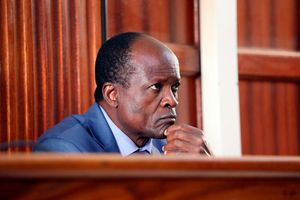
Former Kiambu County Governor Ferdinand Waititu at Milimani Law Court on February 13, 2025
Photo credit: Wilfred Nyangaresi | Nation Media Group
In February 2025, the Milimani Anti-Corruption Court convicted former Kiambu Governor Ferdinand Waititu, his wife Susan Wangari Ndung'u, and several co-accused over the irregular award of a Sh588 million road tender during his tenure as governor.
The court found that Mr Waititu had received Sh25.6 million in kickbacks from a contractor linked to the project and sentenced him to 12 years in prison or a fine of Sh53.5 million, while also barring him from holding or contesting public office for 10 years.
The criminal case was followed by a separate civil recovery suit in which the High Court ordered Mr Waititu and his wife to surrender assets worth Sh131.2 million, including land and vehicles, after investigators concluded that the wealth could not be explained by their legitimate income.
Former Migori Governor Okoth Obado's corruption case took a different path from the conventional criminal prosecution route, ending with a negotiated settlement that allowed the State to recover substantial assets without securing a criminal conviction.
Under an agreement reached between Mr Obado, the Office of the Director of Public Prosecutions and the Ethics and Anti-Corruption Commission, the former governor, his four children and 13 other co-accused agreed to surrender assets valued at approximately Sh235.6 million in exchange for the withdrawal of corruption charges.
Former Migori Governor Okoth Obado at Milimani Law Court during a past hearing of a case against him.
Photo credit: File
The assets forfeited to the State included two Toyota Land Cruisers, residential properties in Nairobi's Loresho and Greenspan estates, and several commercial and residential developments in Migori County.
There are also some cases at EACC where high-profile investigations involving county officials often generate dramatic raids, cash recoveries and asset seizures, only for the cases to later encounter procedural and constitutional hurdles in court.
In Turkana County, detectives investigating a Sh600 million suspected fraud involving fictitious contracts recovered Sh6.5 million in cash from the vehicle of County Executive Committee Member for Finance Michael Eregae Ekidor.
The operation targeted senior county officials suspected of facilitating fraudulent payments for contracts that investigators say either never existed or were never implemented.
Busia County has not escaped scrutiny either. Detectives investigating an alleged Sh1.4 billion procurement scandal executed simultaneous raids targeting senior county officials, recovering cash and documents relating to assets whose acquisition investigators are now seeking to establish.
In January this year, EACC also arrested former Homa Bay County Assembly Clerk Faith Adhiambo Apuko, former County Executive Committee Member for Lands Roseline Anyango Odhiambo and several company directors over an alleged Sh349 million procurement fraud.
The arrests were part of a broader investigation into the misuse of public funds and irregular tender awards within the county assembly. The case followed a series of successful asset recovery efforts by anti-corruption agencies and the courts, which in recent years have ordered the recovery of millions of shillings from former county officials implicated in corruption and financial misconduct.
Among the cases cited by investigators was the recovery of more than Sh26 million linked to fraudulent payments involving the former county assembly clerk, underscoring the scale of financial losses that continue to be uncovered years after public officials have left office.
What is increasingly emerging from these investigations is a disturbing pattern of huge encounters of large quantities of liquid cash kept outside the banking system, often hidden in residences, offices and vehicles. For anti-corruption investigators, the significance of these discoveries extends beyond the amounts recovered.
“The practice of holding millions of shillings in cash allows officials to avoid the banking trail that investigators normally rely on to trace financial transactions. Some even have bought houses where they hide the cash away from their known homes since they know they can be raided at any time,” an anti-fraud investigator, who sought anonymity, said.
It also raises questions about the source of the funds and whether they originated from legitimate business activities or from public resources diverted through procurement fraud, kickbacks and bribery schemes.
The trend has coincided with growing concerns over the emergence of a powerful class of county bureaucrats whose influence often rivals that of elected leaders. Unlike governors, who face voters every five years, many senior county officials operate largely outside public scrutiny while controlling procurement processes, approvals, licensing systems and payment mechanisms worth billions of shillings annually.
Former Nairobi Governor Mike Mbuvi Sonko testifies during the hearing of a graft case against him at the Milimani Law Courts in Nairobi on February 5, 2026.
Photo credit: Billy Ogada | Nation Media Group
Former Nairobi Governor Mike Sonko also remains entangled in a series of corruption-related court battles that have stretched over several years.
The most significant of the ongoing matters is a Sh20 million corruption case in which Mr Sonko and businessman Antony Ombok Jamal are accused of conspiracy to commit corruption, money laundering, conflict of interest and receiving suspected proceeds of crime arising from a 2019 City Hall revenue collection tender.
Although the case was initially dismissed in 2022, the High Court overturned the acquittal in late 2024 after finding errors in the handling of the charges. In early 2025, the Milimani Anti-Corruption Court ruled that Mr Sonko had a case to answer and placed him on his defence.