The arrest of Mr Patrick Analo Akivaga, Nairobi County's Chief Officer for Urban Planning and for years one of Governor Johnson Sakaja's closest and most trusted allies, has laid bare the workings of a building approval system that critics say has enabled illegal developments to flourish across the city, often with deadly consequences.
Mr Analo's dramatic arrest by Ethics and Anti-Corruption Commission (EACC) detectives on Thursday marked the latest chapter in a controversy that has dogged his tenure at City Hall, where he has repeatedly found himself at the centre of disputes over irregular building approvals, enforcement failures and allegations of abuse of office.
Nairobi County Chief Officer for Urban Planning Patrick Analo (masked) at the EACC offices after his arrest at his Syokimau residence.
Photo credit: Wilfred Nyangaresi I Nation Media Group
The EACC operation carried out at his Syokimau residence resulted in the recovery of troves of evidence that investigators say could be crucial in an ongoing investigation into unexplained wealth and approval of buildings that have increasingly come under scrutiny.
The CEO of the EACC Abdi Mohamud on Thursday linked the probe directly to the growing crisis of unsafe developments in the capital city.
"The problem we are having in Nairobi is that the approval of the buildings has not been going through the right procedure, and that is why we are seeing a rise in the development of substandard buildings. There are many lives that we have lost in this process, and that is why we need to act," said Mr Mohamud.
(From left) Ethics and Anti-Corruption Commission (EACC) Deputy Director of Forensic Investigations Ignatius Wekesa, Chief Executive Officer Abdi Ahmed Mohamud and Director of Investigations John Lolkoloi address the media during a press briefing at Integrity Centre, Nairobi, on June 4, 2026, following the arrest of Nairobi County Chief Officer for Urban Planning Patrick Analo as part of ongoing anti-corruption investigations.
Photo credit: Wilfred Nyangaresi I Nation Media Group
He added that investigators had uncovered assets whose value appeared inconsistent with the officer's known earnings.
"We saw that the property and buildings that he owns are not commensurate with his earnings for the time that he has worked at City Hall. When we went for the operation, we also found out more than we had actually anticipated and this has opened our eyes and we are actually going to intensify our operations to make sure that justice is served," he said.
The raid at Mr Analo's residence yielded what investigators described as substantial evidentiary material, including Sh51.3 million in cash and $113,000 (about Sh14 million), bringing the total amount recovered to approximately Sh65.3 million.
Bundles of cash were recovered by detectives during a search at the Syokimau residence of Nairobi County Chief Officer for Urban Planning Patrick Analo. Investigators say Sh65.3 million was seized during the operation. Analo was later taken to the Ethics and Anti-Corruption Commission (EACC) headquarters for questioning.
Photo credit: Wilfred Nyangaresi | Nation Media Group
Part of the money was recovered from the residence while the rest was found in the boot of his motor vehicle.
Detectives also seized several title deeds, motor vehicle logbooks, laptops, mobile phones, iPads, land and vehicle sale agreements, Nairobi County building approval plans and other documents that investigators believe could help unravel alleged corruption, abuse of office, bribery and possession of unexplained wealth.
For years, Mr Analo occupied a powerful position within governor Sakaja's administration, becoming one of the most influential officials at City Hall. At one point, he simultaneously held the positions of Chief Officer for Urban Planning and Acting County Secretary, effectively placing him at the centre of both the county's administrative machinery and the department responsible for approving multi-billion-shilling developments.
His clout within the administration was such that he was widely viewed as the governor's right-hand man, regularly representing the county in key functions and wielding considerable authority over planning decisions.
Nairobi County Chief Officer for Urban Planning Patrick Analo (left) at the EACC offices yesterday after his arrest at his Syokimau residence.
Photo credit: Wilfred Nyangaresi I Nation Media Group
The relationship, however, appeared to cool in August 2024 when he was removed from the acting county secretary position following what insiders described as a fallout with the governor. Long before his exit from the influential role, questions had begun mounting over how building approvals were being processed at City Hall.
In one of the most explosive hearings conducted by the Nairobi County Assembly's Planning Committee in 2024, junior officials within his department stunned MCAs when they disclosed that he had approved close to 600 building applications.
Mr Fred Ochanda, a junior officer told the committee that he had been exercising approval powers delegated to him by the Chief Officer. The revelation sparked concerns over who exactly was in charge of Nairobi's building approval system and whether approvals were being issued outside legally established procedures.
Mr Analo on several occasions distanced himself from the approvals and denied delegating his authority.
Nairobi County Chief Officer Urban Development and Planning, Patrick Analo during an interview at his office in Nairobi on September 2, 2025.
Photo credit: Wilfred Nyangaresi I Nation Media Group
"I do not have such rights to the system and I cannot therefore give what I do not have. I cannot account for the building approvals that have been released by the county government because I do not have the rights to the system. The system has the records on who provides these approvals," he told the committee.
During the assembly hearings, Urban Planning Committee chairman Alvin Palapala painted a picture of a deeply entrenched corruption network within City Hall's planning department.
Last year, the Architectural Association of Kenya told the County Assembly hearings that a section of officials led by Mr Analo had deliberately interfered with the automated approval system, forcing developers to seek manual approvals.
According to the association, the breakdown opened a window for manipulation, delayed approvals and the door for corruption. More troubling were claims from members of the Urban Planning Technical Committee that some developments were being approved even after the committee had rejected them.
"We get surprised when we disapprove buildings and in the next meeting the building has already been approved without any explanation," she said.
Professional bodies, residents and county legislators have repeatedly accused City Hall of operating a compromised approval regime that allows buildings to proceed despite objections from technical experts.
Nairobi County Chief Officer for Urban Planning Patrick Analo (masked) at the EACC offices after his arrest at his Syokimau residence. Detectives reportedly recovered Sh5.3 million in cash during the operation.
Photo credit: Wilfred Nyangaresi I Nation Media Group
Concerns would later be reinforced by findings from the Office of the Ombudsman in February this year. The Commission on Administrative Justice recommended criminal prosecution of several senior Nairobi planning officials, among them Mr Analo.
The commission found that approvals had been issued before mandatory deliberations were completed, enforcement notices ignored and non-compliant developments allowed to proceed despite clear violations of planning laws.
Investigators specifically faulted Mr Analo for forwarding non-compliant applications for ratification and failing to act on enforcement notices issued against developers.
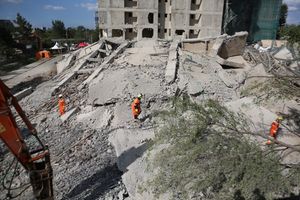
The findings emerged against the backdrop of growing public anger over building collapses in the city. The collapse of a 16-storey building on Muhoho Road in South C on January 2, which killed two people reignited concerns about illegal approvals and weak enforcement at City Hall.
Investigations established that the building had only been approved for 12 floors, yet the developer continued construction despite multiple stop orders and enforcement notices issued by Nairobi County in May, July and December 2025.
The disaster prompted fresh legal action against Mr Analo, with a petitioner moving to the High Court seeking his suspension from office over alleged dereliction of duty and gross negligence.
The petition argued that allowing him to remain in office could compromise investigations into illegal approvals and systemic failures within the county's planning department.