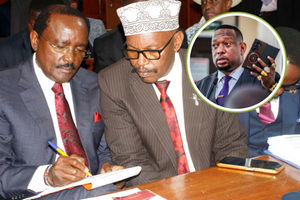
Former Nairobi governor Mike Sonko is now free to access his millions at Equity Bank, which were frozen about six years ago over suspicion of money laundering.
In a ruling on Friday, Tax Appeals Tribunal directed Kenya Revenue Authority (KRA) to lift the agency notices freezing six bank acounts, which were part of 10 accounts containing Sh537 million attached in 2020.
"By consent, the Respondent (KRA) do hereby lift agency notices issued on the Applicant's bank accounts at Equity Bank Ltd," the ruling stated.
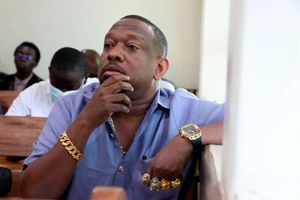
Former Nairobi Governor Mike Mbuvi Sonko testifies during the hearing of a graft case against him at the Milimani Law Courts in Nairobi on February 5, 2026.
Photo credit: Billy Ogada | Nation Media Group
The funds were frozen in February 2020 over suspicion that it was part of illicit money allegedly siphoned from Nairobi County government.
The High Court, however, lifted the preservation order in October last year and freed the millions, which were frozen following a petition by Assets Recovery Agency (ARA).
The court had ruled that there was no legal basis for ordering the forfeiture of the funds to the government, as sought by ARA.
Sonko was forced to file the application before the Tribunal after only four bank acounts were unfrozen while the funds in the rest of the accounts remained withheld.
The former governor had argued that the Tribunal had previously issued orders on November 14, 2025, directing KRA to lift the agency notices on specified bank accounts.
However, he said the orders inadvertently omitted certain accounts that were part of his original application and which were subject to the notices.
“The omission constitutes an accidental slip and/or clerical error, amenable to correction by this Tribunal,” Sonko submitted.
Sonko told the tribunal that his bankers, through correspondence, had indicated that they were unable to act outside the express terms of the Tribunal order and can only release funds as directed.
Last month, an attempt by ARA to continue holding the money was rejected by the Court of Appeal. The agency had asked the appellate court to suspend the decision of the High Court, unfreezing the bank accounts, pending its appeal.
While dismissing ARA’s case in October last year, the High Court said the agency had failed to show that the millions in several bank accounts were proceeds of crime.
Not satisfied with the decision, ARA moved to the Court of Appeal seeking a stay of the judgment.
However, a bench of three judges of the appellate court said there was nothing to stay in a negative order, which does not direct ARA to do or refrain from doing something.
“To the extent that the applicant seeks an order of stay of execution against a judgment dismissing its suit, the Court cannot issue such an order. Accordingly, the applicant’s notice of motion dated January 22, 2026 has no merit and is hereby dismissed with costs to the respondent. It is so ordered,” said the court.
ARA argued that a preservation order and any order authorising seizure of the money was still in force, pending the outcome of the appeal.
The Milimani Law Courts in Nairobi.
Photo credit: File | Nation Media Group
Sonko, however, submitted through his lawyers that the court cannot stay a negative order and that section 97 of Proceeds of Crime and Anti-Money Laundering Act cannot be applied in seeking the orders.
While lifting the freeze, the High Court accused ARA for conducting shoddy investigations, saying such a probe should be ‘thorough, air-tight and water-tight’- since the findings lead to liability, whether civil or criminal.
“The evidence so far on record, is insufficient to support the assertion that the funds flagged by the applicant (ARA) and which are subject of these proceedings and are on various of the respondent’s bank accounts, are proceeds of crime,” said the court.
The agency moved to court in 2020 stating that they had received information that Sonko was involved in money laundering, using funds allegedly stolen from the city county government.
This was after Sonko was charged in December 2019 with conflict of interest and money laundering among other offences.
Then, the agency successfully sought orders to access, investigate and be supplied with the documents relating to the 10 accounts, which held funds in US dollars and Kenya shillings.
While seeking the orders, the agency alleged that the accounts received suspicious money, which is believed to be proceeds of crime from illegal financing, theft and money laundering activities from Nairobi county government.
The agency stated that between August 2017 and December 2019, the former Nairobi County boss allegedly received huge cash deposits in different bank accounts depicting a clear case of money laundering.
Sonko defended himself saying he had various businesses even before joining politics. He said was normal as a businessman for his bank accounts to receive the deposits.
Among the businesses were operating matatu, night clubs, restaurants, cyber cafes and that he was also involved in real estate.
The former Nairobi governor said the agency rushed to court and obtained the freeze order, before giving him an opportunity to explain the source of the funds.
Sonko submitted that some of the money were proceeds from sale of properties, which were made in installments.
The properties, he said, included several parcels of land in Kwale and Kajiado, which he allegedly sold for between Sh24 million and Sh175 million.