The High Court has declined to certify as urgent an application by a man claiming to be the biological son of former Internal Security Minister Prof George Saitoti and seeking a share of his estate, 14 years after the minister’s death.
Instead, the court directed James Njage to serve the application on the estate administrator ahead of an inter-partes hearing scheduled for September 24.
“That the Notice of Motion dated June 15, 2026 is not certified urgent. The same shall be served to be heard inter-parties on September 24, 2026,” the court ordered.
In documents filed under a certificate of urgency, Njage claims he is a son and beneficiary of the estate of Saitoti, who served as the vice-president in President Daniel arap Moi’s government. He died on June 10, 2012 in a helicopter crash.
Njage argues that his delay in challenging the grant was not intentional or aimed at frustrating the administration of the estate. According to him, he was a minor and living outside the country when the grant was confirmed in favour of the widow, Margaret Wanjiku Saitoti.
“I have never been involved in any proceedings concerning the administration of the estate, nor have I received any information, accounts or assets from his estate since his demise,” he states in court papers.
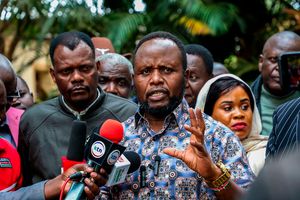
James Njage, who claims to be the biological son of former Internal Security Minister George Saitoti, during an interview at Loresho in Nairobi on June 20, 2026.
Photo credit: Wilfred Nyangaresi | Nation Media Group
Mr Njage says he was never notified of the succession proceedings and did not participate in the process that led to the distribution of the estate. He contends that neither a guardian nor any legal representative was appointed to safeguard his interests as a minor at the time.
Prof Saitoti died in a 2012 helicopter crash in the Kibiko area of Ngong Forest. He was travelling to a fundraiser in Ndhiwa, Homa Bay County. Also killed in the crash were his assistant Orwa Ojode, two pilots and two bodyguards.
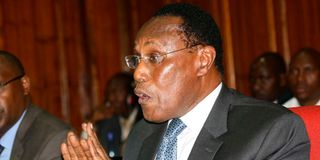
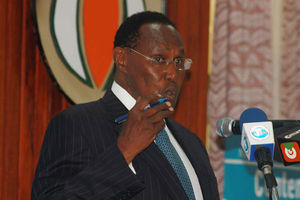
Then-Internal Security Minister George Saitoti during a presentation to the Constitutional Implementation Oversight Committee on President Mwai Kibaki’s stand on the appointment of the 47 County Commissioners at County Hall on May 29, 2012.
Photo credit: File | Nation Media Group
A commission of inquiry chaired by then Court of Appeal judge Kalpana Rawal heard that air traffic controllers at Wilson Airport lost contact with the aircraft six minutes after take-off.
In its October 2012 report, the commission cited pilot error, poor weather and the condition of the helicopter battery among the possible causes of the crash. The report found that the pilots lacked sufficient experience to operate in adverse weather and that the battery had not been properly maintained.
Following Saitoti’s death, his estate—which includes land, residential properties, shares and cash—was distributed between his widow Margaret and son Zachary Musengi.
Mr Njage now argues that the grant and subsequent confirmation certificate, including the rectified version issued on November 11, 2019, were obtained without disclosing his existence or providing for him as a beneficiary.
He describes this omission as material non-disclosure, contending that the existence of the deceased's child was a fact of fundamental importance that should have been presented to the court before the grant was confirmed.
Mr Njage claims that he was not served with the petition for the grant, the summons for confirmation or the proposed mode of distribution. Consequently, he claims that he was unable to participate in the proceedings, object to the distribution, or safeguard his alleged interest in the estate.
He further claims that the grant, as currently framed, is defective and was obtained through concealment of material facts relating to his status and beneficial interest as a son of the deceased.
Mr Njage is seeking orders suspending the implementation of the grant pending the determination of an application to revoke it. He also wants the court to compel the estate administrators to provide a full and verified account of the estate from the date of confirmation.
“At the time the grant was issued, confirmed and rectified, I was a minor and therefore lacked the legal capacity, means, knowledge and opportunity to object to or participate in the succession proceedings,” he states.
The accounts sought include details of all income, expenditure, transfers, distributions, rents, investments, bank withdrawals and liabilities linked to the estate.
He says he fears that the assets of the estate may already have been distributed or otherwise dealt with without his knowledge, participation or consent.
Mr Njage further states that his claim may require scientific verification. He has indicated that he will seek orders allowing the exhumation of Saitoti’s remains for DNA testing to establish whether he is the deceased’s biological son.
“The prayer for exhumation is necessary, proportionate and in the interests of justice, as it goes to the root of the objector/applicant’s status, standing and entitlement in the estate,” he says.
If the court grants the request, Mr Njage proposes that DNA samples be analysed by the government pathologist and two independent private pathologists, one appointed by him and the other by the widow.
Through Murage Juma & Company Advocates, Njage maintains that his exclusion from the estate was unlawful, unjust and prejudicial.