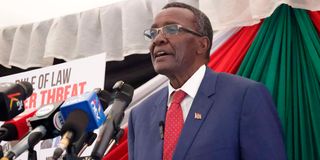
A report on police reforms recommended measures to protect the independence of the National Police Service, including transparent recruitment of commanders and junior officers, but it has largely been ignored, says former Chief Justice David Maraga.
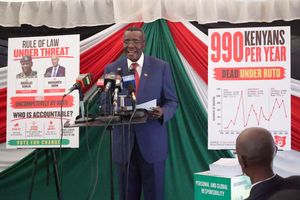
Maraga, who chaired the task force that submitted its report to President Ruto in 2023, on Monday made public a copy of the document, cautioning that failure to implement the recommendations could leave the country in the hands of a partisan police force and trigger post-election chaos.
“A partisan police force was a root cause of the slaughter of 2007/2008,” the former Chief Justice warned, citing cases of rogue police officers alongside goons unleashing terror on government critics. “Kenyans should not forget that the 2010 Constitution’s independent institutions clauses were written in that blood.”
President William Ruto speaks during the official handover of the Maraga-led Police Taskforce Report at State House, Nairobi on November 16, 2023.
Photo credit: Wilfred Nyangaresi | Nation Media Group
The former Chief Justice held that much, if not all, of what is ailing the NPS would have been cured by now if the recommendations of the taskforce were realised and compliance with the Constitution.
The taskforce’s implementation matrix gives a clearer picture of which reforms can be undertaken quickly and which require a longer process.
By the taskforce’s estimation, it would have taken at most two years to implement nearly all the reforms.
The report had categories listing recommendations that could be implemented immediately, ranging to those that needed a year or more.
Recruitment of the NPS top brass, casting a retirement age for them in stone and improving hiring of new recruits were among the report’s recommendations.
Others were better pay for officers, return of the old police uniform, digitisation of the service, promotion of long-serving officers and fairness in transfers also featured prominently.
However, Mr Maraga said that while the police uniform change was part of the 200 reforms the taskforce recommended, it was not urgent.
President William Ruto inspects a guard of honour when he presided over the passing-out parade of 6,000 police recruits at the National police College Main Campus in Kiganjo, Nyeri County on August 29, 2026.
Photo credit: PCS
In fact, the taskforce had said, “in line with the overwhelming views of members of the public, NPS officers, and the leadership of NPS, the taskforce recommends that NPS reverts to its old uniform for a period of three years, during which a process of designing a new uniform can be commenced in accordance with the foregoing recommendations.”
The taskforce said, “Maternity dresses should be included in the issuance of uniform and trousers for female officers.”
Mr Maraga holds that developing legislation for transparent recruitment of the Inspector-General, Deputy Inspectors-General and the Director of Criminal Investigations (DCI) should have taken three months, with implementation taking up to six years.
President William Ruto (right) receives the security agencies welfare reforms task force report from former Chief Justice David Maraga at State House Nairobi yesterday.
Photo credit: Wilfred Nyangaresi | Nation Media Group
Teso North MP Oku Kaunya in August, 2025 sponsored amendments to the NPS Act to streamline the recruitment of police top brass, and introduce 60 years as their retirement age.
The Bill has been stuck at the National Assembly for over a year, currently at the stage of the second reading.
The team recommended fresh vetting of police officers from the rank of Senior Superintendent of Police and above.
Mr Maraga had last week given President Ruto a seven-day ultimatum to publish the report of the taskforce on police reforms submitted, failure to which he would release it himself.
The former chief justice says the team he chaired recommended independence of the NPS to stop what he termed as state capture resulting in the misuse and abuse.
The former CJ said that the police, during President Ruto’s first term in office, have killed 990 civilians per year – double the 404 and 415 people killed under Presidents Mwai Kibaki and Uhuru Kenyatta regimes respectively.
“The answer to this malaise is simple: comply with the Constitution,” Mr Maraga said on Monday.
“The central finding in the report is the constitutional command. The National Police Service must be independent. It is a demand to dismantle the colonial police system and end the state capture of the security system,” he added.
While the constitution is clear, Mr Maraga said, the Security Laws (Miscellaneous Amendments) Act 2014 “tore those safeguards out”, resulting in the “capture” of NPS.
The taskforce demanded the repeal of the 2014 amendments and fresh vetting and appointment of officers from the rank of senior superintendent of police. But the recommendation was ignored, he said.
The constitution “is blunt” that the national security organs and officers serving in any of them should not be partisan in any manner. They should not further the interest of any political party or cause, Mr Maraga explained. And they should respect human rights and dignity.
The constitution, he said, creates an Inspector-General who “shall exercise independent command” and places the recruitment in the National Police Service Commission, “not in State House.”
The parliament once honoured that design, however, the Security Laws (Miscellaneous Amendments) Act 2014, he said, “tore those safeguards out”. It currently allows the president to pick a name for the IG of police, the deputies and the DCI and send it to parliament for vetting.
“That is not reform, it is capture,” said Mr Maraga, adding that the taskforce termed the 2014 amendments unconstitutional.
Inspector-General of Police Douglas Kanja.
Photo credit: File | Nation Media Group
The law on age, he said, was also bent and the result is for “obvious political benefit.” This is especially contentious because both IG of Police Douglas Kanja and DCI boss Mohamed Amin are well over 60 years and their contracts have had to be extended.
Director of Criminal Investigations (DCI) Mohammed Amin.
Photo credit: File | Nation Media Group
According to the constitution, public officers retire at 60 and should only be contracted after that age for rare skills the service cannot otherwise find. However, Mr Maraga wondered what skills they hold that other senior officers do not.
“Neither were they chosen by open competition and the result is that both occupy those offices illegally,” said Mr Maraga.
The former CJ urged Kenyans to work together to restore the independence of national security organs, especially the NPS, “in order to guarantee peace and security of our country.”
The police officers have been implicated in the abduction of Kenyans, particularly in the aftermath of the deadly Anti-Finance Bill 2024 protests, when cases of enforced disappearances, abductions and torture increased.
Human rights defenders and civil society organisations put the number of deaths at about 60, while warning that the toll could rise as more cases were documented.
The Maraga-led taskforce submitted the report to President William Ruto on November 16, 2023. However, for nearly three years, the report’s recommendations have not been fulfilled, nor has the restoration of the independence of the NPS, Mr Maraga explained.
The Interior Ministry in August 2024 said it had “finalised a comprehensive strategic framework to unpack and implement”. Little, if anything, has been implemented beyond that.