A series of aircraft accidents and serious incidents at Wilson Airport, including a mid-air collision over Nairobi National Park, hard landings, runway overshoots and a recent crash landing that temporarily shut down operations, have put Kenya's busiest domestic aviation hub under renewed scrutiny.
This is even as the Kenya Airports Authority (KAA) races to complete a Sh1.4 billion rehabilitation project.
The incidents, detailed in submissions presented to the National Assembly's Transport and Infrastructure Committee, have reignited concerns over safety, ageing infrastructure and whether Wilson Airport can continue supporting growing air traffic without significant upgrades.
The airport, which serves as the country's main domestic aviation gateway and a critical hub for tourism, humanitarian operations, medical evacuation flights and pilot training, is currently undergoing extensive rehabilitation works aimed at modernising key infrastructure and improving operational safety.
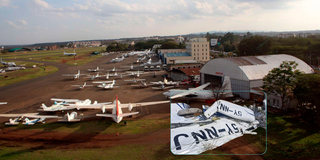
Aircraft parked at Wilson Airport in Nairobi on May 2, 2019.
Photo credit: File | Nation Media Group
The concerns emerged when MPs toured the airport and demanded answers from KAA and the Ministry of Roads and Transport over the status of ongoing projects, safety standards and recurring incidents at the facility.
Committee Chairperson George Kariuki said Wilson should be developed into a strategic aviation facility capable of supporting operations at Jomo Kenyatta International Airport (JKIA) during emergencies and operational disruptions.
"We want Wilson Airport to be a role model and offer auxiliary services to JKIA whenever there is a challenge. Some aircraft from JKIA should be able to land here. Let us work to make Wilson better. This is a business, and we should not give room to losses," said Mr Kariuki.
Nine accidents since 2024
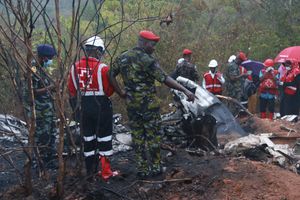
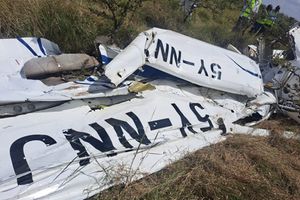
The scrutiny comes against the backdrop of at least nine major accidents and serious incidents recorded at the airport since March 2024. Among the most notable was a mid-air collision on March 5, 2024, involving a Safarilink Dash 8 passenger aircraft and a Cessna 172 training aircraft operated by Nine Nines Flying School over Nairobi National Park.
The wreckage of the aircraft after the accident on March 5, 2024.
Photo credit: Courtesy
The accident shocked the aviation industry and triggered investigations by the Aircraft Accident Investigation Department (AAID), with the final report yet to be released.
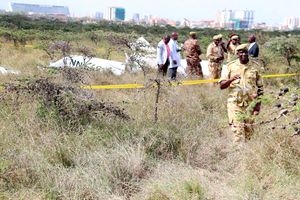
Other incidents include a hard landing involving an ALS Dash 8 aircraft on March 20 this year after what investigators described as an unstable approach to Runway 32, a landing gear collapse involving a Dornier 228 operated by Kasas Limited on May 22 this year and multiple runway overshoots involving commercial and ferry flights operating through the airport.
Investigators are also looking into a training aircraft accident involving Pegasus Flyers East Africa and a Beechcraft Baron belly landing after suffering a total electrical failure while approaching the airport.
According to the Ministry of Roads and Transport, all accidents and serious incidents are investigated in line with International Civil Aviation Organisation (ICAO) standards, with the objective of identifying safety gaps and preventing recurrence.
The ministry told lawmakers that investigations have pointed to the need for enhanced regulatory oversight, improved pilot training, stricter operational compliance and strengthened airside safety measures.
Authorities have since intensified surveillance of airlines, maintenance organisations and flight training schools operating from Wilson Airport while reviewing traffic management procedures within the Wilson control zone.
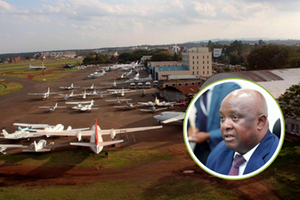
An aerial view of a section of Wilson Airport in Nairobi.
Photo credit: File | Nation Media Group
The revelations come as KAA undertakes one of the most significant infrastructure upgrades in the airport's recent history.
The Sh1.44 billion project involves rehabilitation of Runway 14/32, widening it from 23 metres to 30 metres, extending the runway by 160 metres and strengthening the pavement structure to meet international standards.
The project also includes the construction of concrete turning pads, correction of runway slopes, relocation of sections of the airside perimeter fence and maintenance works on Runway 07/25.KAA has said the works, which began in September last year, are expected to take 18 months and have so far achieved 38 per cent physical progress.
The authority has also secured funding for the rehabilitation and expansion of taxiways and aprons to accommodate larger aircraft and ease aircraft movement within the airport.
KAA Managing Director Moses Wekesa told lawmakers that the authority was deliberately taking a long-term approach to ensure the airport does not require further major disruptions after completion of the project.
"There's a time we must take some pain to correct something once and for all. It will not bear any good for us to rush and finish a job when we know the challenges involved. And after three months, I tell you I'm asking for some time to close the runway," Mr Wekesa said.
His remarks come as operators continue to complain about disruptions caused by the ongoing works, with lawmakers warning that prolonged construction timelines were affecting business and increasing operational costs for airlines and aircraft owners.
Wilson Airport is currently struggling with a challenge that has been decades in the making - growth that has far outpaced the airport's original design.
The current terminal building, constructed in 1962 when the airport was officially renamed Wilson Airport, was designed to handle approximately 20,000 passengers annually and provides seating capacity for only 50 departing passengers.
The airport's departure lounge, which was originally built to accommodate about 50 passengers, is regularly stretched by the growing number of travellers using the facility. Today, the airport handles about 800,000 passengers every year.
Mr Wekesa disclosed that the aerodrome was originally designed for Code B aircraft but is currently serving larger Code C aircraft, placing additional strain on ageing runway pavements and airport infrastructure.
KAA is currently finalising a master plan that will guide future expansion of the airport, including construction of a modern passenger terminal, additional aprons, enhanced cargo facilities, a multi-storey car park and infrastructure to support growing regional traffic.
The authority is also seeking to reclaim sections of airport land from private developers to facilitate future expansion and improve safety around the facility.