The standoff over the recruitment of 10,000 police officers has deepened, exposing a fresh power struggle within the security sector.
Controversy erupted after it emerged that funds for the exercise were routed to the National Police Service (NPS) rather than its legally mandated employer, the National Police Service Commission (NPSC).
The row intensified yesterday as the NPSC confirmed that the recruitment of 10,000 police constables would be advertised tomorrow, with successful candidates expected to report for training on November 17 this year.
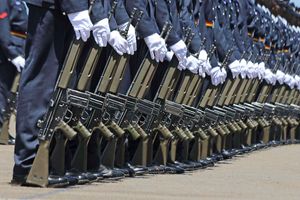
Recruits in a parade during a past pass-out ceremony at Kenya Police College Kiganjo
Photo credit: File | Nation Media Group
Appearing before the National Assembly’s Administration and National Security Committee, NPSC chief executive officer Peter Leley said the commission had requested Sh379 million for recurrent expenditure in the 2025/26 financial year but was allocated only Sh75 million.
“Notably, the budget for recruitment was directly allocated to the National Police Service, a position confirmed by the National Treasury in a letter dated June 10, 2025,” Mr Leley told MPs. “This budgetary shortfall and misallocation severely undermine the commission’s ability to independently and effectively discharge its recruitment mandate.”
Chief Executive Officer of the National Police Service Commission, Peter Kiptanui Leley.
Photo credit: File| Nation
The dispute between the NPSC and the NPS over recruitment methods and management of the multi-billion-shilling police payroll has persisted for months. Two meetings convened to resolve the impasse collapsed, despite the intervention of President William Ruto. Inspector-General of Police Douglas Kanja told MPs the two bodies would retreat to agree on the date and roadmap for the exercise. “Let me assure the country that the National Police Service and the commission work together. Very soon, we are going to carry out the recruitment,” he said.
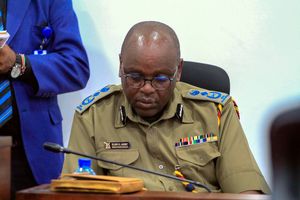
Mr Amani Yuda Komora.
Photo credit: Billy Ogada | Nation Media Group
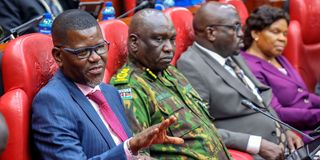
Mr Leley appeared alongside NPSC chairperson Yuda Komora, IG Kanja, Deputy Inspector-Generals Eliud Lagat (Kenya Police) and Gilbert Masengeli (Administration Police), Director of Criminal Investigations Mohamed Amin, and several commissioners. The security chiefs were summoned to update MPs on measures to promote transparency, fairness, accountability, inclusivity and public confidence in the recruitment exercise.
Mr Leley told lawmakers that the Constitution vests recruitment powers exclusively in the commission. “Article 246(3)(a) of the Constitution mandates the commission to recruit and appoint persons into the National Police Service,” he said. “This covers the entire process: advertising vacancies, shortlisting, conducting background checks, appointing recruitment panels, accrediting independent observers, publishing successful candidates, and submitting a comprehensive recruitment report to the President and Parliament.”
By contrast, he said, the NPS’s recruitment role is limited to training and induction under Article 244(d) of the Constitution. “The service’s responsibilities commence after recruitment by the commission. These include training, kitting, equipping and preparing officers for deployment,” he said.
The CEO argued that delegating recruitment powers to the Inspector-General under Section 10(2) of the National Police Service Act had proved problematic. “Though well-intentioned, this delegation has been prone to abuse, leading to widespread malpractices and irregularities in past recruitment exercises,” Mr Leley said. “Historical instances of such delegation led to the annulment of entire recruitment drives, costing the government millions of shillings and eroding public confidence.”
He cited findings of the National Taskforce on the Improvement of Terms and Conditions of Service, which warned that improper designation of recruitment powers amounted to abdication of the commission’s constitutional mandate.
The Inspector-General of the National Police Service Douglas Kanja (centre) CEO of the National Police Service Commission Peter Leley (right) and Commissioner Edwin Cheluget appear before the National Assembly Public Accounts Committee on July 29, 2025.
Photo credit: Dennis Onsongo | Nation Media Group
Commission chair Komora assured MPs that the NPSC was prepared to conduct the recruitment and address the country’s police-to-civilian ratio. “We intend to use technology as we undertake recruitment,” he said. “But we have noted concerns that some far-flung areas may lack network access. We will retreat and agree on the best way forward.” He added that whether manual, hybrid or fully automated, the process would adhere to regulations.
Committee chair Narok West MP Gabriel Tongoyo urged the NPSC and NPS to resolve their differences. “We want you to agree on a recruitment method that guarantees fairness, transparency and accountability,” he said. The stalemate has raised questions about the independence of the NPSC and the credibility of the upcoming recruitment, which is central to strengthening national security. With just days to the planned rollout, both institutions face pressure to set aside differences and assure the public of a transparent and merit-based process.